
Security Affairs
Two Barracuda ESG Flaws Could Be Combined for Full Root Access; Patches Released|Cyberattack Hits French Blood Banks as Hackers Target Refrigeration Systems Across Europe|CVE-2026-58868: Critical Android Bug Could Let Attackers Run Remote Code|U.S. CISA adds WordPress flaw to its Known Exploited Vulnerabilities catalog|Binance Hack: How Fake Job Interviews and AI Abuse Led to a $6.34 Billion Attack|Synology Warns of Ransomware Attacks Targeting NAS Devices Running Outdated DSM Versions|Inside XCPE, the botnet that turned 1.3M set-top boxes into proxy servers|NIS2 Makes Board Members Personally Liable for Access Control Decisions|Apple’s spyware notifications reach the Bundestag: what the BSI says to do now|VOLTA, the infostealer that asks an AI which victims are worth the effort|New wave of fridge cyberattacks hits European supermarkets, this time in Belgium, Luxembourg, Sweden and Estonia|Hackers Send Fake Nuclear Threat Alerts to Ukrainian and Russian Citizens|Two Barracuda ESG Flaws Could Be Combined for Full Root Access; Patches Released|Cyberattack Hits French Blood Banks as Hackers Target Refrigeration Systems Across Europe|CVE-2026-58868: Critical Android Bug Could Let Attackers Run Remote Code|U.S. CISA adds WordPress flaw to its Known Exploited Vulnerabilities catalog|Binance Hack: How Fake Job Interviews and AI Abuse Led to a $6.34 Billion Attack|Synology Warns of Ransomware Attacks Targeting NAS Devices Running Outdated DSM Versions|Inside XCPE, the botnet that turned 1.3M set-top boxes into proxy servers|NIS2 Makes Board Members Personally Liable for Access Control Decisions|Apple’s spyware notifications reach the Bundestag: what the BSI says to do now|VOLTA, the infostealer that asks an AI which victims are worth the effort|New wave of fridge cyberattacks hits European supermarkets, this time in Belgium, Luxembourg, Sweden and Estonia|Hackers Send Fake Nuclear Threat Alerts to Ukrainian and Russian Citizens|
Advertisement

Ad Placeholder

Full Width × 90

Cyber Crime

470 million sites are One Day Wonders, one in five is malicious

A study conducted by Blue Coat on 660 million unique hostnames reports that 470 Million websites are One Day Wonders and 22 Percent are malicious. A recent research conducted by security experts at Blue Coat revealed that 470 million websites exist only for one day and nearly one on five is malicious. Blue Coat experts over a […]

470 million sites are One Day Wonders, one in five is malicious

A study conducted by Blue Coat on 660 million unique hostnames reports that 470 Million websites are One Day Wonders and 22 Percent are malicious.

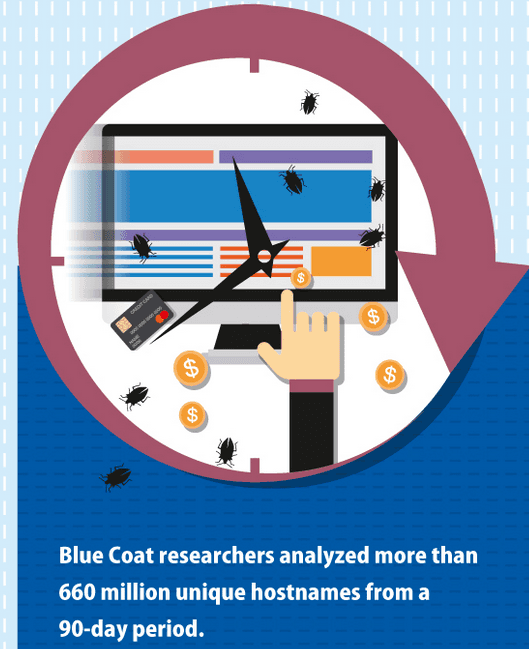
A recent research conducted by security experts at Blue Coat revealed that 470 million websites exist only for one day and nearly one on five is malicious. Blue Coat experts over a 90-day period  analyzed more than 660 million unique hostnames requested by 75 million Internet users discovering that 71 percent of the them (470 million) were online only for a single day, for this reason called “One Day Wonders,”.
“71 percent of hostnames appeared for just 24 hours. While the majority of these “One-Day Wonders” are the backbone for how Internet content is shared and delivered, the sheer volume provides cover for malicious activity, including communication to infected systems. ” states the post published by Blue Coat
The worrying news is that of the top 50 parent domains (22%) that most frequently used One-Day Wonders were malicious.
“While most One-Day Wonders are essential to legitimate Internet practices and aren’t malicious, the sheer volume of them creates the perfect environment for malicious activity,” said Tim van der Horst, senior threat researcher for Blue Coat Systems. “The rapid building up and tearing down of new and unknown sites destabilizes many existing security controls. Understanding what these sites are and how they are used is a key to building a better security posture.”
These websites are used by cyber criminals to serve malicious code, manage botnets, taking advantage of the site being “new and unknown” to evade security solutions. Content Delivery Networks often create a unique sub-sub-domain per user to track its visit for marketing purposes, but cybercriminals are adopting the approach too. One Day Wonders websites are difficult to track and could be quickly online, for this reason they could be used by threat actors to easily build dynamic command and control architectures. Another common use of such domains is the creation of unique subdomain for each spam email, attackers use this technique to make hard detection by spam filters.
Bluecoat one day worders website 2
The principal organizations that manage One-Day Wonders are companies with a meaningful presence on the Internet, like Google, Amazon and Yahoo and Web optimization companies that help their customers to accelerate the delivery of content. One-Day Wonders are a privileged choice in the cyber crime ecosystem  because they:
  • Dynamic domains are harder to track than static domains and help crooks to maintain under the radar their malicious campaigns.
  • Are easy to generate for this reason criminals used to generate a high volume of domains to increase the chances that some of elude security controls.
  • Improve detection avoidance capabilities of malicious code, combining One-Day Wonders with the usage of encryption.

The only way to prevent such attacks it to improve security with adoption of real-time intelligence systems that can help security experts to quickly identify malicious One Day Wonders.

An infographic summarizing key findings is available for download at following link.

Pierluigi Paganini

(Security Affairs – One Day Wonders, cybercrime)


