
Security Affairs
Two Barracuda ESG Flaws Could Be Combined for Full Root Access; Patches Released|Cyberattack Hits French Blood Banks as Hackers Target Refrigeration Systems Across Europe|CVE-2026-58868: Critical Android Bug Could Let Attackers Run Remote Code|U.S. CISA adds WordPress flaw to its Known Exploited Vulnerabilities catalog|Binance Hack: How Fake Job Interviews and AI Abuse Led to a $6.34 Billion Attack|Synology Warns of Ransomware Attacks Targeting NAS Devices Running Outdated DSM Versions|Inside XCPE, the botnet that turned 1.3M set-top boxes into proxy servers|NIS2 Makes Board Members Personally Liable for Access Control Decisions|Apple’s spyware notifications reach the Bundestag: what the BSI says to do now|VOLTA, the infostealer that asks an AI which victims are worth the effort|New wave of fridge cyberattacks hits European supermarkets, this time in Belgium, Luxembourg, Sweden and Estonia|Hackers Send Fake Nuclear Threat Alerts to Ukrainian and Russian Citizens|Two Barracuda ESG Flaws Could Be Combined for Full Root Access; Patches Released|Cyberattack Hits French Blood Banks as Hackers Target Refrigeration Systems Across Europe|CVE-2026-58868: Critical Android Bug Could Let Attackers Run Remote Code|U.S. CISA adds WordPress flaw to its Known Exploited Vulnerabilities catalog|Binance Hack: How Fake Job Interviews and AI Abuse Led to a $6.34 Billion Attack|Synology Warns of Ransomware Attacks Targeting NAS Devices Running Outdated DSM Versions|Inside XCPE, the botnet that turned 1.3M set-top boxes into proxy servers|NIS2 Makes Board Members Personally Liable for Access Control Decisions|Apple’s spyware notifications reach the Bundestag: what the BSI says to do now|VOLTA, the infostealer that asks an AI which victims are worth the effort|New wave of fridge cyberattacks hits European supermarkets, this time in Belgium, Luxembourg, Sweden and Estonia|Hackers Send Fake Nuclear Threat Alerts to Ukrainian and Russian Citizens|
Advertisement

Ad Placeholder

Full Width × 90

Breaking News

Android devices could be hacked by playing a video due to CVE-2019-2107 flaw

Watch out! Playing a video on Android devices could be a dangerous operation due to a critical CVE-2019-2107 RCE flaw in Android OS between version 7.0 and 9.0. Playing a specially-crafted video on devices with the Android’s native video player application could allow attackers to compromise them due to a dangerous critical remote code execution […]

CVE-2019-2107

Watch out! Playing a video on Android devices could be a dangerous operation due to a critical CVE-2019-2107 RCE flaw in Android OS between version 7.0 and 9.0.

Playing a specially-crafted video on devices with the Android’s native video player application could allow attackers to compromise them due to a dangerous critical remote code execution flaw. The vulnerability, tracked as CVE-2019-2107, affected Android OS between version 7.0 and 9.0 (Nougat, Oreo, or Pie) potentially impacting over 1 billion devices.

The RCE flaw CVE-2019-2107 resides in the Android media framework.

Google already addressed the flaw with July 2019 Android Security Bulletin, but millions of devices still waiting for the patch to be released by their manufacturers.

“The most severe vulnerability in this section [media framework] could enable a remote attacker using a specially crafted file to execute arbitrary code within the context of a privileged process,” reads the security advisory.

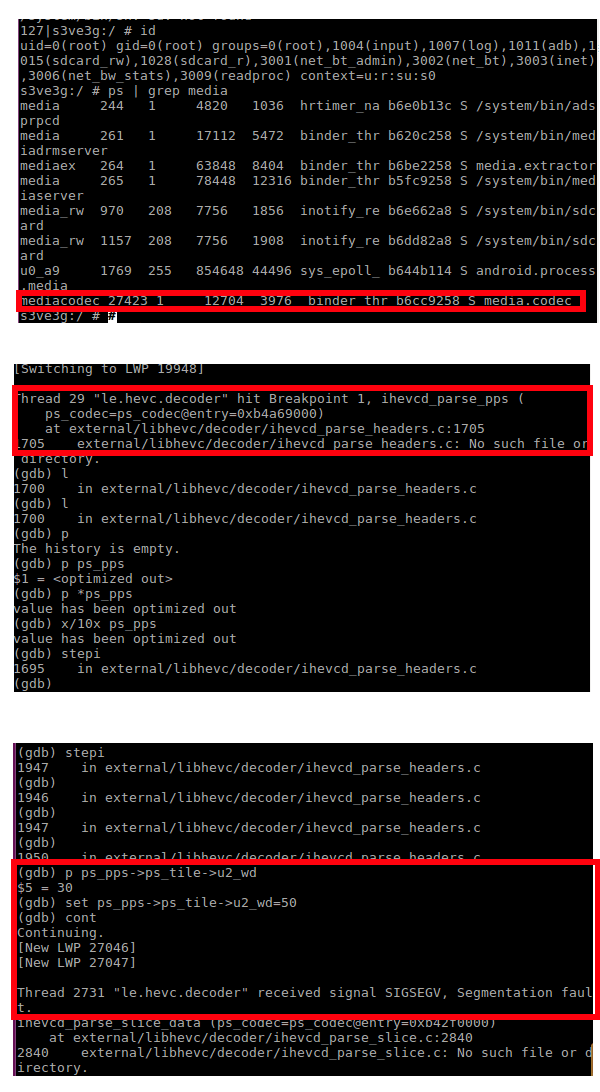
The Android developer Marcin Kozlowski has also published a proof-of-concept code to exploit this flaw.

The PoC code, an HEVC encoded video, could allow an attacker to crash the media player. Potentially an attacker could develop an exploit to remotely execute arbitrary code.

However, it should be noted that if such malicious videos are received through an instant messaging app like WhatsApp or Facebook Messenger or uploaded on a service like YouTube or Twitter, the attack won’t work.

“CVE-2019-2107 – looks scary. Still remember Stagefright and PNG bugs vulns …. With CVE-2019-2107 the decoder/codec runs under mediacodec user and with properly “crafted” video (with tiles enabled – ps_pps->i1_tiles_enabled_flag) you can possibly do RCE. The codec affected is HVEC (a.k.a H.265 and MPEG-H Part 2)” wrote Kozlowski.

CVE-2019-2107

To prevent the exploitation of this flaw, users have to update their Android versions by applying the latest security patches. Of course, they have to avoid downloading and playing videos from untrusted sources

[adrotate banner=”9″][adrotate banner=”12″]

Pierluigi Paganini

(SecurityAffairs – CVE-2019-2107, Android)

[adrotate banner=”5″]

[adrotate banner=”13″]


