
Security Affairs
Two Barracuda ESG Flaws Could Be Combined for Full Root Access; Patches Released|Cyberattack Hits French Blood Banks as Hackers Target Refrigeration Systems Across Europe|CVE-2026-58868: Critical Android Bug Could Let Attackers Run Remote Code|U.S. CISA adds WordPress flaw to its Known Exploited Vulnerabilities catalog|Binance Hack: How Fake Job Interviews and AI Abuse Led to a $6.34 Billion Attack|Synology Warns of Ransomware Attacks Targeting NAS Devices Running Outdated DSM Versions|Inside XCPE, the botnet that turned 1.3M set-top boxes into proxy servers|NIS2 Makes Board Members Personally Liable for Access Control Decisions|Apple’s spyware notifications reach the Bundestag: what the BSI says to do now|VOLTA, the infostealer that asks an AI which victims are worth the effort|New wave of fridge cyberattacks hits European supermarkets, this time in Belgium, Luxembourg, Sweden and Estonia|Hackers Send Fake Nuclear Threat Alerts to Ukrainian and Russian Citizens|Two Barracuda ESG Flaws Could Be Combined for Full Root Access; Patches Released|Cyberattack Hits French Blood Banks as Hackers Target Refrigeration Systems Across Europe|CVE-2026-58868: Critical Android Bug Could Let Attackers Run Remote Code|U.S. CISA adds WordPress flaw to its Known Exploited Vulnerabilities catalog|Binance Hack: How Fake Job Interviews and AI Abuse Led to a $6.34 Billion Attack|Synology Warns of Ransomware Attacks Targeting NAS Devices Running Outdated DSM Versions|Inside XCPE, the botnet that turned 1.3M set-top boxes into proxy servers|NIS2 Makes Board Members Personally Liable for Access Control Decisions|Apple’s spyware notifications reach the Bundestag: what the BSI says to do now|VOLTA, the infostealer that asks an AI which victims are worth the effort|New wave of fridge cyberattacks hits European supermarkets, this time in Belgium, Luxembourg, Sweden and Estonia|Hackers Send Fake Nuclear Threat Alerts to Ukrainian and Russian Citizens|
Advertisement

Ad Placeholder

Full Width × 90

Breaking News

Bogus social button plugin redirects to Angler Exploit Kit

Experts at Malwarebytes observed a new attack pattern that relies on fake social button plugin that redirects visitors to Angler Exploit Kit. Cyber criminals continue to use compromised websites to serve malware or to redirect visitors to domains hosting exploit kits. Experts at Malwarebytes observed a new attack pattern that relies on a domain name to lure […]

Bogus social button plugin redirects to Angler Exploit Kit

Experts at Malwarebytes observed a new attack pattern that relies on fake social button plugin that redirects visitors to Angler Exploit Kit.

Cyber criminals continue to use compromised websites to serve malware or to redirect visitors to domains hosting exploit kits.

Experts at Malwarebytes observed a new attack pattern that relies on a domain name to lure owners of websites into thinking it is a component of social plugins or a widget.

“Rather, this one uses a domain name used to lure website owners into thinking this is part of social plugins or such widget: socialbutton[.]site. Those buttons typically allow users to ‘Like” or retweet an article easily from the website they are visiting.” states a blog post published by MalwareBytes.
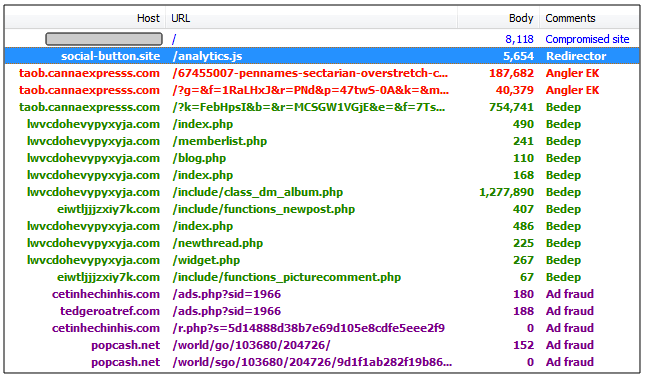
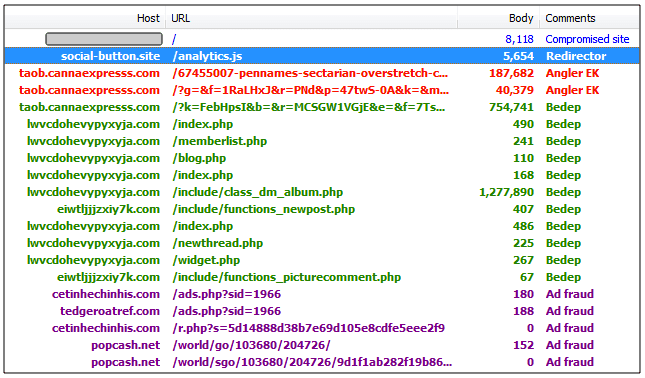
Angler Exploit Kit Social Button Plugin

The researchers discovered two JavaScript files (analytics.js and widget.js) used by crooks, each of them has a clean version and a malicious one.

Users are served the malicious version only when they land on the website with the proper referer (compromised upper site).

The experts have analyzed the Injected script and obfuscated code gathering evidence of a redirection to the Angler exploit kit. The analysis of the domain hosting the Angler EK allowed the experts to confirm its fraudulent purpose.

Angler Exploit Kit Social Button Plugin

Domain: social-button.site
Registrar: Namecheap INC
Email: b81089942b384e87b51d86fdf05c5bc7.protect@whoisguard.com
Country: Panama
Create Date: 2016-04-13T19:39:57

The Angler Exploit Kit was used by crooks to serve a fileless variant of the Bedep malware.

Experts at Malwarebytes highlight that the hacking campaign mainly targeted poorly configured and outdated websites that were breached via automated attacks.

Recently security experts spotted a large number of attacks relying on exploit kits (e.g. Neutrino Exploit Kit, Angler Exploit kit, Rig Exploit Kit) installed on websites running popular CMS such as Joomla and WordPress.

[adrotate banner=”9″]

Pierluigi Paganini

(Security Affairs – Angler Exploit Kit, cybercrime)


