
Security Affairs
Two Barracuda ESG Flaws Could Be Combined for Full Root Access; Patches Released|Cyberattack Hits French Blood Banks as Hackers Target Refrigeration Systems Across Europe|CVE-2026-58868: Critical Android Bug Could Let Attackers Run Remote Code|U.S. CISA adds WordPress flaw to its Known Exploited Vulnerabilities catalog|Binance Hack: How Fake Job Interviews and AI Abuse Led to a $6.34 Billion Attack|Synology Warns of Ransomware Attacks Targeting NAS Devices Running Outdated DSM Versions|Inside XCPE, the botnet that turned 1.3M set-top boxes into proxy servers|NIS2 Makes Board Members Personally Liable for Access Control Decisions|Apple’s spyware notifications reach the Bundestag: what the BSI says to do now|VOLTA, the infostealer that asks an AI which victims are worth the effort|New wave of fridge cyberattacks hits European supermarkets, this time in Belgium, Luxembourg, Sweden and Estonia|Hackers Send Fake Nuclear Threat Alerts to Ukrainian and Russian Citizens|Two Barracuda ESG Flaws Could Be Combined for Full Root Access; Patches Released|Cyberattack Hits French Blood Banks as Hackers Target Refrigeration Systems Across Europe|CVE-2026-58868: Critical Android Bug Could Let Attackers Run Remote Code|U.S. CISA adds WordPress flaw to its Known Exploited Vulnerabilities catalog|Binance Hack: How Fake Job Interviews and AI Abuse Led to a $6.34 Billion Attack|Synology Warns of Ransomware Attacks Targeting NAS Devices Running Outdated DSM Versions|Inside XCPE, the botnet that turned 1.3M set-top boxes into proxy servers|NIS2 Makes Board Members Personally Liable for Access Control Decisions|Apple’s spyware notifications reach the Bundestag: what the BSI says to do now|VOLTA, the infostealer that asks an AI which victims are worth the effort|New wave of fridge cyberattacks hits European supermarkets, this time in Belgium, Luxembourg, Sweden and Estonia|Hackers Send Fake Nuclear Threat Alerts to Ukrainian and Russian Citizens|
Advertisement

Ad Placeholder

Full Width × 90

Breaking News

Apple opens its bug bounty program to all white hat hackers

As announced in August, Apple has now announced the opening of its invite-only bug bounty program to all security researchers. Apple has now announced the opening of its invite-only bug bounty program to all security researchers. The tech giant will pay white hat hackers that will report security flaws in the iOS, macOS, watchOS, tvOS, […]

bug bounty Apple

As announced in August, Apple has now announced the opening of its invite-only bug bounty program to all security researchers.

Apple has now announced the opening of its invite-only bug bounty program to all security researchers. The tech giant will pay white hat hackers that will report security flaws in the iOS, macOS, watchOS, tvOS, iPadOS, and iCloud.

In August, at the Blackhat cybersecurity conference, Apple announced a few major changes to its bug bounty program including the opening to any researcher.

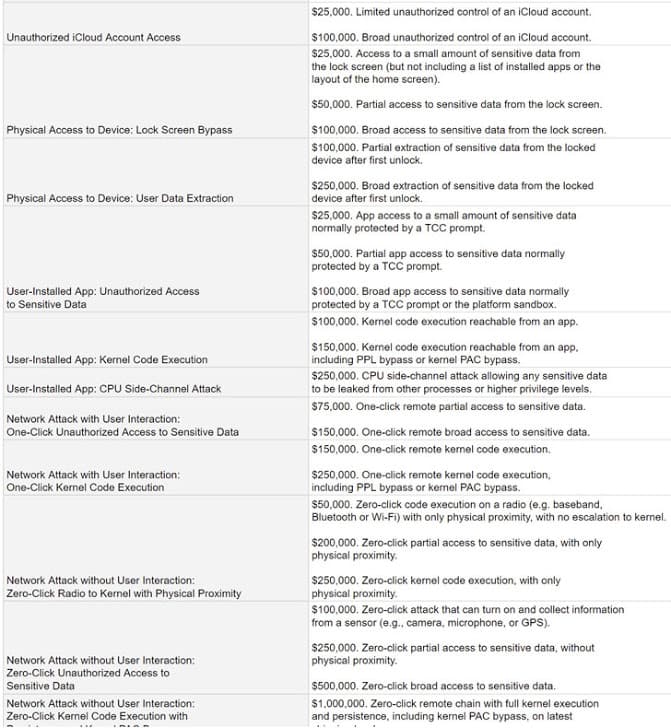
The most striking change is related to the payout for the rewards, the
maximum reward passed from $200,000 to $1 million. This is the biggest payout for a bug bounty program operated by a tech company.

Apple will pay up to $1 million rewards for a zero-click kernel code execution vulnerability zero user clicks,  that could be exploited by an attacker to take over a device.

On top of the maximum reward of $1 million, the tech giant announced it will also offer a supplementary bonus of 50% to those experts who report security issues in beta version software before its public release.

bug bounty Apple

Until now the Apple’s bug bounty program only rewarded researchers that reported vulnerabilities in the iOS mobile operating system.

Apple’s decision to extend the bug bounty program and increase the rewards is very important. Let’s consider that since now the best way to earn money for a bug hunter was to sell the exploits to zero-day broker firms like Zerodium. These companies historically offered greater rewards for working zero-day exploits for popular software like iOS and the Tor Browser.

[adrotate banner=”9″] [adrotate banner=”12″]

Pierluigi Paganini

(SecurityAffairs – Apple, hacking)

[adrotate banner=”5″]

[adrotate banner=”13″]


