
Security Affairs
Two Barracuda ESG Flaws Could Be Combined for Full Root Access; Patches Released|Cyberattack Hits French Blood Banks as Hackers Target Refrigeration Systems Across Europe|CVE-2026-58868: Critical Android Bug Could Let Attackers Run Remote Code|U.S. CISA adds WordPress flaw to its Known Exploited Vulnerabilities catalog|Binance Hack: How Fake Job Interviews and AI Abuse Led to a $6.34 Billion Attack|Synology Warns of Ransomware Attacks Targeting NAS Devices Running Outdated DSM Versions|Inside XCPE, the botnet that turned 1.3M set-top boxes into proxy servers|NIS2 Makes Board Members Personally Liable for Access Control Decisions|Apple’s spyware notifications reach the Bundestag: what the BSI says to do now|VOLTA, the infostealer that asks an AI which victims are worth the effort|New wave of fridge cyberattacks hits European supermarkets, this time in Belgium, Luxembourg, Sweden and Estonia|Hackers Send Fake Nuclear Threat Alerts to Ukrainian and Russian Citizens|Two Barracuda ESG Flaws Could Be Combined for Full Root Access; Patches Released|Cyberattack Hits French Blood Banks as Hackers Target Refrigeration Systems Across Europe|CVE-2026-58868: Critical Android Bug Could Let Attackers Run Remote Code|U.S. CISA adds WordPress flaw to its Known Exploited Vulnerabilities catalog|Binance Hack: How Fake Job Interviews and AI Abuse Led to a $6.34 Billion Attack|Synology Warns of Ransomware Attacks Targeting NAS Devices Running Outdated DSM Versions|Inside XCPE, the botnet that turned 1.3M set-top boxes into proxy servers|NIS2 Makes Board Members Personally Liable for Access Control Decisions|Apple’s spyware notifications reach the Bundestag: what the BSI says to do now|VOLTA, the infostealer that asks an AI which victims are worth the effort|New wave of fridge cyberattacks hits European supermarkets, this time in Belgium, Luxembourg, Sweden and Estonia|Hackers Send Fake Nuclear Threat Alerts to Ukrainian and Russian Citizens|
Advertisement

Ad Placeholder

Full Width × 90

Breaking News

Apple Mail stores parts of encrypted emails in plaintext DB

The Apple Mail app available on macOS stores leaves a portion of users encrypted emails in plaintext in a database called snippets.db. The Apple expert Bob Gendler discovered that the Apple Mail app available on macOS stores leaves a portion of users encrypted emails in plaintext in a database called snippets.db. The issue affects all […]

Apple mail encrypted messages

The Apple Mail app available on macOS stores leaves a portion of users encrypted emails in plaintext in a database called snippets.db.

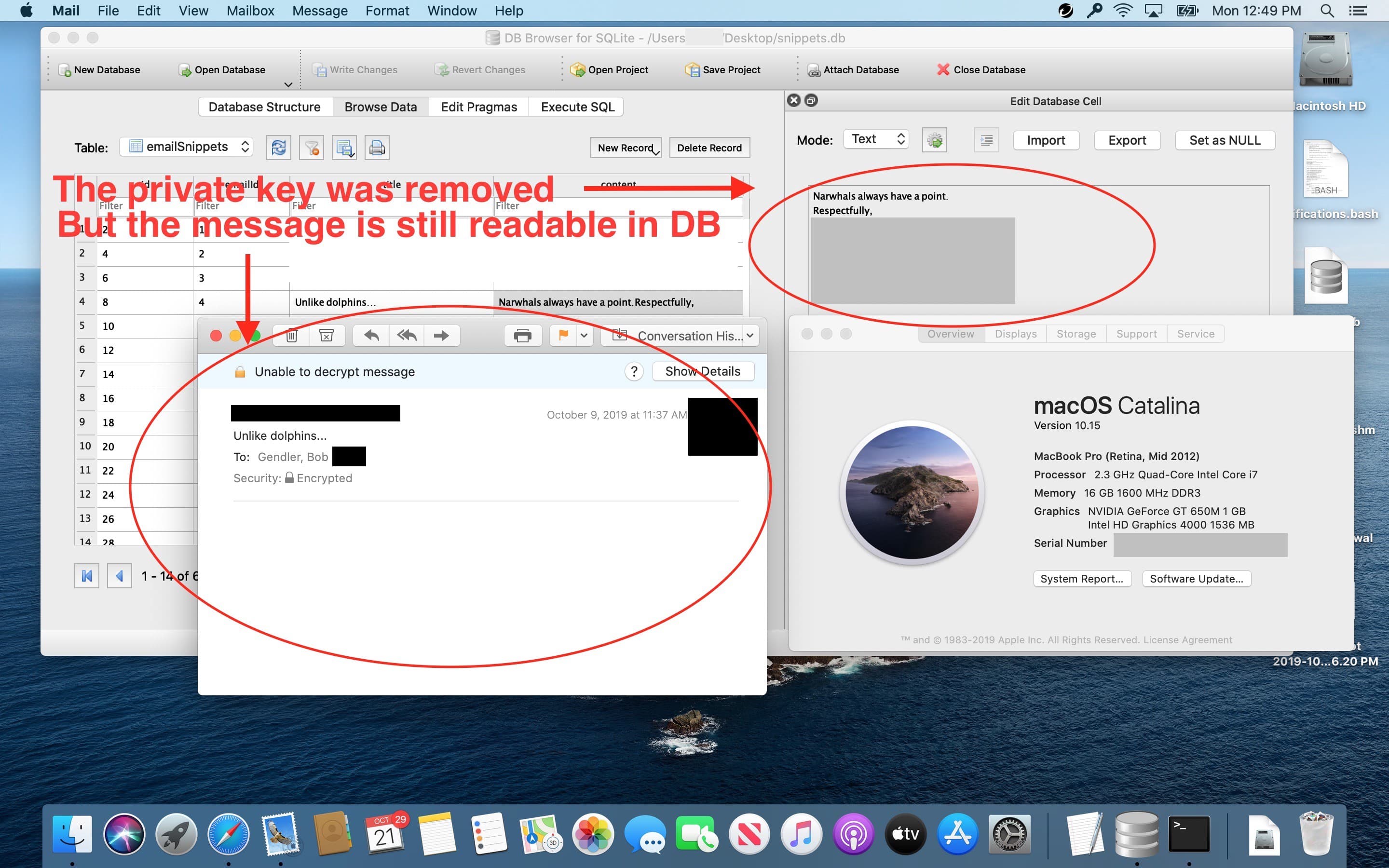
The Apple expert Bob Gendler discovered that the Apple Mail app available on macOS stores leaves a portion of users encrypted emails in plaintext in a database called snippets.db. The issue affects all macOS versions, including the latest Catalina.

The issue is yet to be fixed and even if Apple plans to address it, the company did not provide a timeline.

“But if you send encrypted emails from Apple Mail, there’s currently a way to read some of the text of those emails as if they were unencrypted — and allegedly, Apple’s known about this vulnerability for months without offering a fix.” reads a post published by The Verge.

“Apple tells The Verge it’s aware of the issue and says it will address it in a future software update. The company also says that only portions of emails are stored. But the fact that Apple is still somehow leaving parts of encrypted emails out in the open, when they’re explicitly supposed to be encrypted, obviously isn’t good.”

The expert discovered the issue while he was investigating how macOS and Siri suggest contacts and information to the user.

“This led me to the process called , run by the system level LaunchAgent apple, and the Suggestions folder in the user-level Library folder, which contains multiple files and some potentially important database files ( files).” reads a post published by Gendler on Medium. “These are databases with information from Apple Mail and other Apple applications that enable and Siri to become better at suggesting information.”

Gendler explained that Siri uses a process named “suggestd” to collect contact information from various apps. Data collected by the process are stored in the snippets.db file.

The expert discovered that if the Apple Mail is used to send and receive encrypted email, Siri would collect a plaintext version of the emails storing them in the database.

“Let me say that again… The snippets.db database is storing encrypted Apple Mail messages…completely, totally, fully — UNENCRYPTED — readable, even with Siri disabled, without requiring the private key. Most would assume that disabling Siri would stop macOS from collecting information on the user.” continues the post.

“This is a big deal. This is a big deal for governments, corporations and regular people who use encrypted email and expect the contents to be protected”

Unfortunately, disabling Siri will not solve the issue because the ‘suggestd‘ process will continue to scrape emails.

The expert proposed the following three ways to disable these processes from scraping messages from Apple Mail:

  • Manually click the settings, go to System Preferences → Siri →Siri Suggestions & Privacy →Uncheck the boxes for Apple Mail.
  • Run the following command in Terminal to turn off Siri from learning from Apple Mail: defaults write com.apple.suggestions SiriCanLearnFromAppBlacklist -array com.apple.mail
  • Deploy a System-Level (for all users) configuration profile to turn off Siri from learning from Apple Mail.

The third solution is permanent, it will disable macOS and Siri from collecting this Mail information for all users. The expert explained that future OS updates will not re-enable Siri scraping Apple Mail.

Gendler also suggests to manually remove the snippets.db file that is located in “/Users/(username)/Library/Suggestions/”.

[adrotate banner=”9″] [adrotate banner=”12″]

Pierluigi Paganini

(SecurityAffairs – encryption, hacking)

[adrotate banner=”5″]

[adrotate banner=”13″]


