
A Türkiye-linked group used an Output Messenger zero-day to spy on Kurdish military targets in Iraq, collecting user data since April 2024.
Since April 2024, the threat actor Marbled Dust (aka Sea Turtle, Teal Kurma, Marbled Dust, SILICON and Cosmic Wolf) has exploited a zero-day flaw (CVE-2025-27920) in Output Messenger to target Kurdish military-linked users in Iraq, collecting user data and deploying malicious files. Microsoft researchers believe the group selects this method based on reconnaissance, confirming the use of the app.
Marbled Dust has been active since at least 2017 and primarily targets organizations in Europe and the Middle East. Between 2017 and 2019, the APT group mainly used DNS hijacking in its campaigns.
The group targets government entities, Kurdish (political) groups like PKK, telecommunication, ISPs, IT-service providers (including security companies), NGO, and Media & Entertainment sectors.
Over the years, the group enhanced its evasion capabilities.
The vulnerability CVE-2025-27920 is a directory traversal vulnerability allowing attackers to access files outside the intended directory, potentially leading to data exposure. The flaw impacts Output Messenger versions before 2.0.63.
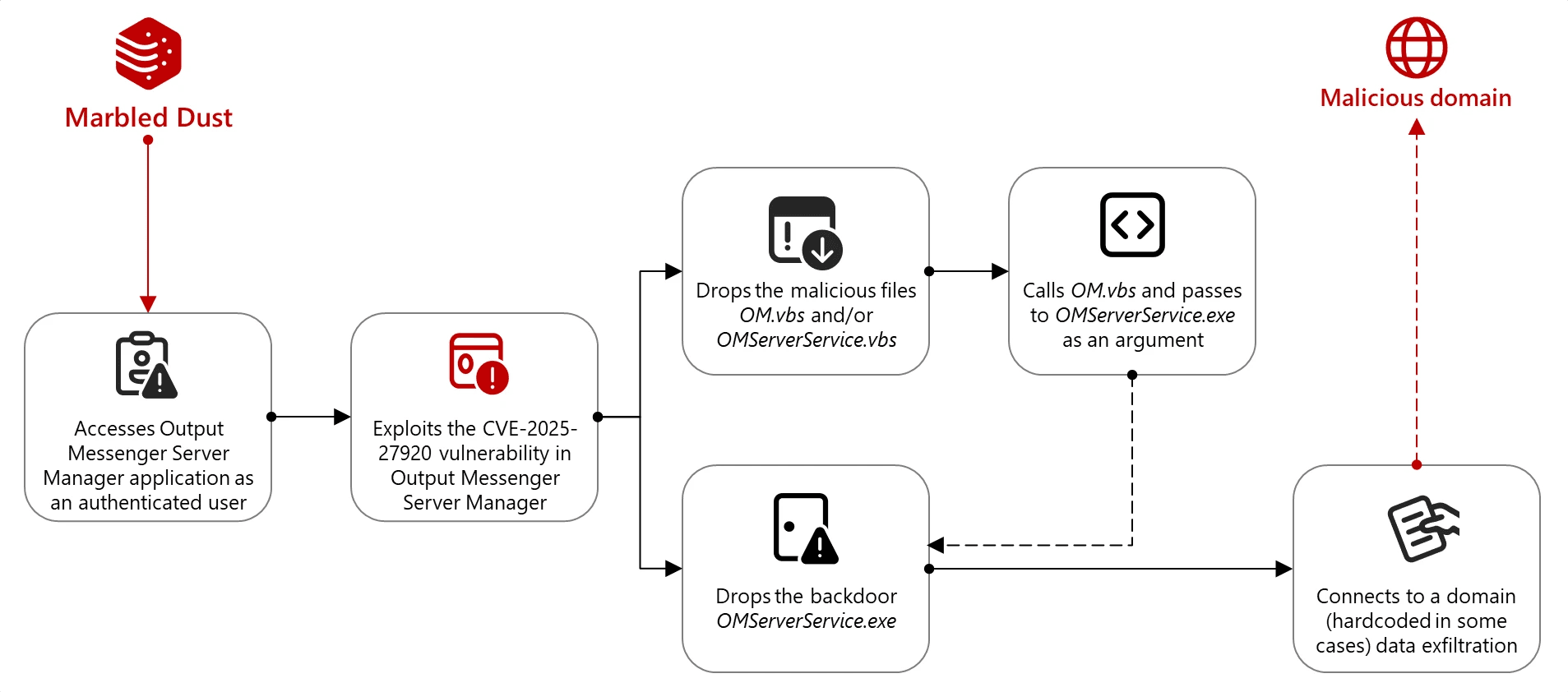
Marbled Dust exploited the flaw to drop a malicious script in the startup folder. Using the server’s file-sharing feature, an attacker could upload files and manipulate the file path to execute arbitrary code. Once inside, they could access all user communications, steal data, impersonate users, and compromise credentials, posing major operational risks.
“Once Marbled Dust gains access to the Output Messenger server, the threat actor can leverage Output Messenger system architecture to gain indiscriminate access to the communications of every user, steal sensitive data and impersonate users, which could lead to operational disruptions, unauthorized access to internal systems, and widespread credential compromise.” reads the report published by Microsoft.
Marbled Dust exploited CVE-2025-27920 after likely stealing credentials via DNS hijacking or typo-squatting. Once authenticated, they uploaded malicious files to the server’s startup directory, deploying Go-based backdoors like OMServerService.exe.

These tools exfiltrate data via api.wordinfos[.]com. Attackers deployed a second backdoor on client systems to collect host information and execute commands from a C2. File theft and RAR exfiltration were also observed via plink SSH, the command-line version of the PuTTY SSH client for Windows.
“This new attack signals a notable shift in Marbled Dust’s capability while maintaining consistency in their overall approach.” concludes the report. “The successful use of a zero-day exploit suggests an increase in technical sophistication and could also suggest that Marbled Dust’s targeting priorities have escalated or that their operational goals have become more urgent.”
Follow me on Twitter: @securityaffairs and Facebook and Mastodon
(SecurityAffairs – hacking, APT)


