
Security Affairs
Cyberattack Hits French Blood Banks as Hackers Target Refrigeration Systems Across Europe|CVE-2026-58868: Critical Android Bug Could Let Attackers Run Remote Code|U.S. CISA adds WordPress flaw to its Known Exploited Vulnerabilities catalog|Binance Hack: How Fake Job Interviews and AI Abuse Led to a $6.34 Billion Attack|Synology Warns of Ransomware Attacks Targeting NAS Devices Running Outdated DSM Versions|Inside XCPE, the botnet that turned 1.3M set-top boxes into proxy servers|NIS2 Makes Board Members Personally Liable for Access Control Decisions|Apple’s spyware notifications reach the Bundestag: what the BSI says to do now|VOLTA, the infostealer that asks an AI which victims are worth the effort|New wave of fridge cyberattacks hits European supermarkets, this time in Belgium, Luxembourg, Sweden and Estonia|Hackers Send Fake Nuclear Threat Alerts to Ukrainian and Russian Citizens|Chainalysis Investigates Security Incident Involving AI-Driven Attack Techniques|Cyberattack Hits French Blood Banks as Hackers Target Refrigeration Systems Across Europe|CVE-2026-58868: Critical Android Bug Could Let Attackers Run Remote Code|U.S. CISA adds WordPress flaw to its Known Exploited Vulnerabilities catalog|Binance Hack: How Fake Job Interviews and AI Abuse Led to a $6.34 Billion Attack|Synology Warns of Ransomware Attacks Targeting NAS Devices Running Outdated DSM Versions|Inside XCPE, the botnet that turned 1.3M set-top boxes into proxy servers|NIS2 Makes Board Members Personally Liable for Access Control Decisions|Apple’s spyware notifications reach the Bundestag: what the BSI says to do now|VOLTA, the infostealer that asks an AI which victims are worth the effort|New wave of fridge cyberattacks hits European supermarkets, this time in Belgium, Luxembourg, Sweden and Estonia|Hackers Send Fake Nuclear Threat Alerts to Ukrainian and Russian Citizens|Chainalysis Investigates Security Incident Involving AI-Driven Attack Techniques|
Advertisement

Ad Placeholder

Full Width × 90

Breaking News

Attackers target Zyxel RCE vulnerability CVE-2023-28771

GreyNoise researchers have observed exploit attempts targeting the remote code execution vulnerability CVE-2023-28771 in Zyxel devices. On June 16, GreyNoise researchers detected exploit attempts targeting CVE-2023-28771 (CVSS score 9.8), a remote code execution flaw impacting Zyxel IKE decoders over UDP port 500. “Exploitation attempts against CVE-2023-28771 were minimal throughout recent weeks. On June 16, GreyNoise observed […]

Zyxel

GreyNoise researchers have observed exploit attempts targeting the remote code execution vulnerability CVE-2023-28771 in Zyxel devices.

On June 16, GreyNoise researchers detected exploit attempts targeting CVE-2023-28771 (CVSS score 9.8), a remote code execution flaw impacting Zyxel IKE decoders over UDP port 500.

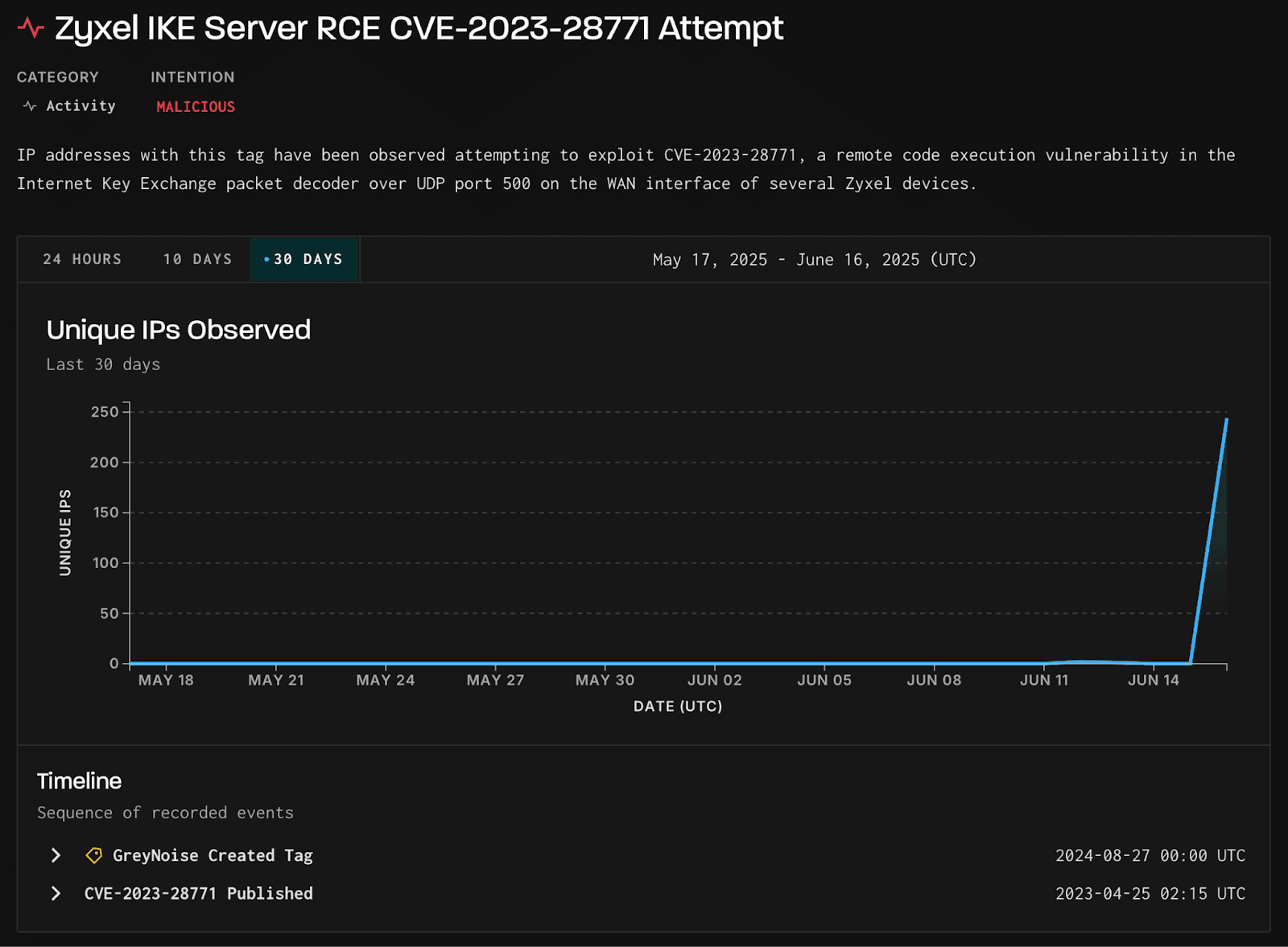
“Exploitation attempts against CVE-2023-28771 were minimal throughout recent weeks. On June 16, GreyNoise observed a concentrated burst of exploit attempts within a short time window, with 244 unique IPs observed attempting exploitation.” reads the alert published by GreyNoise.

The main targets of the CVE-2023-28771 exploit were the U.S., U.K., Spain, Germany, and India. Interestingly, the attacking IPs showed no other suspicious activity in the two weeks before June 16, the attempts focused solely on this specific vulnerability.

All 244 IP addresses linked to the exploit attempts appear to come from Verizon Business in the U.S., but because the attack uses UDP (port 500), the researchers warn that the IP addresses could be spoofed and may not reveal the real source. GreyNoise linked the attempts to Mirai botnet variants, which VirusTotal later confirmed.

Below are mitigations provided by GreyNoise:

  • Block malicious IPs: While spoofing is possible, GreyNoise has classified all 244 IPs as malicious. Defenders should immediately block these IPs while monitoring for related activity. 
  • Review Zyxel device exposure: Verify that any internet-exposed Zyxel devices are patched for CVE-2023-28771. 
  • Monitor for post-exploitation activity: Exploit attempts may lead to botnet enlistment or additional compromise. Monitor affected devices for anomalies. 
  • Limit unnecessary IKE/UDP port 500 exposure: Apply network filtering where possible to reduce unnecessary exposure. 

In April 2023, Zyxel addressed the critical vulnerability CVE-2023-28771 in its firewall devices. The company promptly advised customers to install the provided patches in order to mitigate the vulnerability. At the time, the vendor reported that threat actors are actively attempting to exploit the command injection vulnerability CVE-2023-28771 impacting Zyxel firewalls. Their objective was to leverage this vulnerability to deploy and install malware on the affected systems. At the end of May 2025, US CISA added the vulnerability to its Known Exploited Vulnerability to Catalog based on evidence of active exploitation.

Follow me on Twitter: @securityaffairs and Facebook and Mastodon

Pierluigi Paganini

(SecurityAffairs – hacking, Zyxel)


