
Security Affairs
U.S. Charges Canadian Man in Alleged Hack of University Supercomputers|Two Barracuda ESG Flaws Could Be Combined for Full Root Access; Patches Released|Cyberattack Hits French Blood Banks as Hackers Target Refrigeration Systems Across Europe|CVE-2026-58868: Critical Android Bug Could Let Attackers Run Remote Code|U.S. CISA adds WordPress flaw to its Known Exploited Vulnerabilities catalog|Binance Hack: How Fake Job Interviews and AI Abuse Led to a $6.34 Billion Attack|Synology Warns of Ransomware Attacks Targeting NAS Devices Running Outdated DSM Versions|Inside XCPE, the botnet that turned 1.3M set-top boxes into proxy servers|NIS2 Makes Board Members Personally Liable for Access Control Decisions|Apple’s spyware notifications reach the Bundestag: what the BSI says to do now|VOLTA, the infostealer that asks an AI which victims are worth the effort|New wave of fridge cyberattacks hits European supermarkets, this time in Belgium, Luxembourg, Sweden and Estonia|U.S. Charges Canadian Man in Alleged Hack of University Supercomputers|Two Barracuda ESG Flaws Could Be Combined for Full Root Access; Patches Released|Cyberattack Hits French Blood Banks as Hackers Target Refrigeration Systems Across Europe|CVE-2026-58868: Critical Android Bug Could Let Attackers Run Remote Code|U.S. CISA adds WordPress flaw to its Known Exploited Vulnerabilities catalog|Binance Hack: How Fake Job Interviews and AI Abuse Led to a $6.34 Billion Attack|Synology Warns of Ransomware Attacks Targeting NAS Devices Running Outdated DSM Versions|Inside XCPE, the botnet that turned 1.3M set-top boxes into proxy servers|NIS2 Makes Board Members Personally Liable for Access Control Decisions|Apple’s spyware notifications reach the Bundestag: what the BSI says to do now|VOLTA, the infostealer that asks an AI which victims are worth the effort|New wave of fridge cyberattacks hits European supermarkets, this time in Belgium, Luxembourg, Sweden and Estonia|
Advertisement

Ad Placeholder

Full Width × 90

Cyber Crime

AvosLocker ransomware now targets Linux systems, including ESXi servers

AvosLocker is the latest ransomware that implemented the capability to encrypt Linux systems including VMware ESXi servers. AvosLocker expands its targets by implementing the support for encrypting Linux systems, specifically VMware ESXi servers, Bleeping computed reported. “While we couldn’t find what targets were attacked using this AvosLocker ransomware Linux variant, BleepingComputer knows of at least one […]

AvosLocker ransomware operators

AvosLocker is the latest ransomware that implemented the capability to encrypt Linux systems including VMware ESXi servers.

AvosLocker expands its targets by implementing the support for encrypting Linux systems, specifically VMware ESXi servers, Bleeping computed reported.

“While we couldn’t find what targets were attacked using this AvosLocker ransomware Linux variant, BleepingComputer knows of at least one victim that got hit with a $1 million ransom demand.” reported BleepingComputer. Security researcher MalwareHunterTeam confirmed that the ransomware gang is using the Linux encryptor since November 2021.

Other ransomware operations supporting Linux and ESXi servers are RansomExx/Defray, Mespinoza, HelloKitty, and Babuk. Linux-based versions of popular ransomware allow gangs to target a broad range of organizations, especially those using ESXi servers.

AvosLocker operators already advertised in the past a Linux variant, dubbed AvosLinux, of their malware claiming it was able to support Linux and ESXi servers.

According to BleepingComputer, upon execution AvosLinux terminates all ESXi machines on the server then it starts encrypting files.

The AvosLocker ransomware appends the .avoslinux extension to the filenames of all the encrypted files, then drops ransom notes in each folder containing the encrypted files.

The AvosLocker ransomware-as-a-service recently emerged in the threat landscape and its attacks surged between November and December. In a recent wave of attacks, AvosLocker ransomware is rebooting systems into Windows Safe Mode to disable endpoint security solutions.

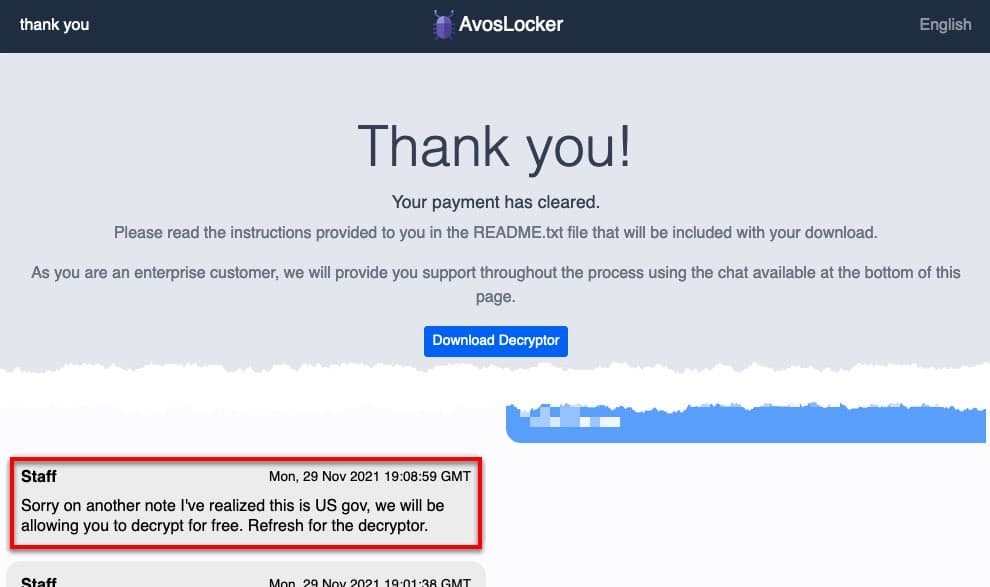
At the end of December, the AvosLocker ransomware operators released a free decryptor after they accidentally encrypted the system of US Government entity.

Follow me on Twitter: @securityaffairs and Facebook

[adrotate banner=”9″][adrotate banner=”12″]

Pierluigi Paganini

(SecurityAffairs – hacking, AvosLocker)

[adrotate banner=”5″]

[adrotate banner=”13″]


