
Security Affairs
Cyberattack Hits French Blood Banks as Hackers Target Refrigeration Systems Across Europe|CVE-2026-58868: Critical Android Bug Could Let Attackers Run Remote Code|U.S. CISA adds WordPress flaw to its Known Exploited Vulnerabilities catalog|Binance Hack: How Fake Job Interviews and AI Abuse Led to a $6.34 Billion Attack|Synology Warns of Ransomware Attacks Targeting NAS Devices Running Outdated DSM Versions|Inside XCPE, the botnet that turned 1.3M set-top boxes into proxy servers|NIS2 Makes Board Members Personally Liable for Access Control Decisions|Apple’s spyware notifications reach the Bundestag: what the BSI says to do now|VOLTA, the infostealer that asks an AI which victims are worth the effort|New wave of fridge cyberattacks hits European supermarkets, this time in Belgium, Luxembourg, Sweden and Estonia|Hackers Send Fake Nuclear Threat Alerts to Ukrainian and Russian Citizens|Chainalysis Investigates Security Incident Involving AI-Driven Attack Techniques|Cyberattack Hits French Blood Banks as Hackers Target Refrigeration Systems Across Europe|CVE-2026-58868: Critical Android Bug Could Let Attackers Run Remote Code|U.S. CISA adds WordPress flaw to its Known Exploited Vulnerabilities catalog|Binance Hack: How Fake Job Interviews and AI Abuse Led to a $6.34 Billion Attack|Synology Warns of Ransomware Attacks Targeting NAS Devices Running Outdated DSM Versions|Inside XCPE, the botnet that turned 1.3M set-top boxes into proxy servers|NIS2 Makes Board Members Personally Liable for Access Control Decisions|Apple’s spyware notifications reach the Bundestag: what the BSI says to do now|VOLTA, the infostealer that asks an AI which victims are worth the effort|New wave of fridge cyberattacks hits European supermarkets, this time in Belgium, Luxembourg, Sweden and Estonia|Hackers Send Fake Nuclear Threat Alerts to Ukrainian and Russian Citizens|Chainalysis Investigates Security Incident Involving AI-Driven Attack Techniques|
Advertisement

Ad Placeholder

Full Width × 90

Breaking News

Backdoored Webmin versions were available for download for over a year

Webmin, the popular open-source web-based interface for Unix admin contained a remote code execution vulnerability for more than a year. Webmin is an open-source web-based interface for system administration for Linux and Unix. It allows users using web browsers to set up user accounts, Apache, DNS, file sharing and much more. News of the day […]

Install Webmin 2

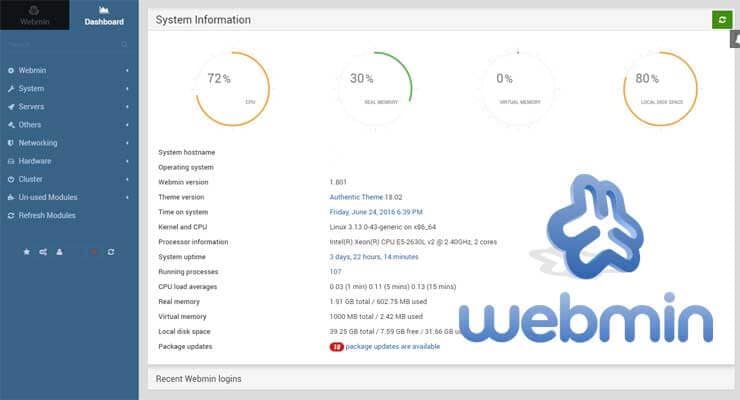
Webmin, the popular open-source web-based interface for Unix admin contained a remote code execution vulnerability for more than a year.

Webmin is an open-source web-based interface for system administration for Linux and Unix. It allows users using web browsers to set up user accounts, Apache, DNS, file sharing and much more.

News of the day is that Webmin contained a remote code execution vulnerability, tracked as CVE-2019-15107, for more than a year. The worst aspect of the story is that the flaw appears to be an intentional backdoor.

Install Webmin 2

The flaw affects the procedure for changing expired passwords, the backdoor could be exploited by a remote attacker to execute malicious commands with root privileges on the machine running vulnerable Webmin.

The expert decided to not report the flaw to the Webmin development team.

The issue was first discovered by security researcher Özkan Mustafa Akkuş that publicly disclosed it at the DEF CON 27 hackers conference earlier in August.

https://twitter.com/ehakkus/status/1160394550323453953

The backdoor affects Webmin 1.882 through 1.921, but experts observed that default configuration are not vulnerable because the affected feature is not enabled by default. Only version 1.890 is affected also in the default configuration.

Webmin 1.930 and Usermin version 1.780 have addressed the flaw.

“I’ve rolled out Webmin version 1.930 and Usermin version 1.780 for all repositories. This release includes several security fixes, including one potentially serious one caused by malicious code inserted into Webmin and Usermin at some point on our build infrastructure.” Webmin developers explained.

“To exploit the malicious code, your Webmin installation must have Webmin -> Webmin Configuration -> Authentication -> Password expiry policy set to Prompt users with expired passwords to enter a new one. This option is not set by default, but if it is set, it allows remote code execution,”

Developers are still investigating how and when the backdoor was inserted, but they pointed out that the exploitable code has never existed in official github repositories, so they have rebuilt from git source on new infrastructure.

It seems that only offical downloads have been compromised with a backdoor along with the SourceForge repository.

Likely the backdoor was planted by threat actors that compromised build infrastructure.

Searching with Shodan for internet-exposed Webmin installs, it is possible to find over 217,000 instances, most of them located in the United States, France and Germany. Only 1,400 are Webmin version 1.890, which is vulnerable in the default configuration.

[adrotate banner=”9″] [adrotate banner=”12″]

Pierluigi Paganini

(SecurityAffairs – Webmin, hacking)

[adrotate banner=”5″]

[adrotate banner=”13″]


