Security Affairs
Two Barracuda ESG Flaws Could Be Combined for Full Root Access; Patches Released|Cyberattack Hits French Blood Banks as Hackers Target Refrigeration Systems Across Europe|CVE-2026-58868: Critical Android Bug Could Let Attackers Run Remote Code|U.S. CISA adds WordPress flaw to its Known Exploited Vulnerabilities catalog|Binance Hack: How Fake Job Interviews and AI Abuse Led to a $6.34 Billion Attack|Synology Warns of Ransomware Attacks Targeting NAS Devices Running Outdated DSM Versions|Inside XCPE, the botnet that turned 1.3M set-top boxes into proxy servers|NIS2 Makes Board Members Personally Liable for Access Control Decisions|Apple’s spyware notifications reach the Bundestag: what the BSI says to do now|VOLTA, the infostealer that asks an AI which victims are worth the effort|New wave of fridge cyberattacks hits European supermarkets, this time in Belgium, Luxembourg, Sweden and Estonia|Hackers Send Fake Nuclear Threat Alerts to Ukrainian and Russian Citizens|Two Barracuda ESG Flaws Could Be Combined for Full Root Access; Patches Released|Cyberattack Hits French Blood Banks as Hackers Target Refrigeration Systems Across Europe|CVE-2026-58868: Critical Android Bug Could Let Attackers Run Remote Code|U.S. CISA adds WordPress flaw to its Known Exploited Vulnerabilities catalog|Binance Hack: How Fake Job Interviews and AI Abuse Led to a $6.34 Billion Attack|Synology Warns of Ransomware Attacks Targeting NAS Devices Running Outdated DSM Versions|Inside XCPE, the botnet that turned 1.3M set-top boxes into proxy servers|NIS2 Makes Board Members Personally Liable for Access Control Decisions|Apple’s spyware notifications reach the Bundestag: what the BSI says to do now|VOLTA, the infostealer that asks an AI which victims are worth the effort|New wave of fridge cyberattacks hits European supermarkets, this time in Belgium, Luxembourg, Sweden and Estonia|Hackers Send Fake Nuclear Threat Alerts to Ukrainian and Russian Citizens|
Advertisement

Ad Placeholder

Full Width × 90

Breaking News

Major hacking forums XSS and Exploit ban ads from ransomware gangs

XSS forum (previously known as DaMaGeLab) one of the most popular hacking forums, announced that it would ban the ads published by ransomware gangs. The popular hacking forum XSS forum, previously known as DaMaGeLab, announced that that it would ban the ads published by ransomware gangs. The forum is one the most important places of […]

ransomware ban

XSS forum (previously known as DaMaGeLab) one of the most popular hacking forums, announced that it would ban the ads published by ransomware gangs.

The popular hacking forum XSS forum, previously known as DaMaGeLab, announced that that it would ban the ads published by ransomware gangs. The forum is one the most important places of aggregation where ransomware gangs offer their services and attempt to recruit new affiliates in their networks.

The decision to ban ads published by ransomware gangs was an attempt to avoid attracting attention from law enforcement, the forum also prohibits any affiliated program. The recent ransomware attack against the Colonial Pipeline conducted by the Darkside gang triggered the response of the US authorities that resulted in the seizure of their servers.

At the time of this writing, ads from ransomware gangs are still allowed on some hacking forums, but another popular cybercrime forum, Exploit, banned this activity.

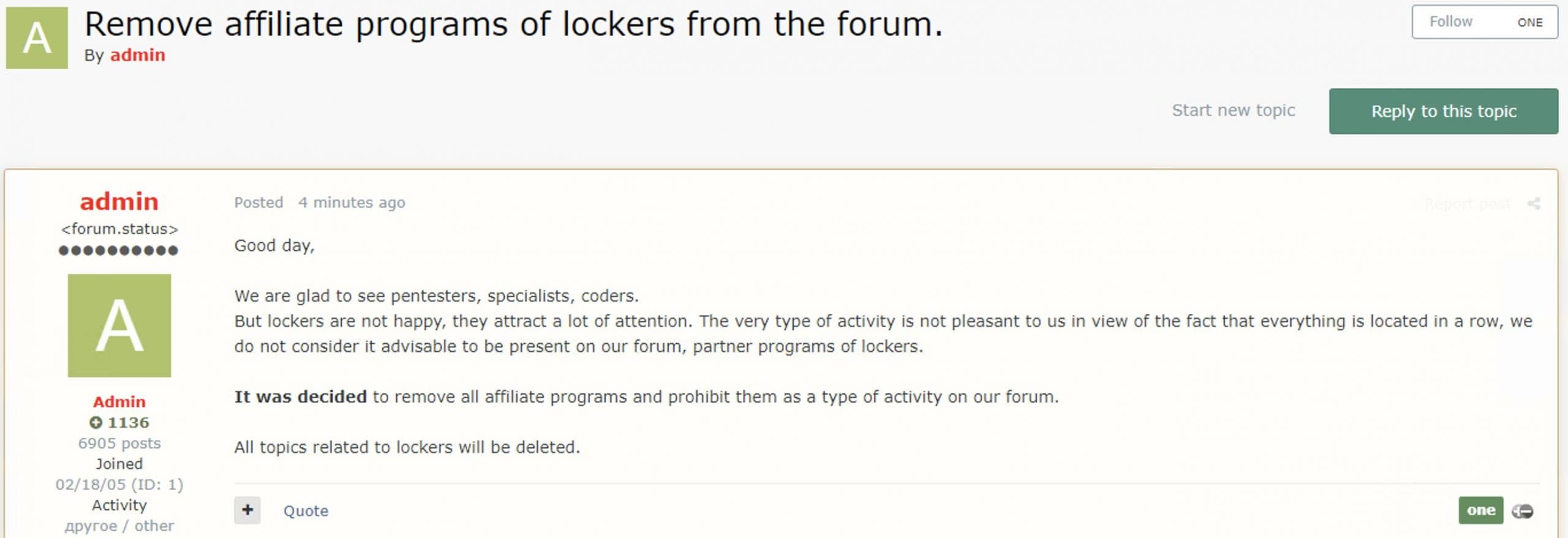
Admins of Exploit will also remove affiliate programs from the hacking forum:

“We are glad to see pentesters, malware specialists, coders, but we are not happy with lockers – they attract a lot of attention. This type of activity is not good to us in view of the fact that networks are locked indiscriminately we do not consider it appropriate for RaaS partner programs to be present on our forum. It was decided to remove all affiliate programs and prohibit them as a type of activity on our forum.” reads the statement published by the admins.

ransomware ban
Source Twitter

Follow me on Twitter: @securityaffairs and Facebook

[adrotate banner=”9″][adrotate banner=”12″]

Pierluigi Paganini

(SecurityAffairs – hacking, ransomware)

[adrotate banner=”5″]

[adrotate banner=”13″]