
Security Affairs
Cyberattack Hits French Blood Banks as Hackers Target Refrigeration Systems Across Europe|CVE-2026-58868: Critical Android Bug Could Let Attackers Run Remote Code|U.S. CISA adds WordPress flaw to its Known Exploited Vulnerabilities catalog|Binance Hack: How Fake Job Interviews and AI Abuse Led to a $6.34 Billion Attack|Synology Warns of Ransomware Attacks Targeting NAS Devices Running Outdated DSM Versions|Inside XCPE, the botnet that turned 1.3M set-top boxes into proxy servers|NIS2 Makes Board Members Personally Liable for Access Control Decisions|Apple’s spyware notifications reach the Bundestag: what the BSI says to do now|VOLTA, the infostealer that asks an AI which victims are worth the effort|New wave of fridge cyberattacks hits European supermarkets, this time in Belgium, Luxembourg, Sweden and Estonia|Hackers Send Fake Nuclear Threat Alerts to Ukrainian and Russian Citizens|Chainalysis Investigates Security Incident Involving AI-Driven Attack Techniques|Cyberattack Hits French Blood Banks as Hackers Target Refrigeration Systems Across Europe|CVE-2026-58868: Critical Android Bug Could Let Attackers Run Remote Code|U.S. CISA adds WordPress flaw to its Known Exploited Vulnerabilities catalog|Binance Hack: How Fake Job Interviews and AI Abuse Led to a $6.34 Billion Attack|Synology Warns of Ransomware Attacks Targeting NAS Devices Running Outdated DSM Versions|Inside XCPE, the botnet that turned 1.3M set-top boxes into proxy servers|NIS2 Makes Board Members Personally Liable for Access Control Decisions|Apple’s spyware notifications reach the Bundestag: what the BSI says to do now|VOLTA, the infostealer that asks an AI which victims are worth the effort|New wave of fridge cyberattacks hits European supermarkets, this time in Belgium, Luxembourg, Sweden and Estonia|Hackers Send Fake Nuclear Threat Alerts to Ukrainian and Russian Citizens|Chainalysis Investigates Security Incident Involving AI-Driven Attack Techniques|
Advertisement

Ad Placeholder

Full Width × 90

Breaking News

Bashware attack, how to run Linux malware on Windows systems

Experts found a new alarming method dubbed Bashware attack that allows attackers to silently run malware to bypass even the most common security solutions, The new Windows 10 feature Windows Subsystem for Linux (WSL) that implements the Linux bash terminal in Microsoft operating system could be exploited by malware to run undetected. The feature was recently […]

Linux of Windows

Experts found a new alarming method dubbed Bashware attack that allows attackers to silently run malware to bypass even the most common security solutions,

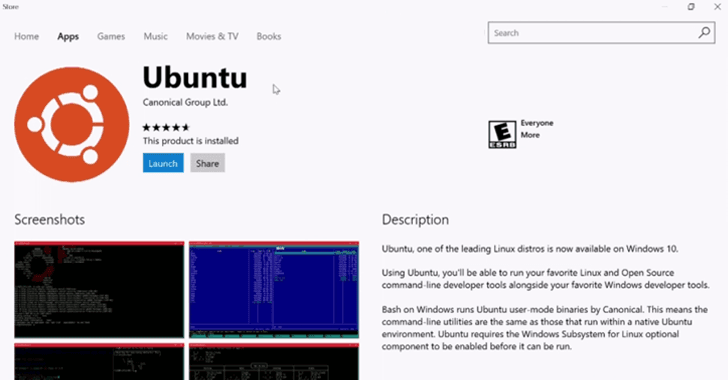
The new Windows 10 feature Windows Subsystem for Linux (WSL) that implements the Linux bash terminal in Microsoft operating system could be exploited by malware to run undetected.

The feature was recently included in beta versions and it will be available for all users in the upcoming Windows 10 Fall Creators Update (FCU), set to be released by Microsoft in October 2017.

According to Because researchers with security firm Check Point, a malware designed for Linux can run undetected on Windows systems.

Bashware Linux of Windows

The new attack technique was dubbed Bashware, it allows the malicious code to evade the detection of antivirus solutions written for Windows, for this reason, it could be implemented also by Linux malware.

“Existing security solutions are still not adapted to monitor processes of Linux executables running on Windows OS, a hybrid concept which allows a combination of Linux and Windows systems to run at the same time.” reads the analysis published by Check Point. “This may open a door for cyber criminals wishing to run their malicious code undetected, and allow them to use the features provided by WSL to hide from security products that have not yet integrated the proper detection mechanisms.”

Below a video PoC of the Bashware attack:

https://youtu.be/4ki6dbEePaw

Security researchers have demonstrated that the Bashware attack goes undetected with most of the security solutions, it may potentially affect more of 400 million Windows systems that already run Windows 10 PC.

“Bashware is so alarming because it shows how easy it is to take advantage of the WSL mechanism to allow any malware to bypass security products. We tested this technique on most of the leading anti-virus and security products on the market, successfully bypassing them all. This means that Bashware may potentially affect any of the 400 million computers currently running Windows 10 PC globally.” continues the analysis.

According to the experts, the risk is anyway limited because the WSL feature must be explicitly enabled by the Windows user, it is disabled by default.

Check Point also added that the WSL could be silently enabled in the background, allowing the malware to run.

Microsoft downplayed the risks to end-users because the feature is disabled by default.

[adrotate banner=”9″]

Pierluigi Paganini

(Security Affairs – Linux on Windows, Bashware)

[adrotate banner=”13″]


