
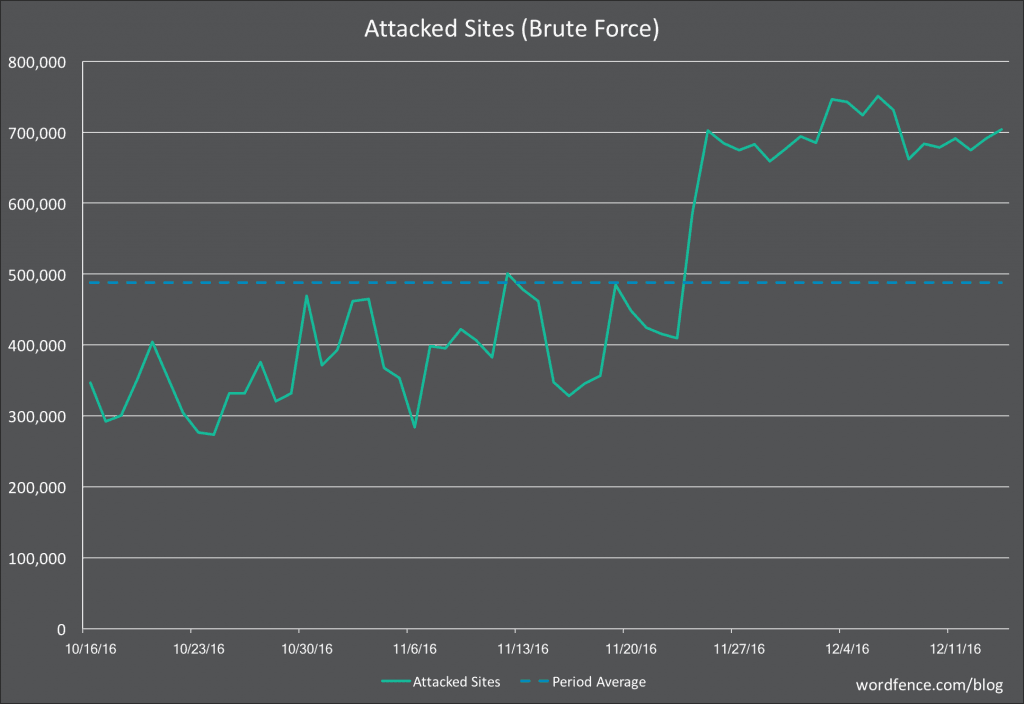
Security experts from Wordfence observed a huge increase in Brute Force attacks in the last three weeks.
The security firm Wordfence is warning the WordPress community of a spike in the number of brute force attacks against websites running WordPress. has increased significantly in December compared to the previous period.
The researchers observed brute force attacks on WordPress websites soar in December.
Brute force attacks still represent a valid method to guess the admin credentials. According to Wordfence, in the last weeks, such kind of attacks increased in a significant way.
“Three weeks ago, on November 24th, we started seeing a rise in brute force attacks. As a reminder, a brute force attack is one that tries to guess your username and password to sign into your WordPress website.” states a blog post published by Wordfence.
In the period between October 16 and November 24, the experts observed less than 500,000 websites were attacked each day. The number of websites attacked soared starting with November 24, it was greater than 700,000 in some days. Wordfence blocked as many as 23 million brute force attack attempts per day.

The number of unique attack IPs also increased in the same period, passing from an average of roughly 13,000 per day to more than 30,000.
Top 20 countries from which the brute force attacks were launched during the past 24 hours is led by Ukraine (15,7% of total attacks), followed by France (11.1%), Russia (6.8%), the U.S. (6.6%), India (5.8%), China (4.2%), Germany (3.2%), Italy (2.4%) and the U.K. (2.2%).
“Most of the attacks come from 8 IP addresses in Ukraine.” states the analysis. “These IPs all belong to the same organization and are on the same network. Doing a Google search on the top IP brings back many reports of abuse around the Internet. They belong to a hosting company in Ukraine called “Pp Sks–lugan“. The servers are a mix. Some aren’t running any services. Others appear to be running Windows IIS web server. ” “These IPs are using brute force attacks exclusively. They don’t launch any sophisticated attacks. They are hammering away at WordPress sites at a rate of over a quarter million login attempts each, in some cases, during a 24 hour period.”
The researcher also tracked other specific networks used in the attacks, France sources have been tracked back to a company called Iliad-Entreprises. Other organizations involved in the cyber attacks are OVH, GoDaddy and BSNL.
hacker
Recently the firm RIPS Technologies published a report based on the analysis of 44,705 plugins in the official WordPress plugins directory and discovered that more than 8,800 of them are flawed.
When it comes to WordPress attacks involving the exploitation of vulnerabilities, malicious actors usually target unpatched plugins. A study conducted recently by RIPS Technologies has showed that of 44,000 plugins available in the official WordPress plugins directory, 8,800 are affected by at least one vulnerability.
[adrotate banner=”9″]
(Security Affairs – WordPress, brute force attacks)


