
Security Affairs
CVE-2026-58868: Critical Android Bug Could Let Attackers Run Remote Code|U.S. CISA adds WordPress flaw to its Known Exploited Vulnerabilities catalog|Binance Hack: How Fake Job Interviews and AI Abuse Led to a $6.34 Billion Attack|Synology Warns of Ransomware Attacks Targeting NAS Devices Running Outdated DSM Versions|Inside XCPE, the botnet that turned 1.3M set-top boxes into proxy servers|NIS2 Makes Board Members Personally Liable for Access Control Decisions|Apple’s spyware notifications reach the Bundestag: what the BSI says to do now|VOLTA, the infostealer that asks an AI which victims are worth the effort|New wave of fridge cyberattacks hits European supermarkets, this time in Belgium, Luxembourg, Sweden and Estonia|Hackers Send Fake Nuclear Threat Alerts to Ukrainian and Russian Citizens|Chainalysis Investigates Security Incident Involving AI-Driven Attack Techniques|FBI Blames North Korea for $6 Billion Binance Crypto Theft|CVE-2026-58868: Critical Android Bug Could Let Attackers Run Remote Code|U.S. CISA adds WordPress flaw to its Known Exploited Vulnerabilities catalog|Binance Hack: How Fake Job Interviews and AI Abuse Led to a $6.34 Billion Attack|Synology Warns of Ransomware Attacks Targeting NAS Devices Running Outdated DSM Versions|Inside XCPE, the botnet that turned 1.3M set-top boxes into proxy servers|NIS2 Makes Board Members Personally Liable for Access Control Decisions|Apple’s spyware notifications reach the Bundestag: what the BSI says to do now|VOLTA, the infostealer that asks an AI which victims are worth the effort|New wave of fridge cyberattacks hits European supermarkets, this time in Belgium, Luxembourg, Sweden and Estonia|Hackers Send Fake Nuclear Threat Alerts to Ukrainian and Russian Citizens|Chainalysis Investigates Security Incident Involving AI-Driven Attack Techniques|FBI Blames North Korea for $6 Billion Binance Crypto Theft|
Advertisement

Ad Placeholder

Full Width × 90

Breaking News

Bug bounty programs and a vulnerability disclosure policy allowed Pentagon fix thousands of flaws

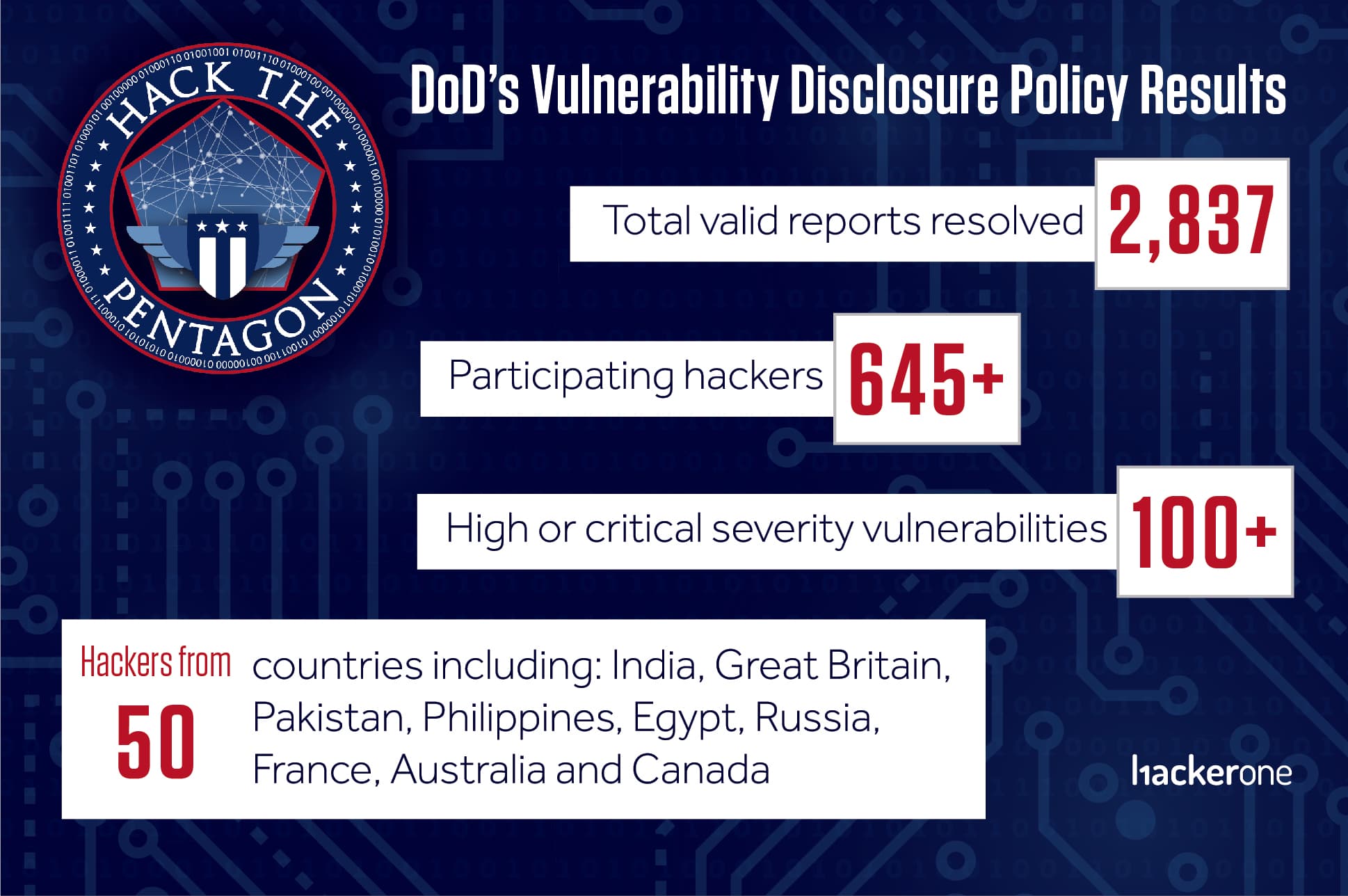
Bug bounty programs allowed the US agency to receive 2,837 valid bug reports from 650 white hat hackers located in 50 countries around the world. Bug bounty program ‘Hack the Pentagon’ launched by the Pentagon in 2016 along with the vulnerability disclosure policy announced nearly one year ago allowed the US agency to receive 2,837 valid bug reports […]

Hack the Pentagon Graphic 111017 fin_B.2

Bug bounty programs allowed the US agency to receive 2,837 valid bug reports from 650 white hat hackers located in 50 countries around the world.

Bug bounty program ‘Hack the Pentagon’ launched by the Pentagon in 2016 along with the vulnerability disclosure policy announced nearly one year ago allowed the US agency to receive 2,837 valid bug reports from 650 white hat hackers located in 50 countries around the world.

“Great news for U.S. citizens! Over 3,000 valid security vulnerabilities have been resolved with the U.S. Department of Defense’s “Hack the Pentagon” hacker-powered security program.” reported the platform used by the US Government to manage the initiatives.

“Just over a year ago, following the success of the pilot, we announced the U.S. Department of Defense was expanding its “Hack the Pentagon,” initiatives. To date, HackerOne and DoD have run bug bounty challenges for Hack the Pentagon, Hack the Army and Hack the Air Force.

The success of the bug bounty programs launched by the UG Government has been undeniable.

The hackers have earned over $300,000 in bounties for their contributions, they reported nearly 500 vulnerabilities in nearly 40 DoD components, more than 100 of the flaws have been rated critical or high severity.

Let me also remind you that the DoD vulnerability disclosure program does not offer any monetary rewards, instead it allows hackers to report security holes without the fear of potential legal consequences.

The list of vulnerabilities includes remote code execution, SQL injection, and authentication bypass issues.

Bug bounty Hack the Pentagon

The majority of the reports were submitted by US researchers, followed by white hat hackers in India, the U.K., Pakistan, Philippines, Egypt, Russia, France, Australia and Canada.

Going through the various bug bounty initiatives launched by the US Government, we can notice that the Hack the Pentagon received 138 valid submissions and paid out roughly $75,000, the Hack the Army paid out approximately $100,000 for 118 valid reports, and Hack the Air Force, which paid out $130,000 for 207 valid reports.

Following the success of “Hack the Pentagon,” several bug bounty programs were announced by U.S. authorities.

[adrotate banner=”9″] [adrotate banner=”12″]

Pierluigi Paganini

Security Affairs –  (Hack the Pentagon, cyber security)

[adrotate banner=”5″]

[adrotate banner=”13″]


