
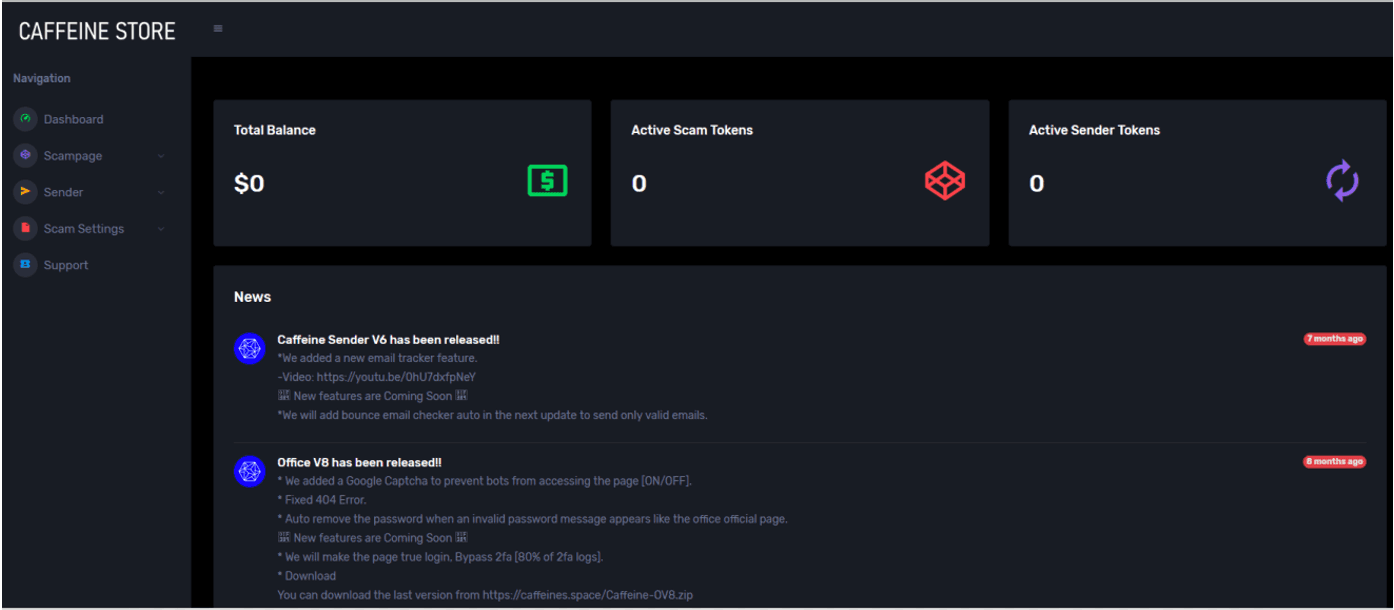
Researchers warn of a new phishing-as-a-service (PhaaS) toolkit, called Caffeine, which is being used by cybercriminals.
In March 2022, Mandiant researchers discovered threat actors using a shared Phishing-as-a-Service (PhaaS) platform called Caffeine. The experts noticed that the toolkit has an intuitive interface and supports multiple features that allow customers to easily arrange phishing campaigns.

The service includes self-service mechanisms to craft customized phishing kits, manage intermediary redirect pages and final-stage lure pages, dynamically generate URLs for hosted malicious payloads, and track campaign email activity.
Unlike most PhaaS platforms, Caffeine features an entirely open registration process, this means that anyone with an email could register for their services.
“Unlike most PhaaS platforms Mandiant encounters, Caffeine is somewhat unique in that it features an entirely open registration process, allowing just about anyone with an email to register for their services instead of working directly through narrow communication channels (such as underground forums or encrypted messaging services) or requiring an endorsement or referral through an existing user.” reads the report published by Mandiant.
“Additionally, to seemingly maximize support for a variety of clientele, Caffeine also provides phishing email templates earmarked for use against Chinese and Russian targets; a generally uncommon and noteworthy feature of the platform (more on this later in the post).”
The toolkit provides templates for a broad range of targets, including Chinese and Russian organizations, which is quite uncommon in the cybercrime ecosystem.
Caffeine is advertised on multiple cybercrime underground forums, its subscription models are more expensive compared with other PhaaS platforms. A monthly base subscription costs approximately $250, while the cost of other PhaaS ranges between $50 and $80. A subscription for three months (Professional) costs $250, while a six-month license (Enterprise) goes for $850.
One of the phishing campaigns analyzed by Mandiant, which relied on the Caffeine toolkit, aimed at stealing Microsoft 365 credentials. Landing pages were hosted on legitimate WordPress sites that were previously compromised.
Landing pages observed by the researchers have currently limited to Microsoft 365 credential harvesting lures, but experts believe that the author of the toolkits will support additional phishing pages in the future as per customer demands.
The report published by Mandiant provides details about the main elements of the Caffeine Phishing Platform, which are:
- Core Caffeine account
- Licensing
- Campaign infrastructure and configuration
“It is also important to keep in mind that defensive measures against PhaaS attacks can be a game of cat and mouse. As quickly as threat actor infrastructure gets taken down, new infrastructure can be spun up.” concludes the report that includes Yare rules for this threat and IoCs.
Below are the recommendations provided by Mandiant for organizations to reduce the impact of phishing attacks and compromised domains on a strategic level:
- Periodically evaluating any public-facing web infrastructure and files against known-good versions of the content.
- Utilizing behavioral analytics for web logs analysis to include initial URL structure, form submission and redirections.
- Occasionally re-assessing security policies regarding passwords and credential resets.
- Implementing two-factor authentication on, at a minimum, any user account used to access an enterprise environment from an external source.
Follow me on Twitter: @securityaffairs and Facebook
| [adrotate banner=”9″] | [adrotate banner=”12″] |
(SecurityAffairs – hacking, Caffeine)
[adrotate banner=”5″]
[adrotate banner=”13″]


