
The head of the crime ring behind the Carbanak gang that since 2013 targeted banks worldwide has been arrested in Spain.
The mastermind suspected of stealing about £870m (€1bn) in a bank cyber heist has been arrested in Spain.
The man is suspected to be the kingpin of the crime ring behind the Carbanak gang that since 2013 targeted banks worldwide with the homonym malware and the Cobalt malicious code.
“The leader of the crime gang behind the Carbanak and Cobalt malware attacks targeting over a 100 financial institutions worldwide has been arrested in Alicante, Spain, after a complex investigation conducted by the Spanish National Police, with the support of Europol, the US FBI, the Romanian, Belarussian and Taiwanese authorities and private cyber security companies.” reads the official announcement from the Europol. “Since 2013, the cybercrime gang have attempted to attack banks, e-payment systems and financial institutions using pieces of malware they designed, known as Carbanak and Cobalt. The criminal operation has struck banks in more than 40 countries and has resulted in cumulative losses of over EUR 1 billion for the financial industry. The magnitude of the losses is significant: the Cobalt malware alone allowed criminals to steal up to EUR 10 million per heist.”
The operation that allowed to arrest the head of the gang was conducted by the Europol, the FBI, along with cyber-security firms and law enforcement agencies in Spain, Romania, Belorussia and Taiwan.
In early 2016, the Carbanak gang target banks and financial institutions, mainly in the US and the Middle East.The Carbanak gang was first discovered by Kaspersky Lab in 2015. the group has stolen arounbd 1 billionn from 100 financial institutions.
In November 2016, experts at Trustwave uncovered a new campaign launched by the group targeting organizations in the hospitality sector.
In January 2017, the Carbanak gang started using Google services for command and control (C&C) communication.

The arrest was the result of one of the most important investigations conducted by the European authorities.
“This global operation is a significant success for international police cooperation against a top level cybercriminal organisation. The arrest of the key figure in this crime group illustrates that cybercriminals can no longer hide behind perceived international anonymity.” said Steven Wilson, Head of Europol’s European Cybercrime Centre (EC3). “This is another example where the close cooperation between law enforcement agencies on a worldwide scale and trusted private sector partners is having a major impact on top level cybercriminality.”
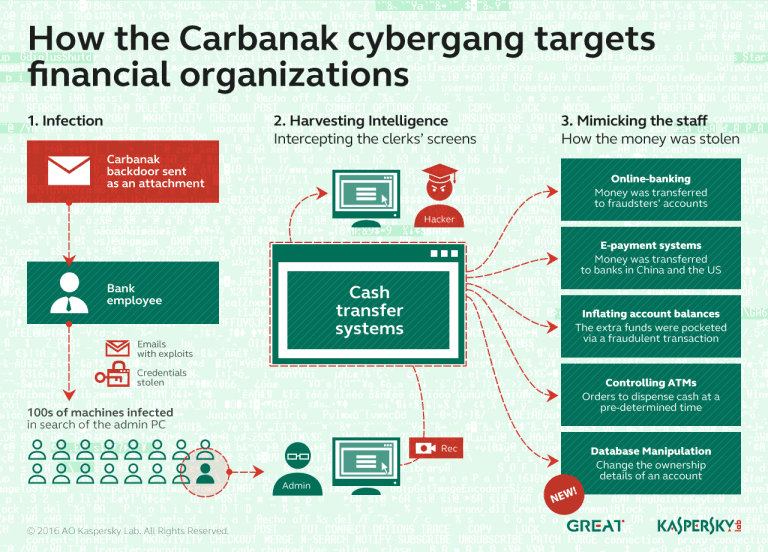
Which is the Carbanak modus operandi?
The infection started with a classic spear phishing attack that allowed Carbanak cybergang to compromise banks’ computer systems. The malicious emails included a link that once clicked triggered the download of the malware.
The malicious code was used by the hackers of the Carbanak cybergang to gather information on the targeted bank, for example, to find employees who were in charge of cash transfer systems or ATMs. In a second phase of the attacks, the hackers installed a remote access tool (RAT) to control the machines of those employees. With this tactic the Carbanak cybergang collected imagines of victims’ screens and study what their daily activity in the bank. At this point, the hackers were able to remotely control the ATMs to dispense money or transfer money to fake accounts.

“The bank’s internal computers, used by employees who process daily transfers and conduct bookkeeping, had been penetrated by malware that allowed cybercriminals to record their every move. The malicious software lurked for months, sending back video feeds and images that told a criminal group — including Russians, Chinese and Europeans — how the bank conducted its daily routines, according to the investigators.
Then the group impersonated bank officers, not only turning on various cash machines, but also transferring millions of dollars from banks in Russia, Japan, Switzerland, the United States and the Netherlands into dummy accounts set up in other countries.” reported the New York Times
| [adrotate banner=”9″] | [adrotate banner=”12″] |
(Security Affairs – cybercrime, Carbanak cybergang)
[adrotate banner=”5″]
[adrotate banner=”13″]


