
Security Affairs
Two Barracuda ESG Flaws Could Be Combined for Full Root Access; Patches Released|Cyberattack Hits French Blood Banks as Hackers Target Refrigeration Systems Across Europe|CVE-2026-58868: Critical Android Bug Could Let Attackers Run Remote Code|U.S. CISA adds WordPress flaw to its Known Exploited Vulnerabilities catalog|Binance Hack: How Fake Job Interviews and AI Abuse Led to a $6.34 Billion Attack|Synology Warns of Ransomware Attacks Targeting NAS Devices Running Outdated DSM Versions|Inside XCPE, the botnet that turned 1.3M set-top boxes into proxy servers|NIS2 Makes Board Members Personally Liable for Access Control Decisions|Apple’s spyware notifications reach the Bundestag: what the BSI says to do now|VOLTA, the infostealer that asks an AI which victims are worth the effort|New wave of fridge cyberattacks hits European supermarkets, this time in Belgium, Luxembourg, Sweden and Estonia|Hackers Send Fake Nuclear Threat Alerts to Ukrainian and Russian Citizens|Two Barracuda ESG Flaws Could Be Combined for Full Root Access; Patches Released|Cyberattack Hits French Blood Banks as Hackers Target Refrigeration Systems Across Europe|CVE-2026-58868: Critical Android Bug Could Let Attackers Run Remote Code|U.S. CISA adds WordPress flaw to its Known Exploited Vulnerabilities catalog|Binance Hack: How Fake Job Interviews and AI Abuse Led to a $6.34 Billion Attack|Synology Warns of Ransomware Attacks Targeting NAS Devices Running Outdated DSM Versions|Inside XCPE, the botnet that turned 1.3M set-top boxes into proxy servers|NIS2 Makes Board Members Personally Liable for Access Control Decisions|Apple’s spyware notifications reach the Bundestag: what the BSI says to do now|VOLTA, the infostealer that asks an AI which victims are worth the effort|New wave of fridge cyberattacks hits European supermarkets, this time in Belgium, Luxembourg, Sweden and Estonia|Hackers Send Fake Nuclear Threat Alerts to Ukrainian and Russian Citizens|
Advertisement

Ad Placeholder

Full Width × 90

Breaking News

Digging the recently leaked Chinese Communist Party database

KELA researchers analyzed a database recently leaked online that contains data for 1.9 million Chinese Communist Party members in Shanghai. After the announcement of the leak of the database which contains the personal information of 1.9 million Chinese Communist Party (CCP) members in Shanghai, KELA researchers have obtained it. This database includes the members’ name, […]

Chinese Communist Party

KELA researchers analyzed a database recently leaked online that contains data for 1.9 million Chinese Communist Party members in Shanghai.

After the announcement of the leak of the database which contains the personal information of 1.9 million Chinese Communist Party (CCP) members in Shanghai, KELA researchers have obtained it. This database includes the members’ name, sex, ethnicity, hometown, organization, ID number, address, mobile number, landline, and education.

Further analysis allowed the experts to determine that the database also includes information of CCP members who worked at foreign consulates in Shanghai, as well as at the Chinese branches of different international banking, pharmaceutical, automotive and defense firms, universities, and research firms.

It is interesting to note that some of the companies in which CCP members were found are Pfizer, AstraZeneca, Airbus, Boeing, HSBC, Rolls-Royce, Jaguar and more. It is important to note that the employment of CCP members in Chinese companies is a known fact – and does not constitute by itself espionage of any sort.

The database was extracted from a server on April 16, 2016 by a local dissident, then a second source, dubbed “the Data Cleaner” uploaded it to activists’ private chat rooms. The “Data Cleaner” converted the database to a Microsoft Excel file on July 3, 2016. According to the README file of the database obtained by the KELA team, the source of the current file is LIHKG (lihkg[.]com) which is a Hong-Kong-based forum, where the database was uploaded on August 18, 2020.

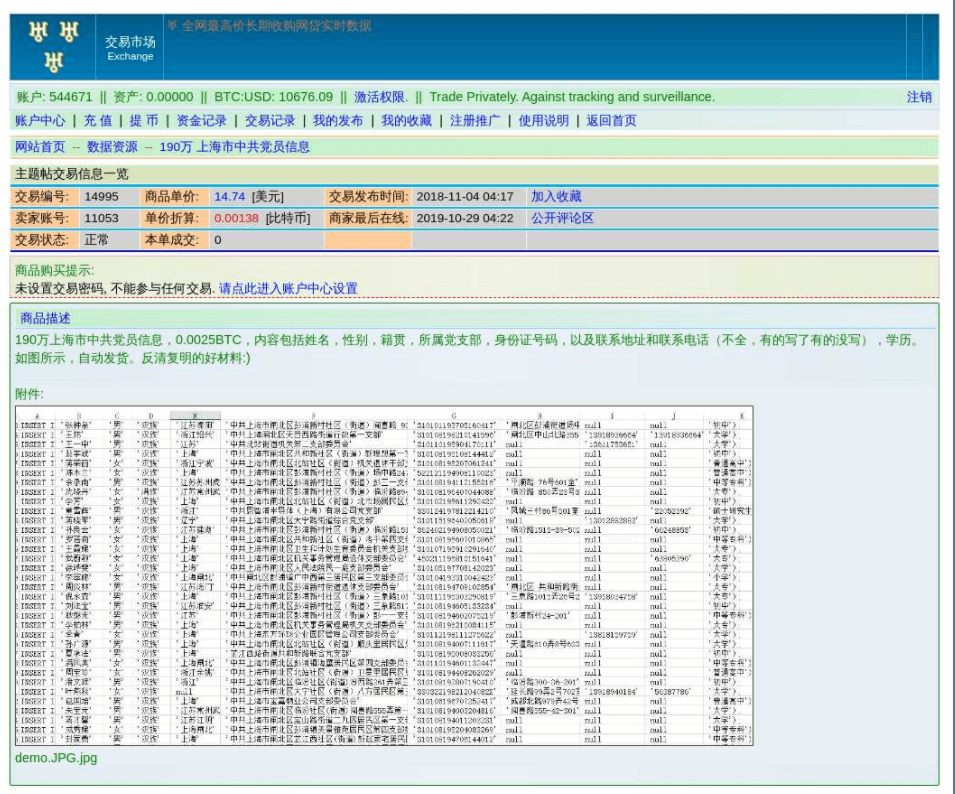
While one might assume that this leaked database is new, it is important to note that the same database has been circulating in Chinese Darknet markets for at least 2 years. Therefore, it is unclear why the database has recently surfaced again. It was first offered for sale on November 4, 2018 on DeepMix market, which is considered as one of the largest and most well-known Chinese Darknet markets. The following is the screenshot of the original offer which was cached by KELA’s systems:    image - 2020-12-16T142551.285.png

[adrotate banner=”9″][adrotate banner=”12″]

Pierluigi Paganini

(SecurityAffairs – hacking, Chinese Communist Party)

[adrotate banner=”5″]

[adrotate banner=”13″]


