
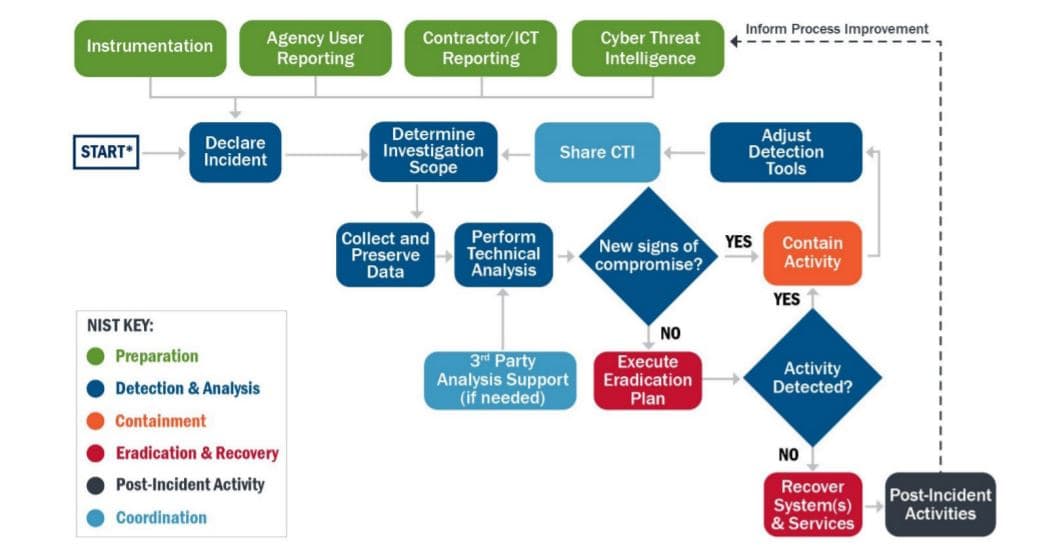
CISA released the Federal Government Cybersecurity Incident Response Playbooks for the federal civilian executive branch agencies.
The Cybersecurity and Infrastructure Security Agency (CISA) has released new cybersecurity response plans for federal civilian executive branch (FCEB) agencies (” Federal Government Cybersecurity Incident and Vulnerability Response Playbooks“).
The documents aim at developing a standard set of operational procedures (i.e., playbook) to be used in planning and conducting cybersecurity vulnerability and incident response activity for federal civilian agency information systems.
“The playbooks provide federal civilian executive branch (FCEB) agencies with operational procedures for planning and conducting cybersecurity incident and vulnerability response activities. The playbooks provide illustrated decision trees and detail each step for both incident and vulnerability response.” reads the announcement.
The definition and adoption of standardized IR procedures allow to drastically reduce the associated risks for impacted organizations.
The document released by CISA presents two playbooks, one for incident response and one for vulnerability response, both developed for FCEB agencies. CISA plans to extend these playbooks for organizations outside of the FCEB to promote a process of standardization of the incident response practices.
The Vulnerability Response Playbook applies to any flaw that is observed to be exploited by threat actors to gain compromise computer networks of the agencies. The playbook builds on CISA’s Binding Operational Directive 22-01 and standardizes the high-level process to address these vulnerabilities.
The playbooks will facilitate better coordination and effective response and enable tracking of cross-organizational successful actions.
“FCEB agencies should use the playbooks to shape their overall defensive cyber operations. The playbooks apply to information systems used or operated by an FCEB agency, a contractor of the agency, or another organization on behalf of the agency. CISA encourages agencies to review the playbooks and CISA’s webpage on EO 14028 for more information.” concludes CISA. “Although CISA created the playbooks for FCEB agencies, we encourage critical infrastructure entities; state, local, territorial, and tribal government organizations; and private sector organizations to review them to benchmark their own vulnerability and incident response practices.”
The incident response playbook has to be used in incidents that involve confirmed malicious cyber activity for which a major incident has been declared or not yet been reasonably ruled out (i.e. Incidents involving lateral movement, credential access, and exfiltration of data, and compromised administrator accounts).
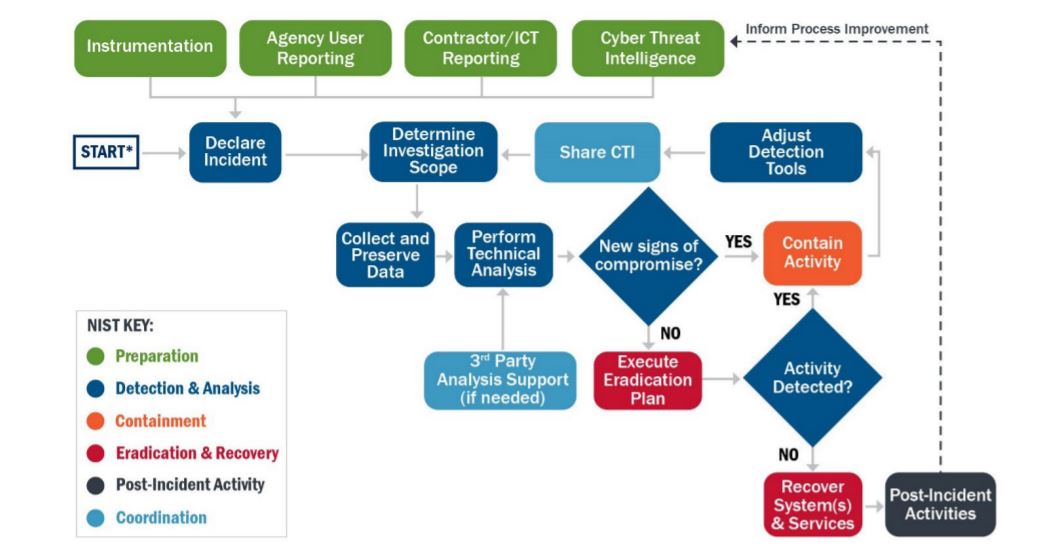
While aimed at federal agencies, CISA also encourages public and private sector partners, including critical infrastructure entities and state, local, territorial, and tribal (SLLT) government organizations, to review them to improve their incident and vulnerability response practices.
“The playbooks we are releasing today are intended to improve and standardize the approaches used by federal agencies to identify, remediate, and recover from vulnerabilities and incidents affecting their systems,” said Matt Hartman, Deputy Executive Assistant Director for Cybersecurity. “This important step, set in motion by President Biden’s Cyber Executive Order, will enable more comprehensive analysis and mitigation of vulnerabilities and incidents across the civilian enterprise. We encourage our public and private sector partners to review the playbooks to take stock of their own vulnerability and incident response practices.”
Follow me on Twitter: @securityaffairs and Facebook
| [adrotate banner=”9″] | [adrotate banner=”12″] |
(SecurityAffairs – hacking, CISA)
[adrotate banner=”5″]
[adrotate banner=”13″]


