
Researchers warn that threat actors started exploiting Citrix ShareFile RCE vulnerability CVE-2023-24489 in the wild.
Citrix ShareFile is a widely used cloud-based file-sharing application, which is affected by the critical remote code execution (RCE) tracked as CVE-2023-24489 (CVSS score of 9.1).
The flaw impacts the customer-managed ShareFile storage zones controller, an unauthenticated, remote attacker can trigger the flaw to compromise the controller by uploading arbitrary file or executing arbitrary code.
Citrix addressed the vulnerability in June 2023 with the release of version 5.11.24.
“A vulnerability has been discovered in the customer-managed ShareFile storage zones controller which, if exploited, could allow an unauthenticated attacker to remotely compromise the customer-managed ShareFile storage zones controller.” the company said in an advisory. “This vulnerability affects all currently supported versions of customer-managed ShareFile storage zones controller before version 5.11.24.”
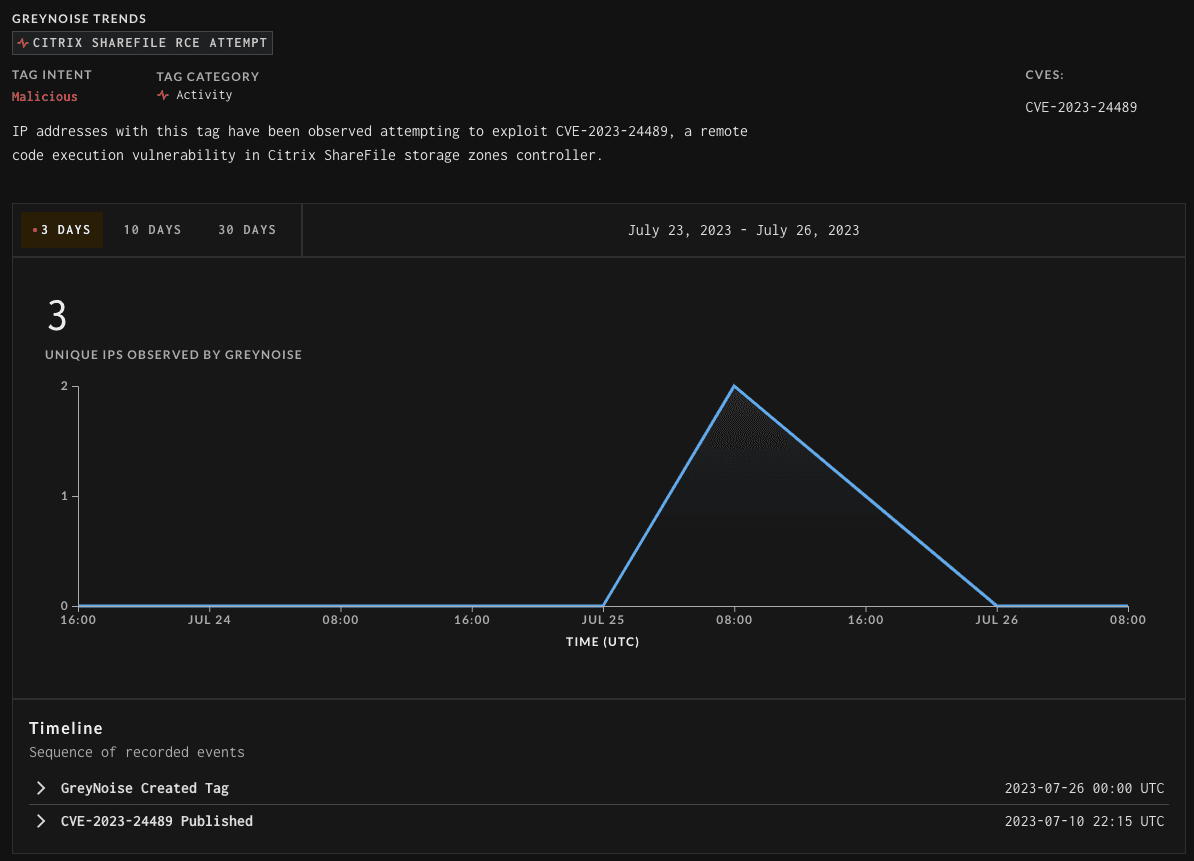
Researchers from threat intelligence firm Greynoise warn of the first attempts to exploit the vulnerability in Citrix ShareFile.
“Attackers can exploit this vulnerability by taking advantage of errors in ShareFile’s handling of cryptographic operations. The application uses AES encryption with CBC mode and PKCS7 padding but does not correctly validate decrypted data.” states Greynoise. “This oversight allows attackers to generate valid padding and execute their attack, leading to unauthenticated arbitrary file upload and remote code execution.”
“As of the publishing timestamp of this post, GreyNoise has observed IPs attempting to exploit this vulnerability. Two have never seen GreyNoise before this activity” adds GreyNoise.

Researchers at the cybersecurity firm Assetnote published technical details of the vulnerability and published proof-of-concept (PoC) code for this flaw.
“A search online shows roughly 1000-6000 instances are internet accessible. This popularity, combined with the software being used to store sensitive data, meant if we found anything it could have quite an impact.” reads the analysis published by Assetnote.
Other PoC exploits have been published online, for this reason, experts warn that the number of attacks exploiting this issue will rapidly increase in the forthcoming days.
“we saw how a few small errors in ShareFile lead to an unauthenticated file upload and then remote code execution. Although the particular endpoint is not enabled in all configurations, it has been common amongst the hosts we have tested.” concludes Assetnote. “Given the number of instances online and the reliability of the exploit, we have already seen a big impact from this vulnerability.”
Follow me on Twitter: @securityaffairs Facebook and Mastodon
(SecurityAffairs – hacking, Citrix ShareFile)


