
Security Affairs
Two Barracuda ESG Flaws Could Be Combined for Full Root Access; Patches Released|Cyberattack Hits French Blood Banks as Hackers Target Refrigeration Systems Across Europe|CVE-2026-58868: Critical Android Bug Could Let Attackers Run Remote Code|U.S. CISA adds WordPress flaw to its Known Exploited Vulnerabilities catalog|Binance Hack: How Fake Job Interviews and AI Abuse Led to a $6.34 Billion Attack|Synology Warns of Ransomware Attacks Targeting NAS Devices Running Outdated DSM Versions|Inside XCPE, the botnet that turned 1.3M set-top boxes into proxy servers|NIS2 Makes Board Members Personally Liable for Access Control Decisions|Apple’s spyware notifications reach the Bundestag: what the BSI says to do now|VOLTA, the infostealer that asks an AI which victims are worth the effort|New wave of fridge cyberattacks hits European supermarkets, this time in Belgium, Luxembourg, Sweden and Estonia|Hackers Send Fake Nuclear Threat Alerts to Ukrainian and Russian Citizens|Two Barracuda ESG Flaws Could Be Combined for Full Root Access; Patches Released|Cyberattack Hits French Blood Banks as Hackers Target Refrigeration Systems Across Europe|CVE-2026-58868: Critical Android Bug Could Let Attackers Run Remote Code|U.S. CISA adds WordPress flaw to its Known Exploited Vulnerabilities catalog|Binance Hack: How Fake Job Interviews and AI Abuse Led to a $6.34 Billion Attack|Synology Warns of Ransomware Attacks Targeting NAS Devices Running Outdated DSM Versions|Inside XCPE, the botnet that turned 1.3M set-top boxes into proxy servers|NIS2 Makes Board Members Personally Liable for Access Control Decisions|Apple’s spyware notifications reach the Bundestag: what the BSI says to do now|VOLTA, the infostealer that asks an AI which victims are worth the effort|New wave of fridge cyberattacks hits European supermarkets, this time in Belgium, Luxembourg, Sweden and Estonia|Hackers Send Fake Nuclear Threat Alerts to Ukrainian and Russian Citizens|
Advertisement

Ad Placeholder

Full Width × 90

Breaking News

Clickjacking Campaign exploits the European Cookie Law

Experts at MalwareBytes discovered a clickjacking campaign that tricks users into clicking on what looks like a legitimate European cookie law notification. Cyber criminals always exploit any opportunity to make profits, news of the day is they are abusing of the legitimate European Cookie Law notices in clever clickjacking campaign. The clickjacking campaign recently discovered […]

Clickjacking Campaign exploits the European Cookie Law

Experts at MalwareBytes discovered a clickjacking campaign that tricks users into clicking on what looks like a legitimate European cookie law notification.

Cyber criminals always exploit any opportunity to make profits, news of the day is they are abusing of the legitimate European Cookie Law notices in clever clickjacking campaign.

The clickjacking campaign recently discovered exploits pop-up alerts that the European Cookie Law is requesting to show to the websites’ visitors.

European websites have to request explicit consent to the users to place a cookie on their computer for commercial purposes, the request is made by displaying a notification pop-up .

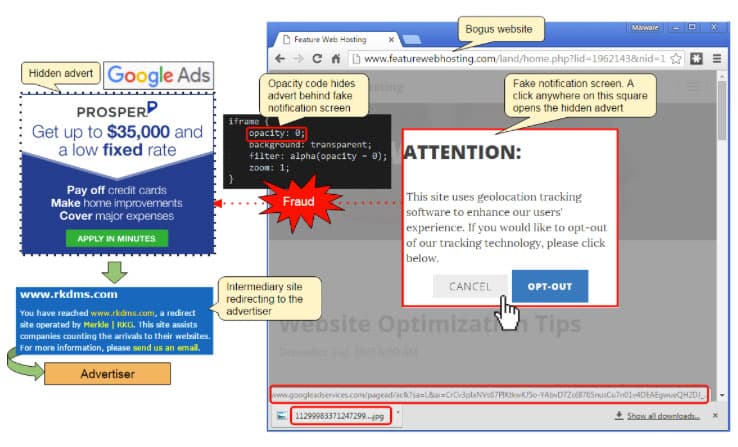
Cyber criminals are exploiting the pop-up by placing a legitimate ad banner on top of the message via an iframe. The crooks deceive the websites’ visitors by using an invisible ad, this is possible by setting the opacity of the frame to zero.

This implies that every time users click on the fake pop-up notification are not aware that they are also clicking on the ad hidden in the message.

clickjacking European cookie law

“The rogue actors behind this fraudulent activity are cleverly leveraging a European law on the use of cookies to seemingly prompt visitors to answer a question.” states a blog post published by Malwarebytes. “While simple, this technique, also known as clickjacking, is pretty effective at generating clicks that look perfectly legitimate and performed by real human beings as opposed to bots.”

“This is costing advertisers and ad networks a lot of money while online crooks are profiting from bogus Pay Per Click traffic.”

The specific clickjacking campaign observed by Malwarebytes is not dangerous for the visitors, but cybercriminals could also exploit the same technique to trick users into clicking on malicious links, redirecting victims on malware hosting exploit kits.

Pierluigi Paganini

(Security Affairs – clickjacking , European Cookie Law)


