Security Affairs
Two Barracuda ESG Flaws Could Be Combined for Full Root Access; Patches Released|Cyberattack Hits French Blood Banks as Hackers Target Refrigeration Systems Across Europe|CVE-2026-58868: Critical Android Bug Could Let Attackers Run Remote Code|U.S. CISA adds WordPress flaw to its Known Exploited Vulnerabilities catalog|Binance Hack: How Fake Job Interviews and AI Abuse Led to a $6.34 Billion Attack|Synology Warns of Ransomware Attacks Targeting NAS Devices Running Outdated DSM Versions|Inside XCPE, the botnet that turned 1.3M set-top boxes into proxy servers|NIS2 Makes Board Members Personally Liable for Access Control Decisions|Apple’s spyware notifications reach the Bundestag: what the BSI says to do now|VOLTA, the infostealer that asks an AI which victims are worth the effort|New wave of fridge cyberattacks hits European supermarkets, this time in Belgium, Luxembourg, Sweden and Estonia|Hackers Send Fake Nuclear Threat Alerts to Ukrainian and Russian Citizens|Two Barracuda ESG Flaws Could Be Combined for Full Root Access; Patches Released|Cyberattack Hits French Blood Banks as Hackers Target Refrigeration Systems Across Europe|CVE-2026-58868: Critical Android Bug Could Let Attackers Run Remote Code|U.S. CISA adds WordPress flaw to its Known Exploited Vulnerabilities catalog|Binance Hack: How Fake Job Interviews and AI Abuse Led to a $6.34 Billion Attack|Synology Warns of Ransomware Attacks Targeting NAS Devices Running Outdated DSM Versions|Inside XCPE, the botnet that turned 1.3M set-top boxes into proxy servers|NIS2 Makes Board Members Personally Liable for Access Control Decisions|Apple’s spyware notifications reach the Bundestag: what the BSI says to do now|VOLTA, the infostealer that asks an AI which victims are worth the effort|New wave of fridge cyberattacks hits European supermarkets, this time in Belgium, Luxembourg, Sweden and Estonia|Hackers Send Fake Nuclear Threat Alerts to Ukrainian and Russian Citizens|
Advertisement

Ad Placeholder

Full Width × 90

Breaking News

Cloudflare mitigates largest-ever DDoS attack at 22.2 Tbps

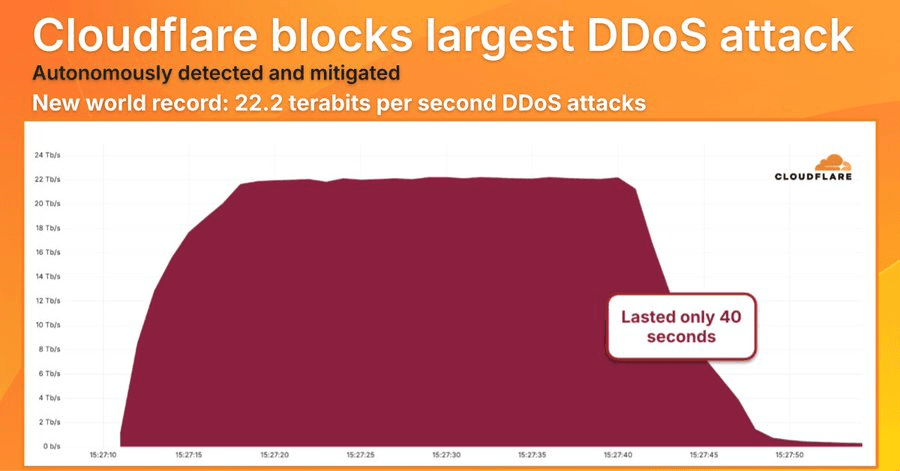
Cloudflare blocked a new record-breaking DDoS attack peaking at 22.2 Tbps and 10.6 billion packets per second. Cloudflare announced it has mitigated a new record-breaking distributed denial-of-service (DDoS) attack that peaked at a record-breaking 22.2 terabits per second (Tbps) and 10.6 billion packets per second (Bpps). Cloudflare has not shared other technical details about the […]

DDoS distributed denial-of-service

Cloudflare blocked a new record-breaking DDoS attack peaking at 22.2 Tbps and 10.6 billion packets per second.

Cloudflare announced it has mitigated a new record-breaking distributed denial-of-service (DDoS) attack that peaked at a record-breaking 22.2 terabits per second (Tbps) and 10.6 billion packets per second (Bpps). Cloudflare has not shared other technical details about the attack.

Cyber security firms like Cloudflare are frequently observing record distributed denial-of-service attacks. In early September, Cloudflare mitigated the largest ever DDoS attack at the time, peaking at 11.5 Tbps. The UDP flood, mainly from Google Cloud, was part of a wave of attacks that lasted several weeks.

In June, Cloudflare announced that during 2025 Q2, it automatically blocked the largest ever reported DDoS attacks, peaking at 7.3 terabits per second (Tbps) and 4.8 billion packets per second (Bpps).

The attack was 12% greater than its previous peak and 1 Tbps greater than the attack reported by the popular cyber journalist Brian Krebs.

The 7.3 Tbps DDoS attack blasted 37.4 TB of data in just 45 seconds, like streaming 9,350 HD movies or downloading 9.35 million songs in under a minute. It’s the data equivalent of a year of nonstop HD video or 4,000 years’ worth of daily high-res photos, all crammed into less than a minute.

Follow me on Twitter: @securityaffairs and Facebook and Mastodon

Pierluigi Paganini

(SecurityAffairs – hacking, distributed denial-of-service)