
Conficker (also known as Downup, Downadup e Kido) is one of the oldest and still active malware, according to Check Point researchers it is “the most prominent family accounting for 14 percent of recognized attacks.”
Conficker is technically a worm that leverages a vulnerability in the Windows Server Service to spread itself, it targets an already-infected computer by using a specially-crafted RPC request to force a buffer overflow and execute shellcode on the target computer.
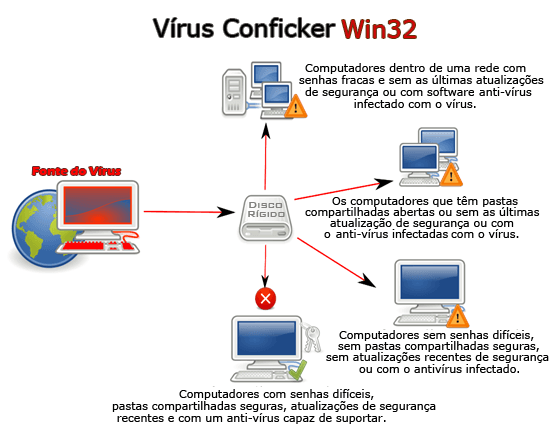
Some other variants of Conficker copy itself into the ADMIN$ share on a computer visible over NetBios service and if the share is protected by a password, I launch a dictionary attack, potentially generating large amounts of network traffic and tripping user account lockout policies.
Following, an image of a classic scenario of that attack:

The first variant of Conficker was discovered in early November 2008, but the threat reached the peak in 2009, when it was estimated to have infected more than three million PCs.
The threat infected big target such as the United Kingdom Ministry of Defence where it compromised over 800 computers, the Bundeswehr, the unified armed forces of Germany, where in 2009 it compromised more than 100 PCs, and the Greater Manchester Police computer network where in 2010 it caused problems for 3 days.
In 2015 iPower company discovered that a police body cameras sold by Martel Electronics were infected with a variant of Conficker.
Microsoft even offered a $250,000 reward for anyone offering information that would lead to Conficker’s creator, but still no one recognize him.
Nowadays, Conflicker represents the most active malware according to the “Top 10 Most Wanted Malware” given by Chek Point researchers:
- Conficker: Type: Worm. Percentage of recognized attacks: 14% ;
- Tinba: Type: Banking Trojan. Percentage of recognized attacks: 9% ;
- Sality: Type: Banking Trojan. Percentage of recognized attacks: 9% ;
- JBossjmx: Type: Worm ;
- Hummingbad: Type: Android Rootkit ;
- Zeroaccess: Type: Worm ;
- Zeus: Type: Banking Trojan ;
- Angler EK: Type: Exploit Kit ;
- Virut: Type: Botnet ;
- Cutwail: Type: Botnet ;
The families belonging to the top ten represent 60% of the recognized attacks at the moment.
According to the Check Point threat index, experts are assisting in a drop-down of the activity related to the Angler EK that caused the diffusion of other exploit kits: the overall EK activity went down 96% compared to April’s levels.
Another point to consider is the fact that in that the above list doesn’t include any ransomware the threat that most of all is characterizing the threat landscape since the diffusion of the first variants of Cryptowall and Teslacrypt.

Written by the IT Security Expert Antonio Cocomazzi
Antonio Cocomazzi is an IT Security Expert specialized in the malware analysis field. Young and recently graduated, he conducts a 6 months research focused on Ransomware giving a full characterization of the recent families defining a new methodology for dissecting this kind of malware.
Follow me on Twitter: @securityaffairs and Facebook
| [adrotate banner=”9″] | [adrotate banner=”12″] |
(Security Affairs – Conficker, worm)
[adrotate banner=”5″]
[adrotate banner=”13″]


