
Security Affairs
Two Barracuda ESG Flaws Could Be Combined for Full Root Access; Patches Released|Cyberattack Hits French Blood Banks as Hackers Target Refrigeration Systems Across Europe|CVE-2026-58868: Critical Android Bug Could Let Attackers Run Remote Code|U.S. CISA adds WordPress flaw to its Known Exploited Vulnerabilities catalog|Binance Hack: How Fake Job Interviews and AI Abuse Led to a $6.34 Billion Attack|Synology Warns of Ransomware Attacks Targeting NAS Devices Running Outdated DSM Versions|Inside XCPE, the botnet that turned 1.3M set-top boxes into proxy servers|NIS2 Makes Board Members Personally Liable for Access Control Decisions|Apple’s spyware notifications reach the Bundestag: what the BSI says to do now|VOLTA, the infostealer that asks an AI which victims are worth the effort|New wave of fridge cyberattacks hits European supermarkets, this time in Belgium, Luxembourg, Sweden and Estonia|Hackers Send Fake Nuclear Threat Alerts to Ukrainian and Russian Citizens|Two Barracuda ESG Flaws Could Be Combined for Full Root Access; Patches Released|Cyberattack Hits French Blood Banks as Hackers Target Refrigeration Systems Across Europe|CVE-2026-58868: Critical Android Bug Could Let Attackers Run Remote Code|U.S. CISA adds WordPress flaw to its Known Exploited Vulnerabilities catalog|Binance Hack: How Fake Job Interviews and AI Abuse Led to a $6.34 Billion Attack|Synology Warns of Ransomware Attacks Targeting NAS Devices Running Outdated DSM Versions|Inside XCPE, the botnet that turned 1.3M set-top boxes into proxy servers|NIS2 Makes Board Members Personally Liable for Access Control Decisions|Apple’s spyware notifications reach the Bundestag: what the BSI says to do now|VOLTA, the infostealer that asks an AI which victims are worth the effort|New wave of fridge cyberattacks hits European supermarkets, this time in Belgium, Luxembourg, Sweden and Estonia|Hackers Send Fake Nuclear Threat Alerts to Ukrainian and Russian Citizens|
Advertisement

Ad Placeholder

Full Width × 90

Breaking News

Thousands of Coronavirus-related malicious domains are being created every day

The Coronavirus-themed attacks continue to increase, experts warn of thousands of COVID-19 scam and malware sites are being created every day. Crooks and nation-state actors continue to exploit the interest of potential victims in the Coronavirus outbreak. In recent weeks, we observed that threat actors are creating thousands of coronavirus-themed websites on a daily basis. […]

coronavirus domains

The Coronavirus-themed attacks continue to increase, experts warn of thousands of COVID-19 scam and malware sites are being created every day.

Crooks and nation-state actors continue to exploit the interest of potential victims in the Coronavirus outbreak.

In recent weeks, we observed that threat actors are creating thousands of coronavirus-themed websites on a daily basis.

The sites are employed in a broad range of attacks, including phishing attacks, frauds, and malware-based attacks.

Since February, we are observing thousands of new Coronavirus-related domains containing keywords like Coronavirus, COVID19, COVID, pandemic, vaccine, virus.

The security researcher who goes online by the name of DustyFresh is one of the experts that monitored the alarmin trend.

The experts published a list containing thousands of COVID19-related domains created between March 14 and March 18, most of them potentially malicious.

The list only analyzed sites containing the word “coronavirus,” clearly extending the search for other terms (i.e. COVID19, vaccine, etc.) and to a longer period, we can find tens of thousands similar websites.

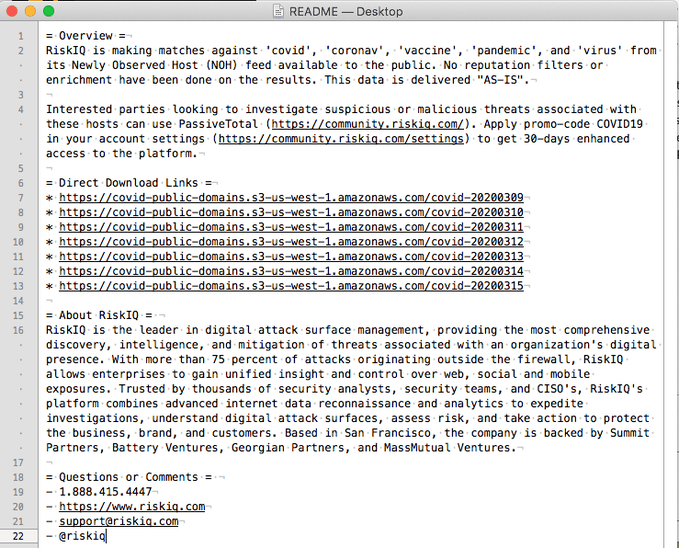
A similar research was conducted by researchers from security firm RiskIQ that shared several lists of COVID19-related malicious domains.

Data reported by RiskIQ are disconcerting, the experts observed more than 13,500 suspicious domains on March 15 and more than 35,000 domains on March 16.

ZDNet proposes a dashboard, which aggregates RiskIQ’s feed and lists domains in real-time, as they’re being discovered.

Security experts from Trend Micro also published an interesting analysis of Coronavirus-themed attacks, they observed a notable increase in domain names using the word “corona.”

[adrotate banner=”9″] [adrotate banner=”12″]

Pierluigi Paganini

(SecurityAffairs – COVID19, hacking)

[adrotate banner=”5″]

[adrotate banner=”13″]


