
Security Affairs
Two Barracuda ESG Flaws Could Be Combined for Full Root Access; Patches Released|Cyberattack Hits French Blood Banks as Hackers Target Refrigeration Systems Across Europe|CVE-2026-58868: Critical Android Bug Could Let Attackers Run Remote Code|U.S. CISA adds WordPress flaw to its Known Exploited Vulnerabilities catalog|Binance Hack: How Fake Job Interviews and AI Abuse Led to a $6.34 Billion Attack|Synology Warns of Ransomware Attacks Targeting NAS Devices Running Outdated DSM Versions|Inside XCPE, the botnet that turned 1.3M set-top boxes into proxy servers|NIS2 Makes Board Members Personally Liable for Access Control Decisions|Apple’s spyware notifications reach the Bundestag: what the BSI says to do now|VOLTA, the infostealer that asks an AI which victims are worth the effort|New wave of fridge cyberattacks hits European supermarkets, this time in Belgium, Luxembourg, Sweden and Estonia|Hackers Send Fake Nuclear Threat Alerts to Ukrainian and Russian Citizens|Two Barracuda ESG Flaws Could Be Combined for Full Root Access; Patches Released|Cyberattack Hits French Blood Banks as Hackers Target Refrigeration Systems Across Europe|CVE-2026-58868: Critical Android Bug Could Let Attackers Run Remote Code|U.S. CISA adds WordPress flaw to its Known Exploited Vulnerabilities catalog|Binance Hack: How Fake Job Interviews and AI Abuse Led to a $6.34 Billion Attack|Synology Warns of Ransomware Attacks Targeting NAS Devices Running Outdated DSM Versions|Inside XCPE, the botnet that turned 1.3M set-top boxes into proxy servers|NIS2 Makes Board Members Personally Liable for Access Control Decisions|Apple’s spyware notifications reach the Bundestag: what the BSI says to do now|VOLTA, the infostealer that asks an AI which victims are worth the effort|New wave of fridge cyberattacks hits European supermarkets, this time in Belgium, Luxembourg, Sweden and Estonia|Hackers Send Fake Nuclear Threat Alerts to Ukrainian and Russian Citizens|
Advertisement

Ad Placeholder

Full Width × 90

Breaking News

Crooks use weaponized coronavirus map to deliver malware

While WHO declares the coronavirus outbreak a pandemic, crooks are attempting to exploit the situation to monetize their efforts. Cybercriminals continue to exploit the fear in the coronavirus outbreak to spread malware and steal sensitive data from victims. Experts from cybersecurity Reason reported cybercrimnals are using new coronavirus-themed attacks to deliver malware. Crooks are targeting […]

Oxford University Lab

While WHO declares the coronavirus outbreak a pandemic, crooks are attempting to exploit the situation to monetize their efforts.

Cybercriminals continue to exploit the fear in the coronavirus outbreak to spread malware and steal sensitive data from victims.

Experts from cybersecurity Reason reported cybercrimnals are using new coronavirus-themed attacks to deliver malware.

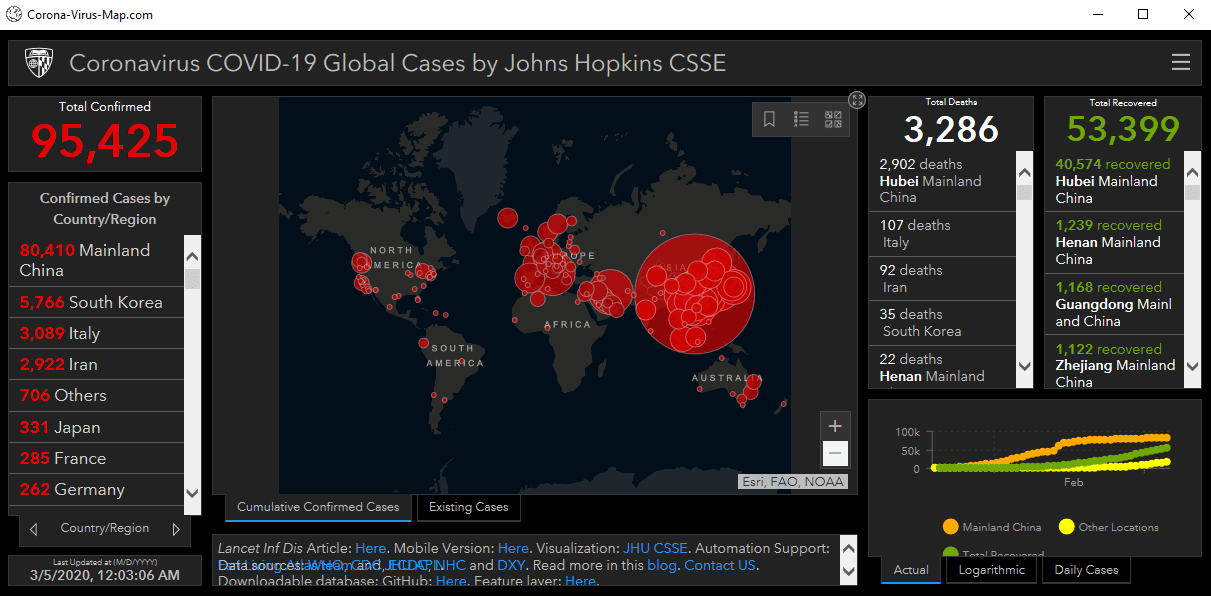
Crooks are targeting users interested in the map representing the infection of COVID-19, in the campaign uncovered by the experts, the attackers are tricking them into downloading and running a malicious application that shows a map loaded from a legit online source.

“This demand creates a vulnerability that malicious actors have quickly taken advantage of by spreading malware disguised as a “Coronavirus map”. reads the analysis published by Reason Labs. “Shai Alfasi, found and analyzed this malware that had weaponized coronavirus map applications in order to steal credentials such as user names, passwords, credit card numbers and other sensitive information that is stored in the users’ browser.”

Attackers are using the weaponized Coronavirus map to steal sensitive and financial data and selling it on the dark web.

Once the victims run the executable, the malware shows a GUI that looks very good and convincing. Upon execution, the GUI window loads information from the Johns Hopkins website, while the malware runs in the background.

“The malware uses a few layers of packing as well as a multi-sub-process technique to make research more difficult. The malware also uses an information-stealing technique, which was first seen in 2016 and related to the “AZORult” malware family. To make sure the malware can persist and keep operating, it uses the “Task Scheduler”.” continues the analysis.

The campaign spotted by the experts aims at spreading the AZORult info stealer, a popular malware that was employed in numerous attacks to steal browsing history, cookies, ID/passwords, cryptocurrency and more.

The malicious code could be used also to download additional malicious payloads onto infected machines.

As the coronavirus continues, coronavirus-themed attacks will continue to target organizations and end-users.

The attack detailed by Reason Labs was first spotted by researchers from MalwareHunterTeam a few days ago.

Reason Labsì report also includes a link to the sample they have analyzed, ‘Corona-virus-Map.com.exe,’ along with indicators of compromise (IoCs).

Experts noticed that upon the execution of the Corona-virus-Map.com.exe, the malware creates duplicates of the Corona-virus-Map.com.exe file and multiple Corona.exe, Bin.exe, Build.exe, and Windows.Globalization.Fontgroups.exe files.

The malware also modifies several register entries under ZoneMap and LanguageList, and creates several mutexes.

Additional technical details are included in the analysis shared by Reason Labs.

[adrotate banner=”9″] [adrotate banner=”12″]

Pierluigi Paganini

(SecurityAffairs – coronavirus, malware)

[adrotate banner=”5″]

[adrotate banner=”13″]


