
Security Affairs
Two Barracuda ESG Flaws Could Be Combined for Full Root Access; Patches Released|Cyberattack Hits French Blood Banks as Hackers Target Refrigeration Systems Across Europe|CVE-2026-58868: Critical Android Bug Could Let Attackers Run Remote Code|U.S. CISA adds WordPress flaw to its Known Exploited Vulnerabilities catalog|Binance Hack: How Fake Job Interviews and AI Abuse Led to a $6.34 Billion Attack|Synology Warns of Ransomware Attacks Targeting NAS Devices Running Outdated DSM Versions|Inside XCPE, the botnet that turned 1.3M set-top boxes into proxy servers|NIS2 Makes Board Members Personally Liable for Access Control Decisions|Apple’s spyware notifications reach the Bundestag: what the BSI says to do now|VOLTA, the infostealer that asks an AI which victims are worth the effort|New wave of fridge cyberattacks hits European supermarkets, this time in Belgium, Luxembourg, Sweden and Estonia|Hackers Send Fake Nuclear Threat Alerts to Ukrainian and Russian Citizens|Two Barracuda ESG Flaws Could Be Combined for Full Root Access; Patches Released|Cyberattack Hits French Blood Banks as Hackers Target Refrigeration Systems Across Europe|CVE-2026-58868: Critical Android Bug Could Let Attackers Run Remote Code|U.S. CISA adds WordPress flaw to its Known Exploited Vulnerabilities catalog|Binance Hack: How Fake Job Interviews and AI Abuse Led to a $6.34 Billion Attack|Synology Warns of Ransomware Attacks Targeting NAS Devices Running Outdated DSM Versions|Inside XCPE, the botnet that turned 1.3M set-top boxes into proxy servers|NIS2 Makes Board Members Personally Liable for Access Control Decisions|Apple’s spyware notifications reach the Bundestag: what the BSI says to do now|VOLTA, the infostealer that asks an AI which victims are worth the effort|New wave of fridge cyberattacks hits European supermarkets, this time in Belgium, Luxembourg, Sweden and Estonia|Hackers Send Fake Nuclear Threat Alerts to Ukrainian and Russian Citizens|
Advertisement

Ad Placeholder

Full Width × 90

Breaking News

Coronavirus news used by Emotet and Trickbot to evade detection

Threat actors exploit the interest in the Coronavirus outbreak while infections increase worldwide, new campaigns aim at spreading TrickBot and Emotet Trojans. Experts warn of new Coronavirus-themed attacks that are spreading TrickBot and Emotet Trojans. Operators behind these campaigns are using new Coronavirus-themed messages to attempt to bypass security software. The trend was first reported […]

coronavirus samples

Threat actors exploit the interest in the Coronavirus outbreak while infections increase worldwide, new campaigns aim at spreading TrickBot and Emotet Trojans.

Experts warn of new Coronavirus-themed attacks that are spreading TrickBot and Emotet Trojans.

Operators behind these campaigns are using new Coronavirus-themed messages to attempt to bypass security software. The trend was first reported by researchers at MalwareHunterTeam a month ago.

Crypters are software used to encrypt, obfuscate, and manipulate malware, to evade detection of solutions that employ machine-learning or artificial intelligence.

Researchers from BleepingComputer discovered that the crypters for TrickBot and Emotet have started using news stories about the Coronavirus outbreak.

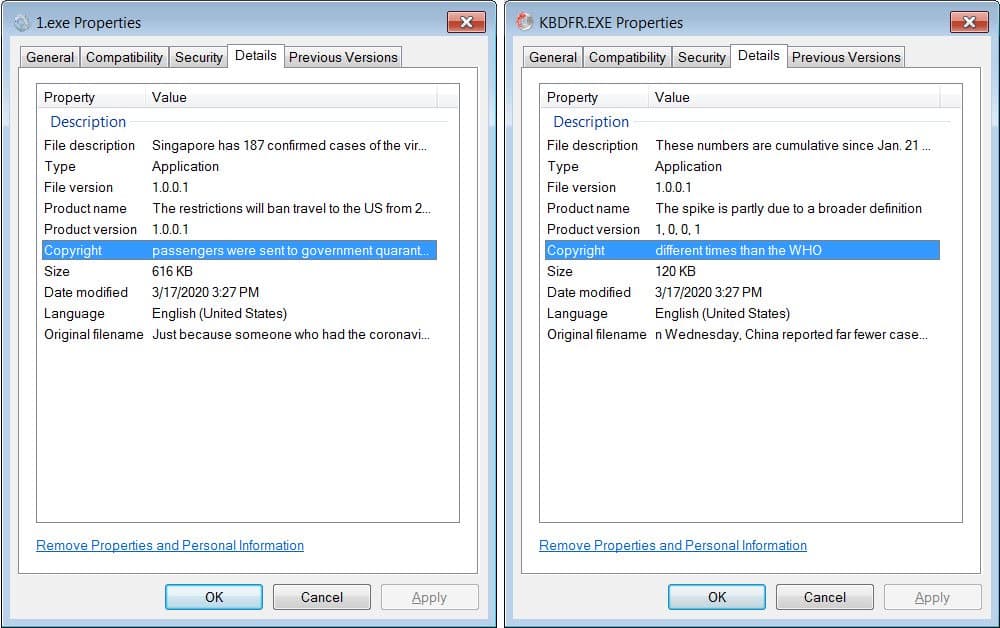
“For example, TrickBot samples seen by BleepingComputer utilizes strings taken from CNN news stories as part of the malware’s file description.” reported BleepingComputer.

Copyright passengers were sent to government quarantine centers
Product The restrictions will ban travel to the US from 26 European countries
Description Singapore has 187 confirmed cases of the virus
Original Name Just because someone who had the coronavirus
Internal Name Just this week, the Grand Princess cruise ship docked
File Version 1.0.0.1 

The researchers also detected an Emotet sample that uses strings from a CNN news story for its file information.

This information is then shown in the Details tab of the malware’s properties as shown below.

The samples created using crypters that employed Coronavirus strings could bypass Artificial Intelligence/Machine Learning systems.

During this period, users should pay attention to any unsolicited Coronavirus-themed emails, here you can find the list of COVID19-themed attacks observed between February 1 and March 15, 2020.

Experts are also warning of thousands of COVID-19 scams and malware sites that are being created every day.

[adrotate banner=”9″] [adrotate banner=”12″]

Pierluigi Paganini

(SecurityAffairs – malware, COVID19)

[adrotate banner=”5″]

[adrotate banner=”13″]


