
Security Affairs
Two Barracuda ESG Flaws Could Be Combined for Full Root Access; Patches Released|Cyberattack Hits French Blood Banks as Hackers Target Refrigeration Systems Across Europe|CVE-2026-58868: Critical Android Bug Could Let Attackers Run Remote Code|U.S. CISA adds WordPress flaw to its Known Exploited Vulnerabilities catalog|Binance Hack: How Fake Job Interviews and AI Abuse Led to a $6.34 Billion Attack|Synology Warns of Ransomware Attacks Targeting NAS Devices Running Outdated DSM Versions|Inside XCPE, the botnet that turned 1.3M set-top boxes into proxy servers|NIS2 Makes Board Members Personally Liable for Access Control Decisions|Apple’s spyware notifications reach the Bundestag: what the BSI says to do now|VOLTA, the infostealer that asks an AI which victims are worth the effort|New wave of fridge cyberattacks hits European supermarkets, this time in Belgium, Luxembourg, Sweden and Estonia|Hackers Send Fake Nuclear Threat Alerts to Ukrainian and Russian Citizens|Two Barracuda ESG Flaws Could Be Combined for Full Root Access; Patches Released|Cyberattack Hits French Blood Banks as Hackers Target Refrigeration Systems Across Europe|CVE-2026-58868: Critical Android Bug Could Let Attackers Run Remote Code|U.S. CISA adds WordPress flaw to its Known Exploited Vulnerabilities catalog|Binance Hack: How Fake Job Interviews and AI Abuse Led to a $6.34 Billion Attack|Synology Warns of Ransomware Attacks Targeting NAS Devices Running Outdated DSM Versions|Inside XCPE, the botnet that turned 1.3M set-top boxes into proxy servers|NIS2 Makes Board Members Personally Liable for Access Control Decisions|Apple’s spyware notifications reach the Bundestag: what the BSI says to do now|VOLTA, the infostealer that asks an AI which victims are worth the effort|New wave of fridge cyberattacks hits European supermarkets, this time in Belgium, Luxembourg, Sweden and Estonia|Hackers Send Fake Nuclear Threat Alerts to Ukrainian and Russian Citizens|
Advertisement

Ad Placeholder

Full Width × 90

Breaking News

New COVID19 wiper overwrites MBR making computers unusable

A recently discovered strain of malware exploits the current COVID19 pandemic to render computers unusable by overwriting the MBR. SonicWall’s security researchers have discovered a new piece of malware that exploits the current COVID19 outbreak to render computers unusable by overwriting the master boot record (MBR). Unfortunately, this is one of the numerous attacks conducted by […]

Johnson & Johnson

A recently discovered strain of malware exploits the current COVID19 pandemic to render computers unusable by overwriting the MBR.

SonicWall’s security researchers have discovered a new piece of malware that exploits the current COVID19 outbreak to render computers unusable by overwriting the master boot record (MBR).

Unfortunately, this is one of the numerous attacks conducted by cyber criminals and nation-state actors in an attempt to take advantage of the COVID19 epidemic.

Among the above threats, researchers also spotted destructive malware, such as the wiper discovered by SonicWall.

“SonicWall Capture Labs Threat Research team recently found a new malware taking advantage of the CoViD19 pandemic which makes disks unusable by overwriting the MBR.” reads the analysis published by the experts.

Upon execution, the wiper drops a series of helper files into a temporary folder, including a BAT file named “coronovirus Installer,” which is responsible for most of the setup work.

The BAT file creates a hidden folder named COVID-19, then move the dropped files to it.

The ‘coronavirus installer’ disables Windows Task Manager and User Access Control (UAC), then changes the desktop wallpaper and disables the options that allow the user to add or modify wallpapers. The malware gains persistence by using registry entries.

The malware then notifies the victim that the installation has been completed and that it is to reboot the system.

“run.exe creates a batch file named run.bat to ensure the registry modifications done by “coronavirus.bat” are kept intact besides facilitating execution of “mainWindow.exe”.” continues the analysis.

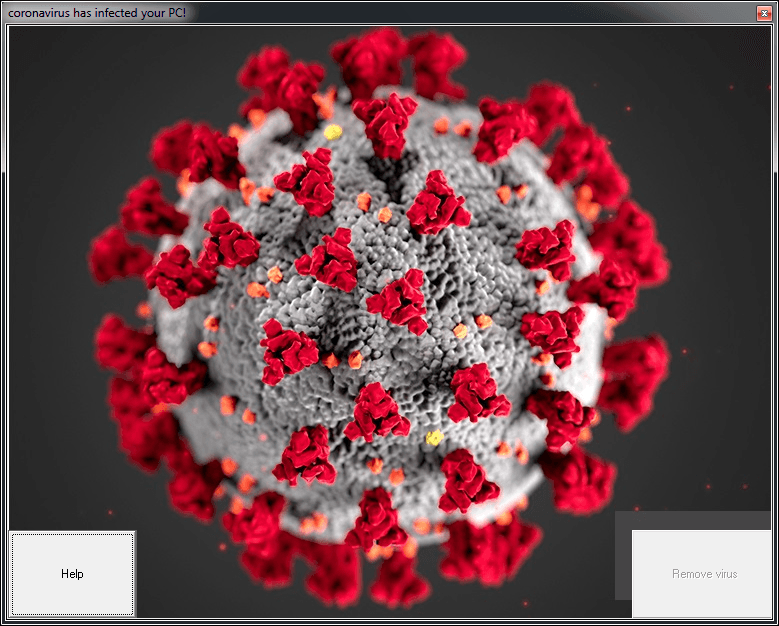
Once executed, MainWindow.exe file displays a window showing the structure of COVID19 virus with two buttons, “Remove virus,” which is not working and the “Help” button.

Once clicked on the Help button, the malicious code will inform the user that the computer was infected.

Upon rebooting the computer, a binary is executed to overwrite the MBR after it has created a backup of the original MBR in the first sector. The malware writes a message on sector 2 of the disk that reads “Created by Angel Castillo. Your Computer Has Been Trashed.”

When the computer reboots, the above message is displayed to the victims.

[adrotate banner=”9″][adrotate banner=”12″]

Pierluigi Paganini

(SecurityAffairs – malware, Coronavirus wiper)

[adrotate banner=”5″]

[adrotate banner=”13″]


