
Security Affairs
Two Barracuda ESG Flaws Could Be Combined for Full Root Access; Patches Released|Cyberattack Hits French Blood Banks as Hackers Target Refrigeration Systems Across Europe|CVE-2026-58868: Critical Android Bug Could Let Attackers Run Remote Code|U.S. CISA adds WordPress flaw to its Known Exploited Vulnerabilities catalog|Binance Hack: How Fake Job Interviews and AI Abuse Led to a $6.34 Billion Attack|Synology Warns of Ransomware Attacks Targeting NAS Devices Running Outdated DSM Versions|Inside XCPE, the botnet that turned 1.3M set-top boxes into proxy servers|NIS2 Makes Board Members Personally Liable for Access Control Decisions|Apple’s spyware notifications reach the Bundestag: what the BSI says to do now|VOLTA, the infostealer that asks an AI which victims are worth the effort|New wave of fridge cyberattacks hits European supermarkets, this time in Belgium, Luxembourg, Sweden and Estonia|Hackers Send Fake Nuclear Threat Alerts to Ukrainian and Russian Citizens|Two Barracuda ESG Flaws Could Be Combined for Full Root Access; Patches Released|Cyberattack Hits French Blood Banks as Hackers Target Refrigeration Systems Across Europe|CVE-2026-58868: Critical Android Bug Could Let Attackers Run Remote Code|U.S. CISA adds WordPress flaw to its Known Exploited Vulnerabilities catalog|Binance Hack: How Fake Job Interviews and AI Abuse Led to a $6.34 Billion Attack|Synology Warns of Ransomware Attacks Targeting NAS Devices Running Outdated DSM Versions|Inside XCPE, the botnet that turned 1.3M set-top boxes into proxy servers|NIS2 Makes Board Members Personally Liable for Access Control Decisions|Apple’s spyware notifications reach the Bundestag: what the BSI says to do now|VOLTA, the infostealer that asks an AI which victims are worth the effort|New wave of fridge cyberattacks hits European supermarkets, this time in Belgium, Luxembourg, Sweden and Estonia|Hackers Send Fake Nuclear Threat Alerts to Ukrainian and Russian Citizens|
Advertisement

Ad Placeholder

Full Width × 90

Breaking News

CryptoWall 4.0 Released with a New Look and Several New Features

The fourth member of the CryptoWall family of ransomware, CryptoWall 4.0, has just been released, complete with new features and a brand new look. We recently reported that CryptoWall 3.0 has allegedly caused over $325 million in annual damages. CryptoWall first emerged in April 2014. Its first major upgrade was dubbed CryptoWall 2.0, and first emerged in October […]

CryptoWall 4.0 Released with a New Look and Several New Features

The fourth member of the CryptoWall family of ransomware, CryptoWall 4.0, has just been released, complete with new features and a brand new look.

We recently reported that CryptoWall 3.0 has allegedly caused over $325 million in annual damages. CryptoWall first emerged in April 2014. Its first major upgrade was dubbed CryptoWall 2.0, and first emerged in October 2014. CryptoWall 3.0 then emerged in January 2015 and terrorized organizations on a global scale. Now, in November 2015, CryptoWall 4.0 has emerged.

New Features

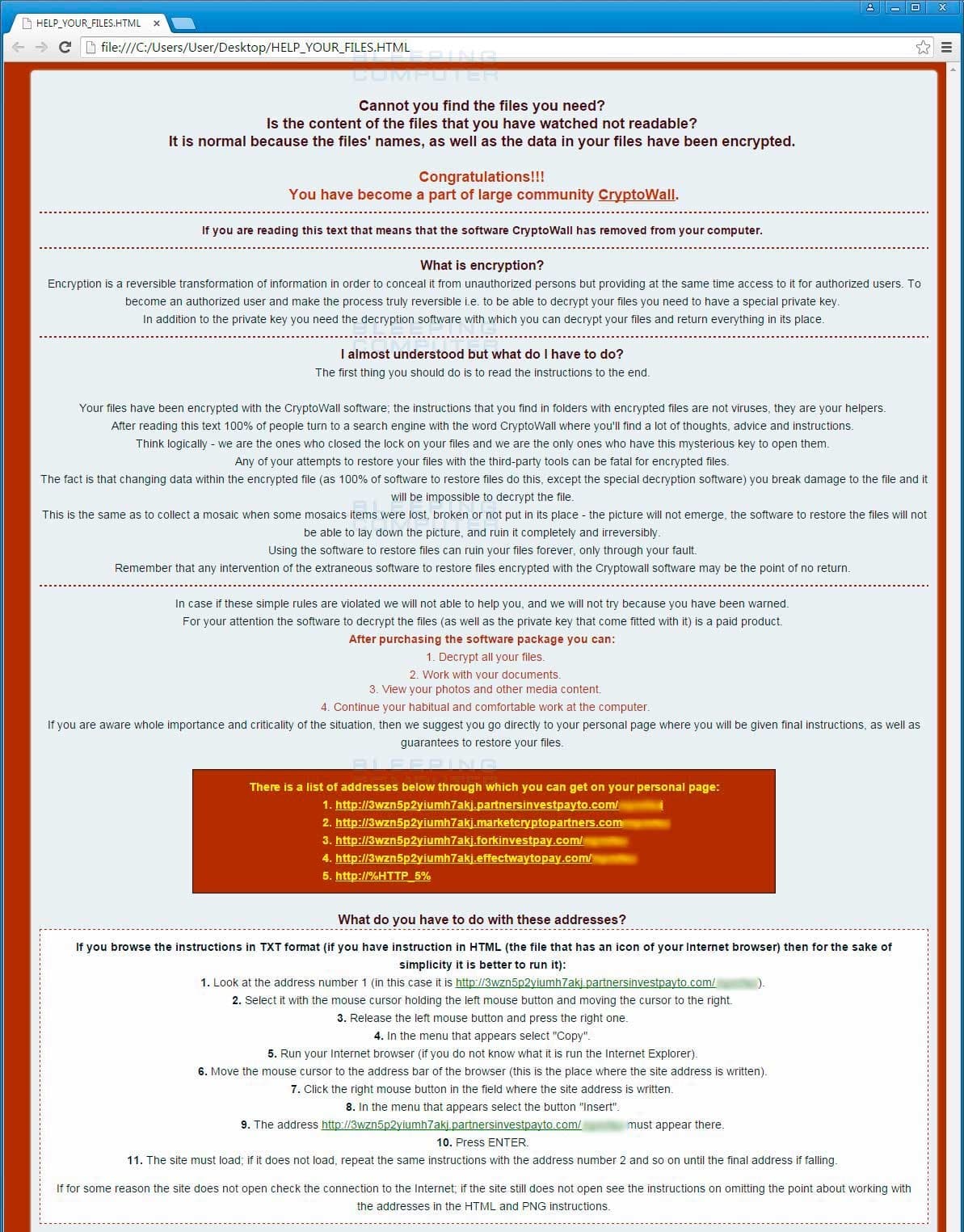
New features such as the encryption of the names and extensions of affected files have emerged with the 4th member of the CryptoWall family. Additionally, CryptoWall 4.0 has changed the name of its ransom notes to HELP_YOUR_FILES.TXTand HELP_YOUR_FILES.HTML.

The ransom note itself contains payment instructions and also mocks the infected user.

CryptoWall 4.0

Spread Method

The initially reported sample, provided by an infected user on the Bleeping Computer forums, was spread via e-mail through phishing e-mails with ZIP archive attachments claiming to be resumes. The file within the ZIP archive is a JavaScript file, that is obfuscated and beautified that downloads the CryptoWall 4.0 payload from a hard-coded URL.

CryptoWall 4.0 2

However, it’s likely that exploit kits will begin to deliver CW4 as a payload very soon, if they are not already (especially the Angler EK).

Technical Information

The C&C communication and behavioural activity of CryptoWall 4.0’s payload is quite similar to its earlier versions. The specific sample that I have analyzed performed the following actions, as can be evidenced by the below images.

Contacted Domains

CryptoWall 4.0 3 CryptoWall 4.0 4

Added Files

CryptoWall 4.0 5

Deleted Files

CryptoWall 4.0 6

Modified Files

CryptoWall 4.0 7

Added Registry Keys

CryptoWall 4.0 8

Process Tree

  • INITIAL SAMPLE
    • exe
      • exe -k netsvcs
        • EXE “C:UsersAdministratorDesktopHELP_YOUR_FILES.TXT”
        • exe “C:UsersAdministratorDesktopHELP_YOUR_FILES.HTML”
      • exe Delete Shadows /All /Quiet


About the Author Michael Fratello

Michael Fratello is a Senior Security Engineer employed by CipherTechs, Inc., a privately held information security services provider located in downtown Manhattan, New York.  Specializing in Penetration Testing and Digital Forensics, Michael, a St. John’s University graduate majoring in Computer Security Systems, has developed a passion for information security and often spends his free time studying, programming, and researching the exponentially growing number of threats found in-the-wild today.

Edited by Pierluigi Paganini

(Security Affairs –  CryptoWall 4.0, ransomware)


