
Security Affairs
Two Barracuda ESG Flaws Could Be Combined for Full Root Access; Patches Released|Cyberattack Hits French Blood Banks as Hackers Target Refrigeration Systems Across Europe|CVE-2026-58868: Critical Android Bug Could Let Attackers Run Remote Code|U.S. CISA adds WordPress flaw to its Known Exploited Vulnerabilities catalog|Binance Hack: How Fake Job Interviews and AI Abuse Led to a $6.34 Billion Attack|Synology Warns of Ransomware Attacks Targeting NAS Devices Running Outdated DSM Versions|Inside XCPE, the botnet that turned 1.3M set-top boxes into proxy servers|NIS2 Makes Board Members Personally Liable for Access Control Decisions|Apple’s spyware notifications reach the Bundestag: what the BSI says to do now|VOLTA, the infostealer that asks an AI which victims are worth the effort|New wave of fridge cyberattacks hits European supermarkets, this time in Belgium, Luxembourg, Sweden and Estonia|Hackers Send Fake Nuclear Threat Alerts to Ukrainian and Russian Citizens|Two Barracuda ESG Flaws Could Be Combined for Full Root Access; Patches Released|Cyberattack Hits French Blood Banks as Hackers Target Refrigeration Systems Across Europe|CVE-2026-58868: Critical Android Bug Could Let Attackers Run Remote Code|U.S. CISA adds WordPress flaw to its Known Exploited Vulnerabilities catalog|Binance Hack: How Fake Job Interviews and AI Abuse Led to a $6.34 Billion Attack|Synology Warns of Ransomware Attacks Targeting NAS Devices Running Outdated DSM Versions|Inside XCPE, the botnet that turned 1.3M set-top boxes into proxy servers|NIS2 Makes Board Members Personally Liable for Access Control Decisions|Apple’s spyware notifications reach the Bundestag: what the BSI says to do now|VOLTA, the infostealer that asks an AI which victims are worth the effort|New wave of fridge cyberattacks hits European supermarkets, this time in Belgium, Luxembourg, Sweden and Estonia|Hackers Send Fake Nuclear Threat Alerts to Ukrainian and Russian Citizens|
Advertisement

Ad Placeholder

Full Width × 90

Breaking News

CVE-2025-11371: Unpatched zero-day in Gladinet CentreStack, Triofox under attack

Threat actors are exploiting a zero-day, tracked as CVE-2025-11371 in Gladinet CentreStack and Triofox products. Threat actors are exploiting the local File Inclusion (LFI) flaw CVE-2025-11371, a zero-day in Gladinet CentreStack and Triofox. A local user can exploit the issue to access system files without authentication. Gladinet CentreStack and Triofox are enterprise file-sharing and cloud […]

Gladinet CentreStack and Triofox

a

Threat actors are exploiting a zero-day, tracked as CVE-2025-11371 in Gladinet CentreStack and Triofox products.

Threat actors are exploiting the local File Inclusion (LFI) flaw CVE-2025-11371, a zero-day in Gladinet CentreStack and Triofox. A local user can exploit the issue to access system files without authentication.

Gladinet CentreStack and Triofox are enterprise file-sharing and cloud storage solutions designed for businesses:

  • CentreStack: Provides a secure platform for file sharing, syncing, and collaboration, integrating on-premises storage with cloud access. It allows companies to offer cloud-like access to internal file servers while maintaining control over data.
  • Triofox: Offers a hybrid cloud solution that enables secure remote access to existing Windows file shares and SMB/NFS storage. It includes features like file versioning, synchronization, and web/mobile access, without moving data from the company’s servers.

Both are used to manage corporate files securely while supporting remote work and collaboration.

Experts are aware of the existence of mitigations, but warn that the issue has yet to be patched.

“In earlier versions of CentreStack and Triofox vulnerable to CVE-2025-30406, a hardcoded machine key would allow a threat actor to perform remote code execution via a ViewState deserialization vulnerability.” reads the report published by Huntress. “After subsequent analysis, Huntress discovered exploitation of an unauthenticated local file inclusion vulnerability (CVE-2025-11371) that allowed a threat actor to retrieve the machine key from the application Web.config file to perform remote code execution via the aforementioned ViewState deserialization vulnerability.”

Gladinet and Huntress have alerted customers to a workaround for the actively exploited CVE-2025-11371 flaw. The cybersecurity firm reported that at least three customers have been targeted so far.

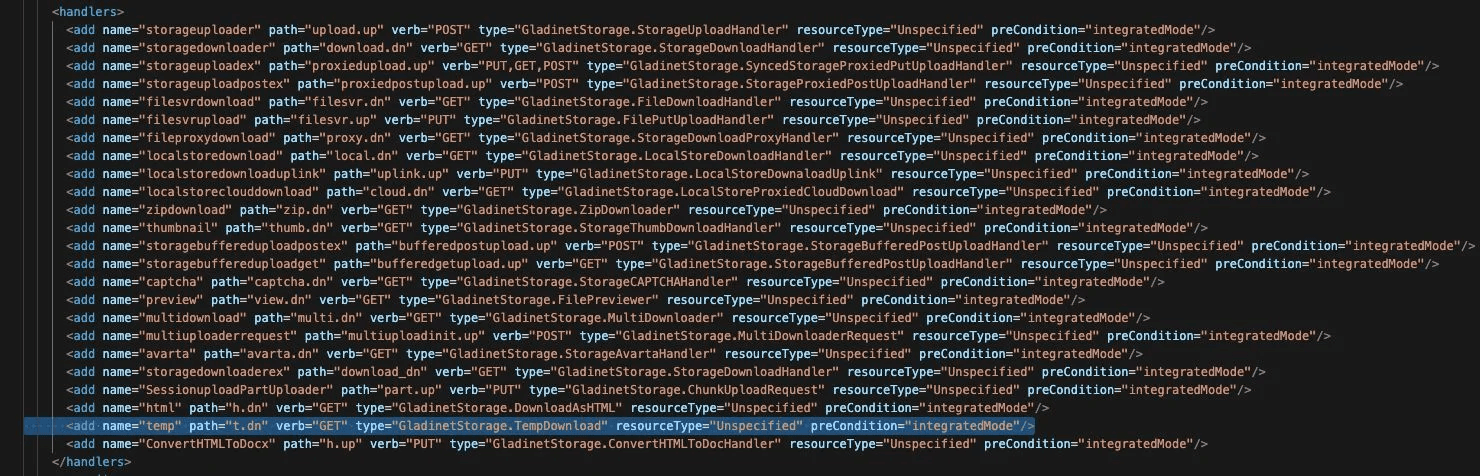
The company recommends disabling the temp handler in UploadDownloadProxy’s Web.config to block exploitation of the vulnerability, though some platform functionality will be affected.

Gladinet CentreStack and Triofox
A visual of the temp handler pointing to t.dn, which can be disabled as a mitigation (Source Huntress)

“Removing the line highlighted above will mitigate the vulnerability present until such time as a patch can be applied.” concludes the report.

Follow me on Twitter: @securityaffairs and Facebook and Mastodon

Pierluigi Paganini

(SecurityAffairs – hacking, Gladinet)


