
Security Affairs
Two Barracuda ESG Flaws Could Be Combined for Full Root Access; Patches Released|Cyberattack Hits French Blood Banks as Hackers Target Refrigeration Systems Across Europe|CVE-2026-58868: Critical Android Bug Could Let Attackers Run Remote Code|U.S. CISA adds WordPress flaw to its Known Exploited Vulnerabilities catalog|Binance Hack: How Fake Job Interviews and AI Abuse Led to a $6.34 Billion Attack|Synology Warns of Ransomware Attacks Targeting NAS Devices Running Outdated DSM Versions|Inside XCPE, the botnet that turned 1.3M set-top boxes into proxy servers|NIS2 Makes Board Members Personally Liable for Access Control Decisions|Apple’s spyware notifications reach the Bundestag: what the BSI says to do now|VOLTA, the infostealer that asks an AI which victims are worth the effort|New wave of fridge cyberattacks hits European supermarkets, this time in Belgium, Luxembourg, Sweden and Estonia|Hackers Send Fake Nuclear Threat Alerts to Ukrainian and Russian Citizens|Two Barracuda ESG Flaws Could Be Combined for Full Root Access; Patches Released|Cyberattack Hits French Blood Banks as Hackers Target Refrigeration Systems Across Europe|CVE-2026-58868: Critical Android Bug Could Let Attackers Run Remote Code|U.S. CISA adds WordPress flaw to its Known Exploited Vulnerabilities catalog|Binance Hack: How Fake Job Interviews and AI Abuse Led to a $6.34 Billion Attack|Synology Warns of Ransomware Attacks Targeting NAS Devices Running Outdated DSM Versions|Inside XCPE, the botnet that turned 1.3M set-top boxes into proxy servers|NIS2 Makes Board Members Personally Liable for Access Control Decisions|Apple’s spyware notifications reach the Bundestag: what the BSI says to do now|VOLTA, the infostealer that asks an AI which victims are worth the effort|New wave of fridge cyberattacks hits European supermarkets, this time in Belgium, Luxembourg, Sweden and Estonia|Hackers Send Fake Nuclear Threat Alerts to Ukrainian and Russian Citizens|
Advertisement

Ad Placeholder

Full Width × 90

Breaking News

Credentials for cybercrime forums found on roughly 120K computers infected with info stealers

Researchers discovered credentials associated with cybercrime forums on roughly 120,000 computers infected with information stealers. Threat intelligence firm Hudson Rock has discovered credentials associated with cybercrime forums on roughly 120,000 computers infected with various information stealer malware. The experts discovered that many of these computers, compromised between 2018 to 2023, belong to threat actors. The […]

cybercrime forums

Researchers discovered credentials associated with cybercrime forums on roughly 120,000 computers infected with information stealers.

Threat intelligence firm Hudson Rock has discovered credentials associated with cybercrime forums on roughly 120,000 computers infected with various information stealer malware. The experts discovered that many of these computers, compromised between 2018 to 2023, belong to threat actors.

The researchers analyzed a database of more than 14.5 million computers infected with info-stealers.

The researchers were able to uncover the real identities of the hackers based on indicators such as additional credentials found on the computers (additional emails, usernames), auto-fill data containing personal information (names, addresses, phone numbers), and system information.

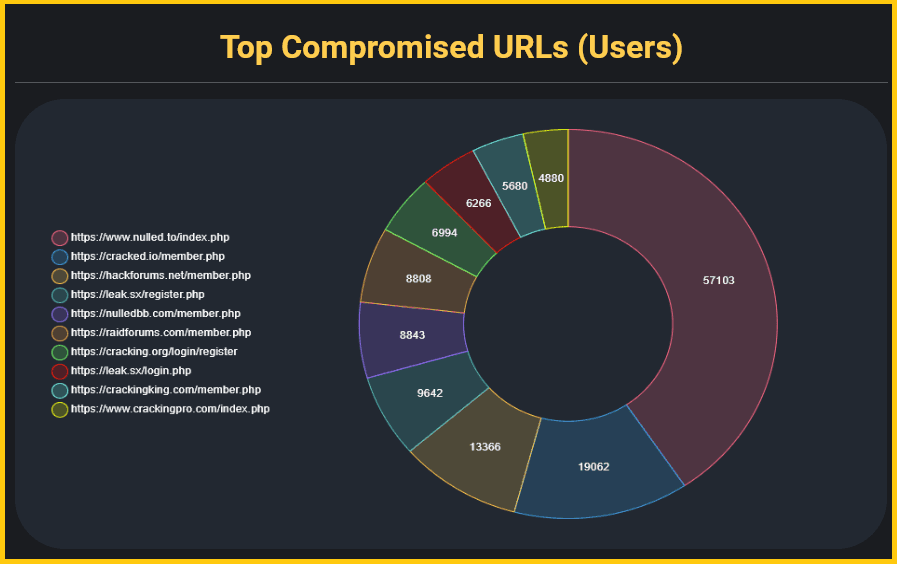
The researchers discovered that the cybercrime forum with the highest number of infected users is “Nulled.to” (57,203), followed by “Cracked.io” (19,062) and “Hackforums.net” (13,366).

cybercrime forums

The analysis of the passwords of users revealed that forum with the strongest user passwords is “Breached.to.”

The expers noticed that the passwords from Cybercrime forums are stronger than passwords used for Government websites.

Most of the infections are attributed to Redline, followed by Raccoon and Azorult. The top 5 countries (Normalized) from which hackers were infected and had at least 1 credential to a cybercrime forum are:

  1. Tunisia (7.55% of total infections in the country)
  2. Malaysia (6%% of total infections in the country)
  3. Belgium (5.14% of total infections in the country)
  4. Netherlands (4.8% of total infections in the country)
  5. Israel (4.43% of total infections in the country)

“Info-stealer infections as a cybercrime trend surged by an incredible 6000% since 2018, positioning them as the primary initial attack vector used by threat actors to infiltrate organizations and execute cyberattacks, including ransomware, data breaches, account overtakes, and corporate espionage.” concludes the report published by Hudson Rock.

Follow me on Twitter: @securityaffairs and Facebook and Mastodon

Pierluigi Paganini

(SecurityAffairs – hacking, cybercrime forums)


