
Security Affairs
Cyberattack Hits French Blood Banks as Hackers Target Refrigeration Systems Across Europe|CVE-2026-58868: Critical Android Bug Could Let Attackers Run Remote Code|U.S. CISA adds WordPress flaw to its Known Exploited Vulnerabilities catalog|Binance Hack: How Fake Job Interviews and AI Abuse Led to a $6.34 Billion Attack|Synology Warns of Ransomware Attacks Targeting NAS Devices Running Outdated DSM Versions|Inside XCPE, the botnet that turned 1.3M set-top boxes into proxy servers|NIS2 Makes Board Members Personally Liable for Access Control Decisions|Apple’s spyware notifications reach the Bundestag: what the BSI says to do now|VOLTA, the infostealer that asks an AI which victims are worth the effort|New wave of fridge cyberattacks hits European supermarkets, this time in Belgium, Luxembourg, Sweden and Estonia|Hackers Send Fake Nuclear Threat Alerts to Ukrainian and Russian Citizens|Chainalysis Investigates Security Incident Involving AI-Driven Attack Techniques|Cyberattack Hits French Blood Banks as Hackers Target Refrigeration Systems Across Europe|CVE-2026-58868: Critical Android Bug Could Let Attackers Run Remote Code|U.S. CISA adds WordPress flaw to its Known Exploited Vulnerabilities catalog|Binance Hack: How Fake Job Interviews and AI Abuse Led to a $6.34 Billion Attack|Synology Warns of Ransomware Attacks Targeting NAS Devices Running Outdated DSM Versions|Inside XCPE, the botnet that turned 1.3M set-top boxes into proxy servers|NIS2 Makes Board Members Personally Liable for Access Control Decisions|Apple’s spyware notifications reach the Bundestag: what the BSI says to do now|VOLTA, the infostealer that asks an AI which victims are worth the effort|New wave of fridge cyberattacks hits European supermarkets, this time in Belgium, Luxembourg, Sweden and Estonia|Hackers Send Fake Nuclear Threat Alerts to Ukrainian and Russian Citizens|Chainalysis Investigates Security Incident Involving AI-Driven Attack Techniques|
Advertisement

Ad Placeholder

Full Width × 90

Breaking News

D-Link firmware accidentally includes Code Signing Keys

The Taiwanese networking equipment manufacturer D-Link has accidentally published its private code signing keys in the source of one of its firmware update. According to the Dutch news site Tweakers, the Taiwan-based networking equipment manufacturer D-Link accidently published its private code signing keys inside its open source firmware packages. One of the readers of the Dutch news […]

D-Link firmware accidentally includes Code Signing Keys

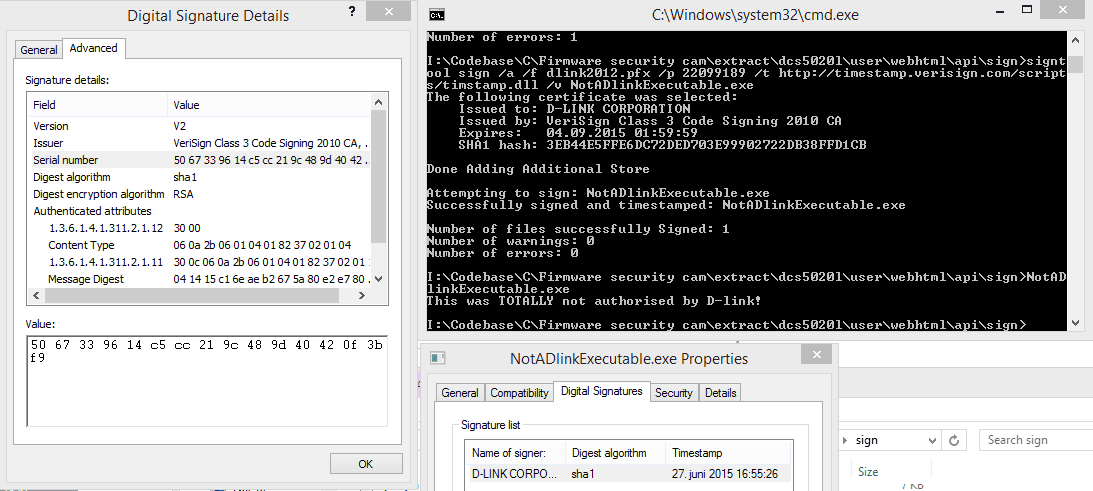
The Taiwanese networking equipment manufacturer D-Link has accidentally published its private code signing keys in the source of one of its firmware update.

According to the Dutch news site Tweakers, the Taiwan-based networking equipment manufacturer D-Link accidently published its private code signing keys inside its open source firmware packages.

One of the readers of the Dutch news site reported, “bartvbl,”  reported the serious issues after he had bought a D-Link DCS-5020L security camera and downloaded the firmware from the official website of D-Link.

D-Link open sources its firmware under the GPL license allowing anyone to analyze it. bartvbl has discovered four different private keys used for code signing.

The reader also discovered other three private code signing keys that appear to be not valid and  pass-phrases needed to sign the software.

The disconcerting discovery was confirmed by the security expert Yonathan Klijnsma from security firm Fox-IT.

“The code signing certificate is indeed a firmware package, firmware version 1.00b03, who’s source was released February 27 this year,” explained the expert.

Why the access to the code signing keys is so important?

Malware creators use to steal valid code signing certificates to sign the source code of their malware and evade detection of security firms.

code signing keys D-Link

At the time I was writing, it is still unclear whether the code signing private keys have been used by threat actors to sign their malicious code signing certificate, and released a new version of the firmware that doesn’t contain any code signing keys.

Pierluigi Paganini

(Security Affairs – code signing keys, D-Link)


