
Security Affairs
Two Barracuda ESG Flaws Could Be Combined for Full Root Access; Patches Released|Cyberattack Hits French Blood Banks as Hackers Target Refrigeration Systems Across Europe|CVE-2026-58868: Critical Android Bug Could Let Attackers Run Remote Code|U.S. CISA adds WordPress flaw to its Known Exploited Vulnerabilities catalog|Binance Hack: How Fake Job Interviews and AI Abuse Led to a $6.34 Billion Attack|Synology Warns of Ransomware Attacks Targeting NAS Devices Running Outdated DSM Versions|Inside XCPE, the botnet that turned 1.3M set-top boxes into proxy servers|NIS2 Makes Board Members Personally Liable for Access Control Decisions|Apple’s spyware notifications reach the Bundestag: what the BSI says to do now|VOLTA, the infostealer that asks an AI which victims are worth the effort|New wave of fridge cyberattacks hits European supermarkets, this time in Belgium, Luxembourg, Sweden and Estonia|Hackers Send Fake Nuclear Threat Alerts to Ukrainian and Russian Citizens|Two Barracuda ESG Flaws Could Be Combined for Full Root Access; Patches Released|Cyberattack Hits French Blood Banks as Hackers Target Refrigeration Systems Across Europe|CVE-2026-58868: Critical Android Bug Could Let Attackers Run Remote Code|U.S. CISA adds WordPress flaw to its Known Exploited Vulnerabilities catalog|Binance Hack: How Fake Job Interviews and AI Abuse Led to a $6.34 Billion Attack|Synology Warns of Ransomware Attacks Targeting NAS Devices Running Outdated DSM Versions|Inside XCPE, the botnet that turned 1.3M set-top boxes into proxy servers|NIS2 Makes Board Members Personally Liable for Access Control Decisions|Apple’s spyware notifications reach the Bundestag: what the BSI says to do now|VOLTA, the infostealer that asks an AI which victims are worth the effort|New wave of fridge cyberattacks hits European supermarkets, this time in Belgium, Luxembourg, Sweden and Estonia|Hackers Send Fake Nuclear Threat Alerts to Ukrainian and Russian Citizens|
Advertisement

Ad Placeholder

Full Width × 90

Breaking News

Avast released a decryptor for DoNex Ransomware and its predecessors

Avast developed and released a decryptor for the DoNex ransomware family that allows victims to recover their files for free. Avast researchers identified a cryptographic flaw in the DoNex ransomware and its predecessors that allowed them to develop a decryptor. The experts revealed the weakness during the Recon 2024 conference. Avast also released a decryptor […]

DoNex ransomware

Avast developed and released a decryptor for the DoNex ransomware family that allows victims to recover their files for free.

Avast researchers identified a cryptographic flaw in the DoNex ransomware and its predecessors that allowed them to develop a decryptor. The experts revealed the weakness during the Recon 2024 conference.

Avast also released a decryptor that allows victims to recover their files for free since March 2024.

“All brands of the DoNex ransomware are supported by the decryptor.” reads the announcement. “DoNex uses targeted attacks on its victims and it was most active in the US, Italy, and Belgium based on our telemetry.”

In cooperation with law enforcement, the company has been silently providing the decryptor to the victims to prevent ransomware author to learn about the way the decryptor was developed.

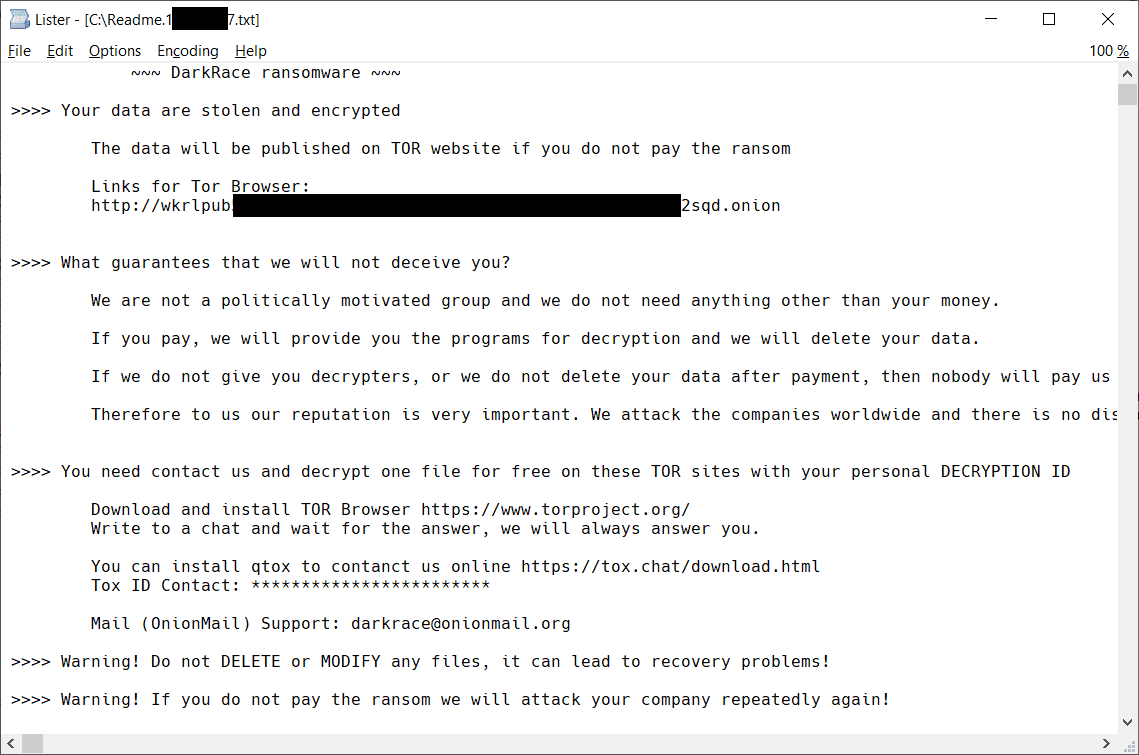
DoNex is a rebrand of Muse and DarkRace ransomware, it first appeared in the threat landscape in April 2022. 

DoNex ransomware

Upon execution, an encryption key is generated by CryptGenRandom() function. The malicious code uses the key to initialize ChaCha20 symmetric key and subsequently encrypt files. Once a file is encrypted, the symmetric file key is encrypted by RSA-4096 and appended to the end of the file. The files are picked by their extension, and file extensions are listed in the ransomware XML config.

Like other ransomware, the entire file is encrypted for small files (up to 1 MB). For files greater than 1MB, the ransomware uses intermittent encryption. Each file is split into blocks that are encrypted separately.

Samples of the DoNex ransomware and its previous versions contain XOR-encrypted configurations. These configurations include settings for whitelisted extensions, whitelisted files, services to kill, and other encryption-related data.

The decryptor for DoNex ransomware is available for free here. The researchers strongly recommend using the 64-bit version of the decryption tool because the password-cracking process requires a lot of memory.

As usual, experts recommend backing up encrypted files before using the decryption tool in case anything goes wrong during the decryption process.

The researchers also provided Indicators of Compromise (IOCs) for this threat.

Pierluigi Paganini

Follow me on Twitter: @securityaffairs and Facebook and Mastodon

(SecurityAffairs – hacking, ransomware)


