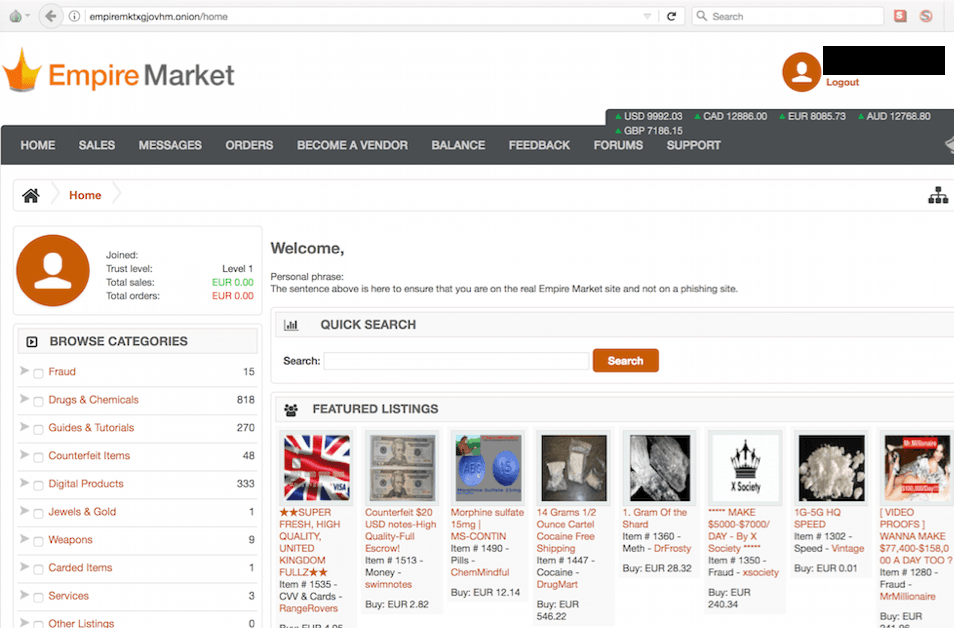
Federal authorities charged two individuals with operating the dark web marketplace Empire Market that facilitated over $430 million in illegal transactions.
Two men, Thomas Pavey (aka “Dopenugget”) and Raheim Hamilton (aka “Sydney” and “Zero Angel”), have been charged in federal court in Chicago for operating the dark web marketplace “Empire Market” from 2018 to 2020.
According to the indictment, the duo was previously involved in selling counterfeit U.S. currency on AlphaBay before starting Empire Market.
The two men are accused of having facilitated over four million transactions for a total value of more than $430 million, involving illegal goods and services. The authorities charged them with various crimes, including drug trafficking, computer fraud, access device fraud, counterfeiting, and money laundering, which carry a maximum sentence of life in federal prison. Pavey and Hamilton are currently in U.S. law enforcement custody, with arraignments yet to be scheduled.
“THOMAS PAVEY, also known as “Dopenugget,” 38, of Ormond Beach, Fla., and RAHEIM HAMILTON, also known as “Sydney” and “Zero Angel,” 28, of Suffolk, Va., owned and operated Empire Market from 2018 to 2020, during which time they facilitated approximately four million transactions between vendors and buyers valued at more than $430 million, according to a superseding indictment returned Thursday in U.S. District Court in Chicago.” reads the press release published by DoJ. “They began operating Empire Market on Feb. 1, 2018, the indictment states.”
The dark web marketplace Empire Market featured multiple categories of illicit goods such as illegal drugs, counterfeit items, Software & Malware, and credit card numbers, it allowed its users to pay using Bitcoin (BTC), Monero (XMR), and Litecoin (LTC).
The dark web marketplace shut down in 2020, leaving users without time to withdraw funds from their escrow accounts, at the time some users blamed a prolonged denial-of-service (DDoS) attack, while others suspected an exit scam.
The two operators used cryptocurrency to conceal the nature and identities involved in the illicit transactions and encouraged users to use “tumbling” services, which mix and exchange cryptocurrencies to obscure their origin and connection to the marketplace.
During the investigation, the feds seized $75 million worth of cryptocurrency at the time of the seizures, as well as cash and precious metals.
Pavey and Hamilton face charges for five counts:
- Conspiracy to sell counterfeit U.S. currency on AlphaBay.
- Conspiracy to distribute controlled substances through Empire Market.
- Conspiracy to possess unauthorized access devices.
- Conspiracy to sell counterfeit currency on Empire Market.
- Conspiracy to commit money laundering to conceal proceeds from illegal activities.
The two men can face a maximum sentence of life in federal prison.
Follow me on Twitter: @securityaffairs and Facebook and Mastodon
(SecurityAffairs – hacking, Empire Market)