
Security Affairs
Two Barracuda ESG Flaws Could Be Combined for Full Root Access; Patches Released|Cyberattack Hits French Blood Banks as Hackers Target Refrigeration Systems Across Europe|CVE-2026-58868: Critical Android Bug Could Let Attackers Run Remote Code|U.S. CISA adds WordPress flaw to its Known Exploited Vulnerabilities catalog|Binance Hack: How Fake Job Interviews and AI Abuse Led to a $6.34 Billion Attack|Synology Warns of Ransomware Attacks Targeting NAS Devices Running Outdated DSM Versions|Inside XCPE, the botnet that turned 1.3M set-top boxes into proxy servers|NIS2 Makes Board Members Personally Liable for Access Control Decisions|Apple’s spyware notifications reach the Bundestag: what the BSI says to do now|VOLTA, the infostealer that asks an AI which victims are worth the effort|New wave of fridge cyberattacks hits European supermarkets, this time in Belgium, Luxembourg, Sweden and Estonia|Hackers Send Fake Nuclear Threat Alerts to Ukrainian and Russian Citizens|Two Barracuda ESG Flaws Could Be Combined for Full Root Access; Patches Released|Cyberattack Hits French Blood Banks as Hackers Target Refrigeration Systems Across Europe|CVE-2026-58868: Critical Android Bug Could Let Attackers Run Remote Code|U.S. CISA adds WordPress flaw to its Known Exploited Vulnerabilities catalog|Binance Hack: How Fake Job Interviews and AI Abuse Led to a $6.34 Billion Attack|Synology Warns of Ransomware Attacks Targeting NAS Devices Running Outdated DSM Versions|Inside XCPE, the botnet that turned 1.3M set-top boxes into proxy servers|NIS2 Makes Board Members Personally Liable for Access Control Decisions|Apple’s spyware notifications reach the Bundestag: what the BSI says to do now|VOLTA, the infostealer that asks an AI which victims are worth the effort|New wave of fridge cyberattacks hits European supermarkets, this time in Belgium, Luxembourg, Sweden and Estonia|Hackers Send Fake Nuclear Threat Alerts to Ukrainian and Russian Citizens|
Advertisement

Ad Placeholder

Full Width × 90

Breaking News

FBI training document shows lawful access to multiple encrypted messaging apps

Which are the most secure encrypted messaging apps? An FBI document shows what data can be obtained from them. The Record shared an FBI training document that reveals the surveillance capabilities of the US law enforcement detailing which data can be extracted from encrypted messaging apps. The document analyzes lawful access to multiple encrypted messaging […]

FBI training document shows lawful access to multiple encrypted messaging apps

Which are the most secure encrypted messaging apps? An FBI document shows what data can be obtained from them.

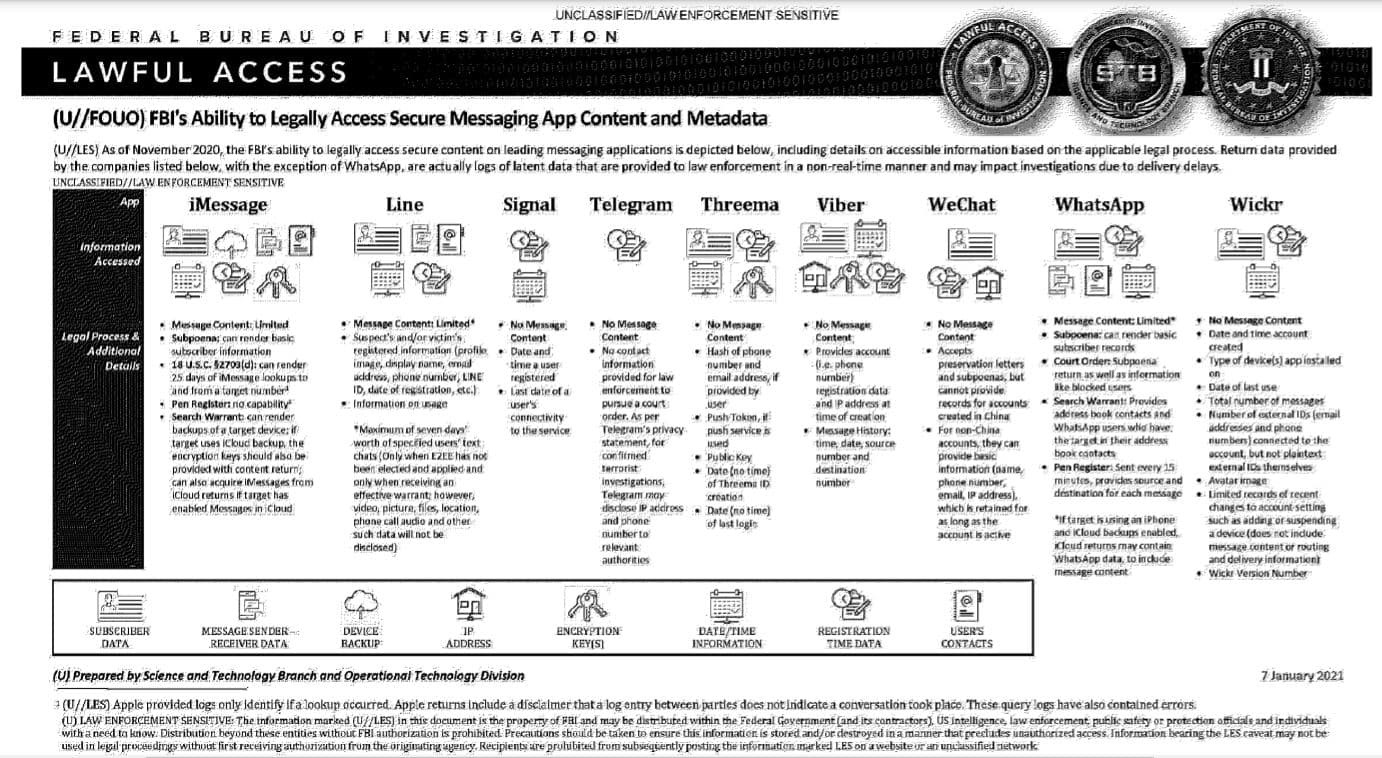
The Record shared an FBI training document that reveals the surveillance capabilities of the US law enforcement detailing which data can be extracted from encrypted messaging apps.

The document analyzes lawful access to multiple encrypted messaging apps, including iMessage, Line, Signal, Telegram, Threema, Viber, WhatsApp, WeChat, or Wickr.

Source Property of the People

The above document, dated to January 7, 2021, was obtained through a FOIA request filed by the US nonprofit organization Property of the People.

“As of November2020, the FBl’s ability to legally access secure content on leading messaging applications is depicted below, including details on accessible information based on-the applicable legal process. Return data provided
by the companies listed below, with the exception of WhatsApp, are actually logs of latent data that are provided to law enforcement in a non-real-time manner and may impact investigations due to delivery delays.” reads the document.
“

The information reported in the training documents provides an up to date picture of the abilities of law enforcement in accessing the content of popular messaging apps.

Feds cannot access the message content for Signal, Telegram, Threema, Viber, WeChat, and Wickr, while they can gain limited access to the content of encrypted communications from iMessage, Line, and WhatsApp.

Anyway, depending on the single encrypted messaging apps, law enforcement could extract varying metadata that could allow unmasking the end-users.

Follow me on Twitter: @securityaffairs and Facebook

[adrotate banner=”9″][adrotate banner=”12″]

Pierluigi Paganini

(SecurityAffairs – hacking, messaging apps)

[adrotate banner=”5″]

[adrotate banner=”13″]


