
Security Affairs
Two Barracuda ESG Flaws Could Be Combined for Full Root Access; Patches Released|Cyberattack Hits French Blood Banks as Hackers Target Refrigeration Systems Across Europe|CVE-2026-58868: Critical Android Bug Could Let Attackers Run Remote Code|U.S. CISA adds WordPress flaw to its Known Exploited Vulnerabilities catalog|Binance Hack: How Fake Job Interviews and AI Abuse Led to a $6.34 Billion Attack|Synology Warns of Ransomware Attacks Targeting NAS Devices Running Outdated DSM Versions|Inside XCPE, the botnet that turned 1.3M set-top boxes into proxy servers|NIS2 Makes Board Members Personally Liable for Access Control Decisions|Apple’s spyware notifications reach the Bundestag: what the BSI says to do now|VOLTA, the infostealer that asks an AI which victims are worth the effort|New wave of fridge cyberattacks hits European supermarkets, this time in Belgium, Luxembourg, Sweden and Estonia|Hackers Send Fake Nuclear Threat Alerts to Ukrainian and Russian Citizens|Two Barracuda ESG Flaws Could Be Combined for Full Root Access; Patches Released|Cyberattack Hits French Blood Banks as Hackers Target Refrigeration Systems Across Europe|CVE-2026-58868: Critical Android Bug Could Let Attackers Run Remote Code|U.S. CISA adds WordPress flaw to its Known Exploited Vulnerabilities catalog|Binance Hack: How Fake Job Interviews and AI Abuse Led to a $6.34 Billion Attack|Synology Warns of Ransomware Attacks Targeting NAS Devices Running Outdated DSM Versions|Inside XCPE, the botnet that turned 1.3M set-top boxes into proxy servers|NIS2 Makes Board Members Personally Liable for Access Control Decisions|Apple’s spyware notifications reach the Bundestag: what the BSI says to do now|VOLTA, the infostealer that asks an AI which victims are worth the effort|New wave of fridge cyberattacks hits European supermarkets, this time in Belgium, Luxembourg, Sweden and Estonia|Hackers Send Fake Nuclear Threat Alerts to Ukrainian and Russian Citizens|
Advertisement

Ad Placeholder

Full Width × 90

Breaking News

ESXi ransomware attacks use SSH tunnels to avoid detection

Threat actors behind ESXi ransomware attacks target virtualized environments using SSH tunneling to avoid detection. Researchers at cybersecurity firm Sygnia warn that threat actors behind ESXi ransomware attacks target virtualized environments using SSH tunneling to avoid detection. Ransomware groups are exploiting unmonitored ESXi appliances to persist and access corporate networks. They use “living-off-the-land” techniques, leveraging […]

ESXi ransomware attacks

Threat actors behind ESXi ransomware attacks target virtualized environments using SSH tunneling to avoid detection.

Researchers at cybersecurity firm Sygnia warn that threat actors behind ESXi ransomware attacks target virtualized environments using SSH tunneling to avoid detection.

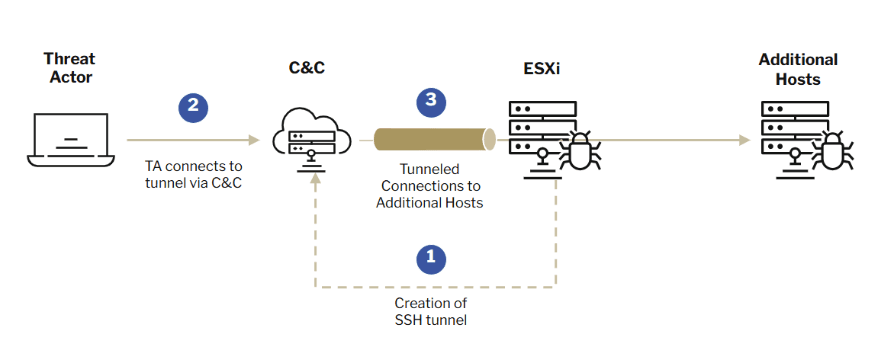
Ransomware groups are exploiting unmonitored ESXi appliances to persist and access corporate networks. They use “living-off-the-land” techniques, leveraging native tools like SSH to create undetected SOCKS tunnels for communication with C2 servers.

The researcher reported that in many cases, attackers compromised the ESXi appliances either by using administrative credentials or by exploiting a known vulnerability to bypass the authentication. 

Once gained access to the device, attackers set up the tunneling using the native SSH functionality or by deploying other common tools with similar capabilities.

ESXi appliances’ resilience makes them ideal for tunneling, providing a semi-persistent backdoor within the network.

ESXi ransomware attacks

ESXi appliances splits logs into multiple files by activity, complicating forensic investigations and monitoring activities. Configuring log forwarding is essential to streamline monitoring and centralize event capture.

“While ESXi does support a few third-party monitoring or telemetry agents, such tools are limited in availability. As a more comprehensive and cost-effective solution, configuring syslog forwarding from the ESXi server to an external syslog server can solve the issue. This setup enables centralized monitoring of all activities within the ESXi server and serves as a means of log retention.” reads the Sygnia report.

“The following key log files are the most important ESXi telemetry files that will often assist with detecting and investigating an attack using SSH tunneling techniques on the appliance: 

  • /var/log/vobd.log (VMware observer daemon log) “
  • /var/log/shell.log (ESXi shell activity log) 
  • /var/log/hostd.log (Host agent log) 
  • /var/log/auth.log (authentication log) “

The report provided multiple examples of common activities and messages found in ESXi syslog files  that might be associated to malicious activity. 

Follow me on Twitter: @securityaffairs and Facebook and Mastodon

Pierluigi Paganini

(SecurityAffairs – hacking, ESXi ransomware attacks)


