
Security Affairs
Two Barracuda ESG Flaws Could Be Combined for Full Root Access; Patches Released|Cyberattack Hits French Blood Banks as Hackers Target Refrigeration Systems Across Europe|CVE-2026-58868: Critical Android Bug Could Let Attackers Run Remote Code|U.S. CISA adds WordPress flaw to its Known Exploited Vulnerabilities catalog|Binance Hack: How Fake Job Interviews and AI Abuse Led to a $6.34 Billion Attack|Synology Warns of Ransomware Attacks Targeting NAS Devices Running Outdated DSM Versions|Inside XCPE, the botnet that turned 1.3M set-top boxes into proxy servers|NIS2 Makes Board Members Personally Liable for Access Control Decisions|Apple’s spyware notifications reach the Bundestag: what the BSI says to do now|VOLTA, the infostealer that asks an AI which victims are worth the effort|New wave of fridge cyberattacks hits European supermarkets, this time in Belgium, Luxembourg, Sweden and Estonia|Hackers Send Fake Nuclear Threat Alerts to Ukrainian and Russian Citizens|Two Barracuda ESG Flaws Could Be Combined for Full Root Access; Patches Released|Cyberattack Hits French Blood Banks as Hackers Target Refrigeration Systems Across Europe|CVE-2026-58868: Critical Android Bug Could Let Attackers Run Remote Code|U.S. CISA adds WordPress flaw to its Known Exploited Vulnerabilities catalog|Binance Hack: How Fake Job Interviews and AI Abuse Led to a $6.34 Billion Attack|Synology Warns of Ransomware Attacks Targeting NAS Devices Running Outdated DSM Versions|Inside XCPE, the botnet that turned 1.3M set-top boxes into proxy servers|NIS2 Makes Board Members Personally Liable for Access Control Decisions|Apple’s spyware notifications reach the Bundestag: what the BSI says to do now|VOLTA, the infostealer that asks an AI which victims are worth the effort|New wave of fridge cyberattacks hits European supermarkets, this time in Belgium, Luxembourg, Sweden and Estonia|Hackers Send Fake Nuclear Threat Alerts to Ukrainian and Russian Citizens|
Advertisement

Ad Placeholder

Full Width × 90

Breaking News

Experts released a free decryptor for Everbe Ransomware

Researchers have released a decryptor tool that could be used by victims of the Everbe Ransomware to decrypt their files for free. Good news for the victims of the Everbe Ransomware, the popular malware researchers Michael Gillespie and Maxime Meignan have released a decryptor that could be used by victims to decrypt their files for free. The Everbe Ransomware encrypts files […]

Experts released a free decryptor for Everbe Ransomware

Taken from BleepingComputer.com

Researchers have released a decryptor tool that could be used by victims of the Everbe Ransomware to decrypt their files for free.

Good news for the victims of the Everbe Ransomware, the popular malware researchers Michael Gillespie and Maxime Meignan have released a decryptor that could be used by victims to decrypt their files for free.

The Everbe Ransomware encrypts files and appends the .[everbe@airmail.cc].everbe, .embrace, or .pain extensions appended to the encrypted file’s name.

In order to decrypt the files, victims need to have an unencrypted version of an encrypted file, then they can use them to brute force the decryption key.

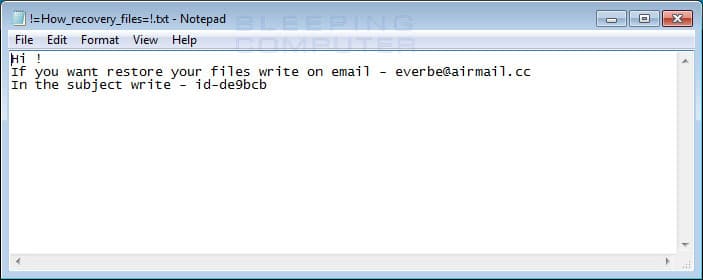
When the malware infects a machine, it drops a ransom note in each folder containing encrypted files. The note titled !=How_recovery_files=!.txt contains the instructions to start payment process, the victims must send an email everbe@airmail.cc for payment instructions.

Now victims can use the InsaneCrypt Decryptor to restore their files, they have to select the menù item “Settings” and choose “Bruteforcer”.

In order to decrypt the files, it is necessary to provide the tool both encrypted and unencrypted versions of the files.

Once the process is completed, the decryptor will have found the decryption key that the tool uses to restore files.

When the decryption process has finished, the decryptor will display a summary of the total amount of files that have been decrypted.

“Though your files are now decrypted, the original encrypted files will still be on your computer. Once you confirm that your files have been properly decrypted, you can use CryptoSearch to move all the encrypted files into one folder so you can delete or archive them.” explained Lawrence Abrams from BleepingComputer.com.

[adrotate banner=”9″] [adrotate banner=”12″]

Pierluigi Paganini

(Security Affairs – Everbe Ransomware, decryptor)

[adrotate banner=”5″]

[adrotate banner=”13″]


