
Security Affairs
Cyberattack Hits French Blood Banks as Hackers Target Refrigeration Systems Across Europe|CVE-2026-58868: Critical Android Bug Could Let Attackers Run Remote Code|U.S. CISA adds WordPress flaw to its Known Exploited Vulnerabilities catalog|Binance Hack: How Fake Job Interviews and AI Abuse Led to a $6.34 Billion Attack|Synology Warns of Ransomware Attacks Targeting NAS Devices Running Outdated DSM Versions|Inside XCPE, the botnet that turned 1.3M set-top boxes into proxy servers|NIS2 Makes Board Members Personally Liable for Access Control Decisions|Apple’s spyware notifications reach the Bundestag: what the BSI says to do now|VOLTA, the infostealer that asks an AI which victims are worth the effort|New wave of fridge cyberattacks hits European supermarkets, this time in Belgium, Luxembourg, Sweden and Estonia|Hackers Send Fake Nuclear Threat Alerts to Ukrainian and Russian Citizens|Chainalysis Investigates Security Incident Involving AI-Driven Attack Techniques|Cyberattack Hits French Blood Banks as Hackers Target Refrigeration Systems Across Europe|CVE-2026-58868: Critical Android Bug Could Let Attackers Run Remote Code|U.S. CISA adds WordPress flaw to its Known Exploited Vulnerabilities catalog|Binance Hack: How Fake Job Interviews and AI Abuse Led to a $6.34 Billion Attack|Synology Warns of Ransomware Attacks Targeting NAS Devices Running Outdated DSM Versions|Inside XCPE, the botnet that turned 1.3M set-top boxes into proxy servers|NIS2 Makes Board Members Personally Liable for Access Control Decisions|Apple’s spyware notifications reach the Bundestag: what the BSI says to do now|VOLTA, the infostealer that asks an AI which victims are worth the effort|New wave of fridge cyberattacks hits European supermarkets, this time in Belgium, Luxembourg, Sweden and Estonia|Hackers Send Fake Nuclear Threat Alerts to Ukrainian and Russian Citizens|Chainalysis Investigates Security Incident Involving AI-Driven Attack Techniques|
Advertisement

Ad Placeholder

Full Width × 90

Breaking News

More than 267 millions of Facebook user phone numbers exposed online

Security researcher Bob Diachenko discovered more than 267 million Facebook user IDs, phone numbers and names in an unsecured database. Security expert Bob Diachenko, along with Comparitech, has discovered more than 267 million Facebook user IDs, phone numbers and names in an unsecured database. The huge trove of data is likely the result of an […]

facebook data scraping

Security researcher Bob Diachenko discovered more than 267 million Facebook user IDs, phone numbers and names in an unsecured database.

Security expert Bob Diachenko, along with Comparitech, has discovered more than 267 million Facebook user IDs, phone numbers and names in an unsecured database.

The huge trove of data is likely the result of an illegal scraping operation or Facebook API abuse by a group of hackers in Vietnam. The exposed data could be used by threat actors to conduct large-scale SMS spam and phishing campaigns.

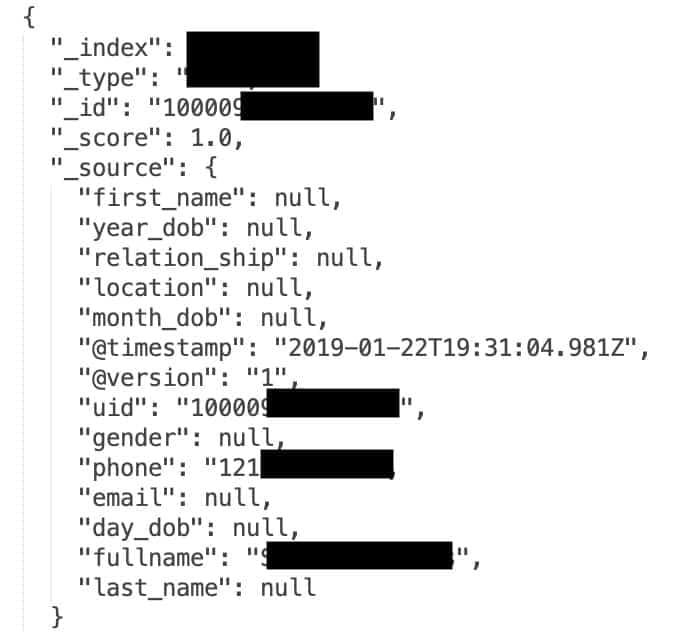
“A database containing more than 267 million Facebook user IDs, phone numbers, and names was left exposed on the web for anyone to access without a password or any other authentication.” reads the post published by Comparitech. “Comparitech partnered with security researcher Bob Diachenko to uncover the Elasticsearch cluster.

In total the archive contained 267,140,436 records, most of the affected users were from the United States.

Diachenko also discovered that the server included a landing page with a login dashboard and a welcome note in Vietnamese language.

Diachenko discovered the unsecured database on December 14, but it was first indexed on December 4, unfortunately, the Facebook information was posted on a hacker forum since December 12.

On December 14, the expert sent an abuse report to the ISP managing the IP address of the server and on December 19 the database was shut down.

facebook data scraping

At the time it is not clear how hackers obtained the data, Diachenko believe that there are to possible scenarios.

In the first scenario, attackers could have exploited Facebook’s API used by developers to access data (i.e. Friends list, photos, and groups). This was possible only before Facebook implemented the restrictions to the access to user phone numbers in 2018, alternatively, the attackers might have exploited a security hole. Criminals could have also scraped information from public Facebook profiles using automated tools. 

In September 2019, other databases containing 419 million records were exposed, the huge trove of data included phone numbers and Facebook IDs.

A Facebook spokesman confirmed that in a statement that the company is investigating into the case, but the information was likely harvested before 2018.

[adrotate banner=”9″] [adrotate banner=”12″]

Pierluigi Paganini

(SecurityAffairs – privacy, Facebook)

[adrotate banner=”5″]

[adrotate banner=”13″]


