
Security Affairs
Two Barracuda ESG Flaws Could Be Combined for Full Root Access; Patches Released|Cyberattack Hits French Blood Banks as Hackers Target Refrigeration Systems Across Europe|CVE-2026-58868: Critical Android Bug Could Let Attackers Run Remote Code|U.S. CISA adds WordPress flaw to its Known Exploited Vulnerabilities catalog|Binance Hack: How Fake Job Interviews and AI Abuse Led to a $6.34 Billion Attack|Synology Warns of Ransomware Attacks Targeting NAS Devices Running Outdated DSM Versions|Inside XCPE, the botnet that turned 1.3M set-top boxes into proxy servers|NIS2 Makes Board Members Personally Liable for Access Control Decisions|Apple’s spyware notifications reach the Bundestag: what the BSI says to do now|VOLTA, the infostealer that asks an AI which victims are worth the effort|New wave of fridge cyberattacks hits European supermarkets, this time in Belgium, Luxembourg, Sweden and Estonia|Hackers Send Fake Nuclear Threat Alerts to Ukrainian and Russian Citizens|Two Barracuda ESG Flaws Could Be Combined for Full Root Access; Patches Released|Cyberattack Hits French Blood Banks as Hackers Target Refrigeration Systems Across Europe|CVE-2026-58868: Critical Android Bug Could Let Attackers Run Remote Code|U.S. CISA adds WordPress flaw to its Known Exploited Vulnerabilities catalog|Binance Hack: How Fake Job Interviews and AI Abuse Led to a $6.34 Billion Attack|Synology Warns of Ransomware Attacks Targeting NAS Devices Running Outdated DSM Versions|Inside XCPE, the botnet that turned 1.3M set-top boxes into proxy servers|NIS2 Makes Board Members Personally Liable for Access Control Decisions|Apple’s spyware notifications reach the Bundestag: what the BSI says to do now|VOLTA, the infostealer that asks an AI which victims are worth the effort|New wave of fridge cyberattacks hits European supermarkets, this time in Belgium, Luxembourg, Sweden and Estonia|Hackers Send Fake Nuclear Threat Alerts to Ukrainian and Russian Citizens|
Advertisement

Ad Placeholder

Full Width × 90

Breaking News

Chinese Police dismantled the behind the Fireball adware campaign that infected more than 250 Million PCs

Chinese authorities arrested eleven members of the gang behind the Fireball adware campaign that infected more than 250 Million PCs. Chinese police have identified and arrested individuals suspected to be the operators behind the massive adware campaign that infected more than 250 Million computers across the world earlier this year. In June, researchers at security firm Check Point discovered the […]

Chinese Police dismantled the behind the Fireball adware campaign that infected more than 250 Million PCs

Chinese authorities arrested eleven members of the gang behind the Fireball adware campaign that infected more than 250 Million PCs.

Chinese police have identified and arrested individuals suspected to be the operators behind the massive adware campaign that infected more than 250 Million computers across the world earlier this year.

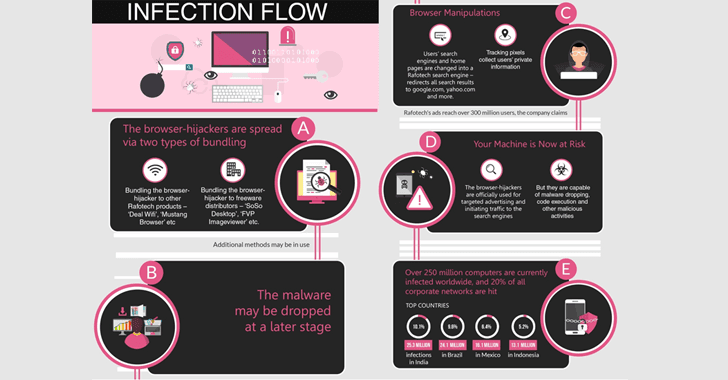
In June, researchers at security firm Check Point discovered the massive campaign spreading the Fireball malware. The malicious code was infecting both Windows and Mac OS systems, it can be used by attackers to gain full controls of the victim’s web browsers, to spy on the victims and exfiltrate user data.

The adware is disguised as a legitimate software and leverages browser plug-ins to boost its own advertisements.

Fireball malware

The researchers associated the campaign with the operation of the Chinese firm Rafotech that is a company that officially offers digital marketing and game apps to 300 million customers.

Chinese media outlets reported eleven Rafotech employees arrested by local police, including executives. It seems that the authorities arrested the suspects in June shortly after the publication of the report.

The Chongqing Morning News confirmed that the president, the technical director, and an operations director were arrested by the Chinese Police.

According to the state-owned outlet “Sixth Tone,” the click-fraud netted 80 million yuan, nearly US$12 million.

The Beijing Municipal Public Security Bureau Haidian Branch Network Security Brigade was informed by someone working under the pseudonym Zhang Ming, then the authorities monitored the Fireball campaign tracking its operators.

The individuals have allegedly “admitted the facts,” they were responsible for the campaign that launched around 2015 when the Rafotech setup the advertising fraud.

According to Beijing Youth Daily, the Fireball adware did not infect Chinese users to avoid being investigated by local authorities.

To check the presence of the malware on your systems open your web browser and try to reply the following questions:

  1. Did you set your homepage?
  2. Are you able to modify your browser’s homepage?
  3. Are you familiar with your default search engine and can modify that as well?
  4. Do you remember installing all of your browser extensions?

To uninstall the adware just remove the respective application from the machine and reset to default settings for your browser.

[adrotate banner=”9″]

Pierluigi Paganini

(Security Affairs –  (Fireball, adware)

[adrotate banner=”13″]


