
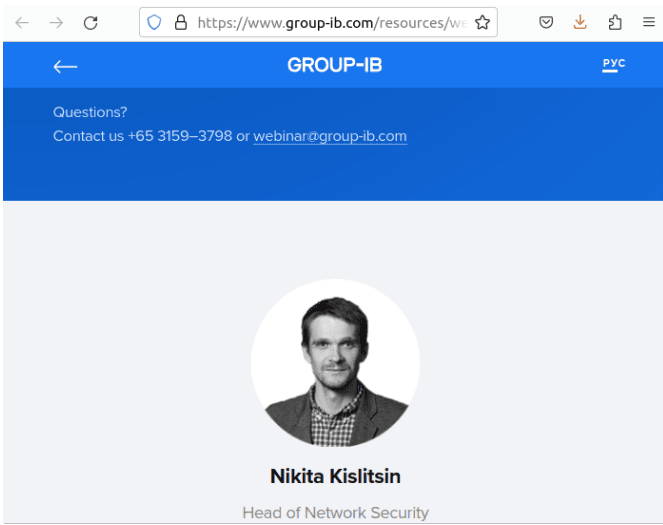
The former head of network security at Group-IB has been arrested in Kazakhstan based on a request from U.S. law enforcement.
Nikita Kislitsin who worked as the head of network security at Group-IB, as well as its Russian-based spinoff company (known as F.A.C.C.T.), has been arrested in Kazahstan based on a request from the U.S. law enforcement. Prior to that, the CEO of Group-IB, Ilya Sachkov, was arrested by law enforcement back in September 2021 and currently remains in prison.

The arrest of Kislitsin was executed on June 22nd, but the news surrounding it became public just today 6 days after the detention. Kislitsin’s Linkedin page and other public social media profiles were wiped prior to that.
According to the indictment which was unsealed by U.S. law enforcement earlier, Kislitsin was involved in the monetization of stolen data which was exfiltrated from multiple companies including Formspring. Later, Group-IB released a statement saying “these actions (of US Department of Justice (DOJ) are unacceptable and a violation of the rights of their employee”.
Following his detention, on June 28th, Russia suddenly expressed their own interest in Kislitsin, the court of Moscow then issued an urgent arrest warrant for Kislitsin with unnamed charges related to the unauthorized access of protected computer information. Russia said it will also seek his extradition from Kazakhstan.
Their statement reads below:
“By the decision of the Tverskoy District Court of Moscow, a measure of restraint in the form of detention was chosen against Nikita Igorevich Kislitsyn, who is accused of committing a crime under Part 3 of Article 272 of the Criminal Code of the Russian Federation (illegal access to legally protected information using his official position) for a period of 2 months, calculating the period from the moment of his extradition to the territory of the Russian Federation or from the moment of detention of the accused in the territory of the Russian Federation.“
Once in Russia, Kislitsin could potentially evade extradition to the U.S. — this tactic was employed in the past mentioned cybersecurity news outlet “The Record”. It cited the case of another prominent Russian hacker Dmitriy Zubaha who was arrested in Cyprus 2012. Zubaha was arrested for the attacks on e-commerce services according to the U.S. law enforcement request, but later extradited back to Russia.
Ironically, since Kislitsin’s stay in Kazakhstan was for a lengthy time frame, Russia has never expressed any interest in him nor had any questions, that is of course until the U.S. law enforcement requested his arrest.
The General Council of Russia and the representative for the Ministry of Foreign Affairs (MOFA) to Russia in Kazahstan Evgeniy Bobrov said in a statement to RIA NOVOSTI law enforcement authorities are arranging contacts regarding Kislitsin’s arrest.
The Russian General Consulate in Almaty asked the Government of Kazakhstan not to extradite Kislitsin to the U.S.
Deputy General Prosecutor of Kazakhstan, Ulan Baizhanov, said: “a red notice was issued via Interpol. He (Kislitsin) was then detained.”
Sources:
– https://therecord.media/russian-cyber-expert-arrested-in-kazakhstan-triggering-showdow
– https://www.cnews.ru/news/top/2023-06-28_arestovan_byvshij_glavred
– https://cyberscoop.com/group-ib-nikita-kislitsin-indicted-formspring-nikulin/
Follow me on Twitter: @securityaffairs and Facebook and Mastodon
(SecurityAffairs – hacking, drones)


