
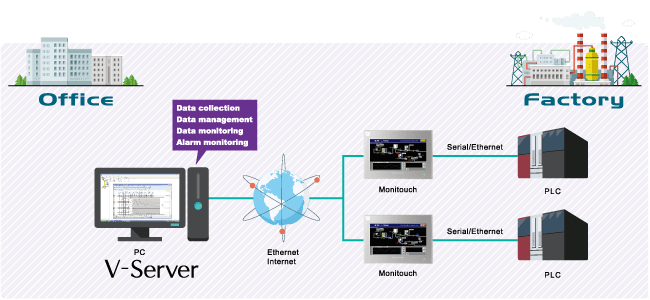
Experts discovered several flaws in Fuji Electric V-Server, a tool that connects PCs within the organizations to Industrial Control Systems (ICS).
Experts discovered several vulnerabilities in Fuji Electric V-Server, a tool that connects PCs within the organizations to Industrial Control Systems (ICS) on the corporate network. The ICS-CERT published two advisories to warn of the existence of the flaws that could have a severe impact on a broad range of companies in the critical manufacturing sector.

The vulnerabilities rated as “high severity” could be exploited by a remote attacker to execute arbitrary code, The kind of issues affecting products that control ICS systems are very dangerous and pose a severe threat to the companies, their security is essential to avoid ugly surprises.
Vulnerabilities affecting products that connect the corporate network to industrial control systems (ICS) can pose a serious threat since that is how many threat actors attempt to make their way onto sensitive systems.
Fuji Electric V-Server devices access to programmable logic controllers (PLCs) on the corporate network via Ethernet. The control of the PLCs is implemented via the Monitouch human-machine interfaces (HMI).
“Successful exploitation of these vulnerabilities could allow for remote code execution on the device, causing a denial of service condition or information exposure.” reads the advisory published by the ICS CERT.
The list of vulnerabilities includes use-after-free, untrusted pointer dereference, heap-based buffer overflow, out-of-bounds write, integer underflow, out-of-bounds read, and stack-based buffer overflow vulnerabilities that could be exploited by remote attackers to execute arbitrary code and trigger denial-of-service (DoS) condition or information disclosure.
The bad news is that public exploits for some flaws are already available online.
The ICS-CERT also warns of another high severity buffer overflow in V-Server Lite that can lead to a DoS condition or information leakage. The flaw could be triggered by tricking victims into opening specially crafted project files.
The vendor addressed the issues with the release of version 4.0.4.0.
The flaws were reported to the vendor via Trend Micro’s Zero Day Initiative (ZDI) by researchers Steven Seeley from Source Incite and Ariele Caltabiano.
ZDI rated the flaws as “medium severity” with a CVSS score of 6.8, while the most severe issue was the one found by Caltabiano.
“This vulnerability allows remote attackers to execute arbitrary code on vulnerable installations of Fuji Electric V-Server. User interaction is required to exploit this vulnerability in that the target must visit a malicious page or open a malicious file.” states the advisory from ZDI.
“The specific flaw exists within the parsing of a VPR file. The issue results from the lack of proper validation of user-supplied data, which can result in an integer underflow before writing to memory. An attacker can leverage this vulnerability to execute code under the context of the V-Server process.”
| [adrotate banner=”9″] | [adrotate banner=”12″] |
(Security Affairs – Fuji Electric V-Server, China)
[adrotate banner=”5″]
[adrotate banner=”13″]


