
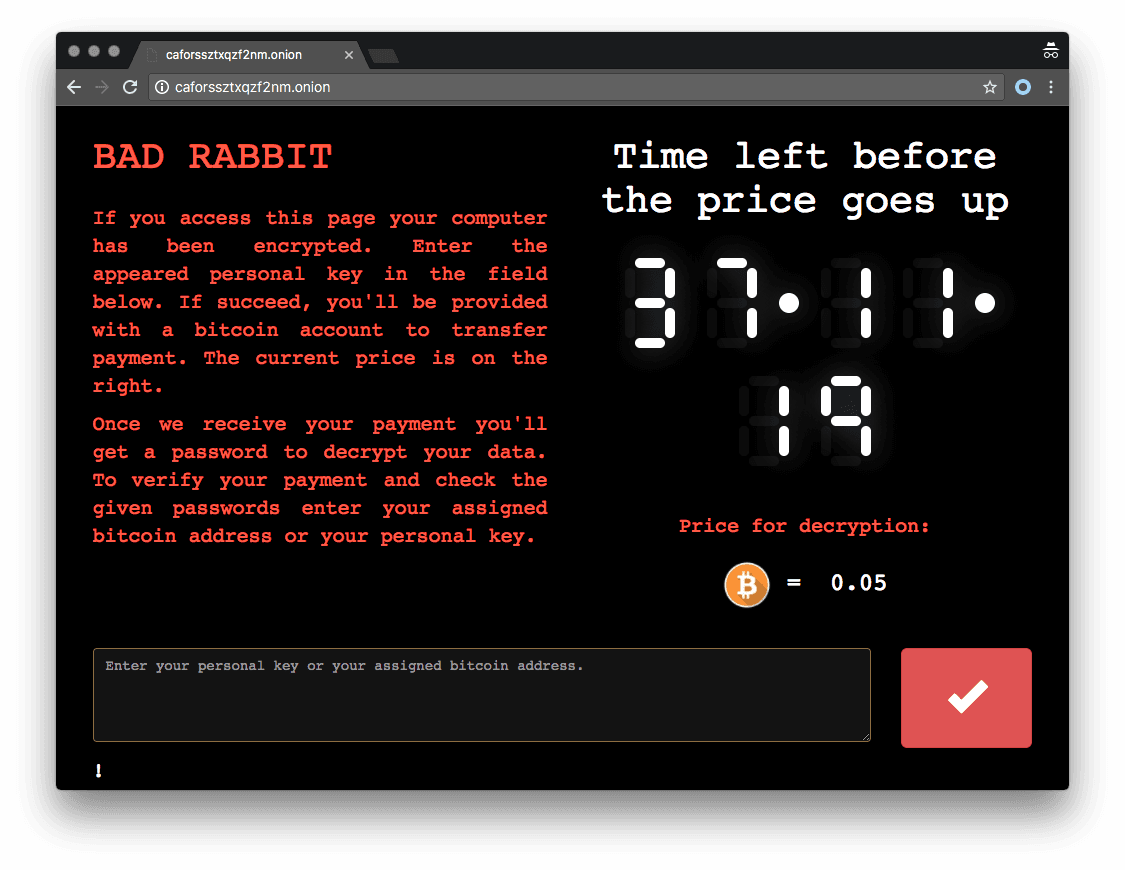
The researchers at CSE Cybsec ZLab have completed their analysis the Bad Rabbit ransomware, the report follows our preliminary analysis.
Introduction
Recently a new ransomware, called BadRabbit, infected systems in many countries, most of in East Europe, such as Ukraine and Russia. The malware was not totally new, it seems to be an evolution of the old NotPetya ransomware for some aspects, including:
- The behavior after the reboot with a particular ransom note.
- The spreading capability through lateral movements that relies on the SMB protocol and exploits a vulnerability based on vulnerability MS17-010.

There are also many differences with NotPetya, including, a more sophisticated behavior and the fixing of coding errors that transform NotPetya from a ransomware to a wiper, through the ad-hoc encrypting library “DiskCryptor”, for this purpose. These aspects suggest that the malware is a pure and correctly developed ransomware. Although there are some discrepancies:
- The onion site indicated in the ransom note, “caforssztxqzf2nm[.]onion”, one the day after the initial infection, was no longer reachable. This implies that victims cannot pay the ransom to decrypt their files. But it’s strange that the onion site could be taken down so rapidly from authorities and it’s more probable that it could be taken down by the authors themselves.
- Most of the compromised websites belong to restaurants, hotels and “house rental” services.
- Most of the infected systems were in Ukraine, for example at the Odessa airport and Kiev metro. The targets are the same places previously targeted by NotPetya hackers.
These reasons make think that the malware isn’t a wiper for the design, but so de facto, because of the impossibility to pay the ransom and that the malware was written by the same authors of NotPetya and to be its evolution.
The full report includes technical details about the malware resulting from static and behavioral analysis. it also included Yara rules for the ransomware detection.
You can download the full ZLAB Malware Analysis Report at the following URL:
http://csecybsec.com/download/zlab/20171101_CSE_BadRabbit_Full_Report.pdf

About the author: Antonio Pirozzi
Principal Malware Scientist and Senior Threat Researcher for CSE CybSec Enterprise spa

Actually, he holds more than 10 Infosec International Certification, from SANS, EC-Council and Department of Homeland Security.
His experience goes beyond the classical Computer Security landscape, he worked on numerous projects on GSM Security, Critical Infrastructure Security, Blockchain Malware, composition malware, malware evasion.

Luigi Martire is graduated in Computer Engineering at the University of Sannio. He’s part of University of Sannio Software Security Lab (ISWAT lab) and participated in some cyber security projects, among them “DoApp – Denial Of App”. Nowadays, he’s also Malware Analyst and Threat Researcher for Z-Lab, the malware lab of CSE CybSec Enterprise spa.

Antonio Farina is graduated in Computer Engineering at the University of Sannio. He’s part of University of Sannio Software Security Lab (ISWAT lab) and participated in some cyber security projects, among them “DoApp – Denial Of App”. Nowadays, he’s also Malware Analyst and Threat Researcher for Z-Lab, the malware lab of CSE CybSec Enterprise spa.
| [adrotate banner=”9″] | [adrotate banner=”12″] |
(Security Affairs – Bad Rabbit ransomware, Cybercrime)
[adrotate banner=”5″]
[adrotate banner=”13″]


