
A group under the Magecart umbrella adopted a new tactic that leverages on MiTM and phishing attacks to target sites using external payment processors.
Security experts at RiskIQ continue to monitor activities of several Magecart groups, recently they spotted a new crew, tracked as Full
The Full
Hacker groups under the Magecart umbrella continue to target to steal payment card data with so-called software skimmers. Security firms have monitored the activities of a dozen groups at least since 2010.
According to a joint report published by RiskIQ and FlashPoint, some groups are more advanced than others, in particular, the gang tracked as Group 4 appears to be very sophisticated.
The list of victims of the groups is long and includes several major platforms such as British Airways, Newegg, Ticketmaster, MyPillow and Amerisleep, and Feedify.
Millions of Magecart instances were detected over time, security experts discovered tens of software skimming scripts.
In a report recently published by RiskIQ, experts estimate that the group has impacted millions of users. RiskIQ reports a total of 2,086,529 instances of Magecart detections, most of them are supply-chain attacks.
The name Fullz House comes from two different attack techniques, the phishing, and the web skimming. The Magecart group used a generic phishing technique to gather and sell full sets of an individual’s personally identifying information along with financial data (identified with the slang term fullz in the cybercrime underground). The group set up an online store called “BlueMagicStore” for this purpose.
The payment card data stolen through web skimming were offered for sale on the carding store called “CardHouse.”
“More recently, RiskIQ observed a group making a jump from the world of phishing into card skimming.” reads the analysis published by RiskIQ. “We’ve named this group “Fullz House”based on the two parts of their operation:
- Generic phishing to sell “fullz,” a slang term used by criminals and data resellers meaning full packages of individuals’ identifying information on their store called “BlueMagicStore.”
- Card skimming to sell credit card information on their carding store named “CardHouse.”

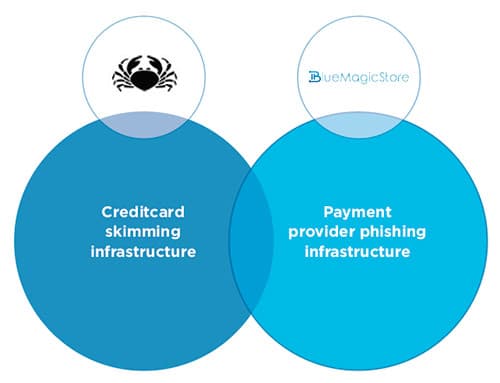
RiskIQ researchers noticed some overlap in the credit card skimming infrastructure and the payment provider phishing infrastructure, they also highlighted an overlap with the infrastructure of the Dark Web stores.
“The [phishing] pages are part of a framework,” they wrote. “They have different templates mimicking every payment provider they implement, but the backend dealing with the information is one and the same for all. While the group uses many different domains, their favorite phishing target remains PayPal.”
Unlike other cybercrime groups, the Fullz House group developed the e-skimmer used in its attacks.
The e-skimmer masquerades as a Google Analytics script and was designed to hook into every input field they can find and waiting for an input change to check if there’s data to steal.
This way to implement a skimmer works more like a
Once the skimmer captured the payment data, it will send it to the “drop location,” packaged and masqueraded as an image that is being included in the page. The URL of the fake image containing the stolen data has the following format:
https://<skimmer domain>/ga.php?analytic=<base64 encoded data>
“Despite their primitive skimmers, Fullz House has also innovated, leveraging their unique cybercrime know-how to introduce a clever technique that performs a
The Magecart group sets up a page with a template mimicking a known payment processor. When victims attempt to purchase something
“The
| [adrotate banner=”9″] | [adrotate banner=”12″] |
(SecurityAffairs – Federal Communications Commission, espionage)
[adrotate banner=”5″]
[adrotate banner=”13″]


