
Security Affairs
Two Barracuda ESG Flaws Could Be Combined for Full Root Access; Patches Released|Cyberattack Hits French Blood Banks as Hackers Target Refrigeration Systems Across Europe|CVE-2026-58868: Critical Android Bug Could Let Attackers Run Remote Code|U.S. CISA adds WordPress flaw to its Known Exploited Vulnerabilities catalog|Binance Hack: How Fake Job Interviews and AI Abuse Led to a $6.34 Billion Attack|Synology Warns of Ransomware Attacks Targeting NAS Devices Running Outdated DSM Versions|Inside XCPE, the botnet that turned 1.3M set-top boxes into proxy servers|NIS2 Makes Board Members Personally Liable for Access Control Decisions|Apple’s spyware notifications reach the Bundestag: what the BSI says to do now|VOLTA, the infostealer that asks an AI which victims are worth the effort|New wave of fridge cyberattacks hits European supermarkets, this time in Belgium, Luxembourg, Sweden and Estonia|Hackers Send Fake Nuclear Threat Alerts to Ukrainian and Russian Citizens|Two Barracuda ESG Flaws Could Be Combined for Full Root Access; Patches Released|Cyberattack Hits French Blood Banks as Hackers Target Refrigeration Systems Across Europe|CVE-2026-58868: Critical Android Bug Could Let Attackers Run Remote Code|U.S. CISA adds WordPress flaw to its Known Exploited Vulnerabilities catalog|Binance Hack: How Fake Job Interviews and AI Abuse Led to a $6.34 Billion Attack|Synology Warns of Ransomware Attacks Targeting NAS Devices Running Outdated DSM Versions|Inside XCPE, the botnet that turned 1.3M set-top boxes into proxy servers|NIS2 Makes Board Members Personally Liable for Access Control Decisions|Apple’s spyware notifications reach the Bundestag: what the BSI says to do now|VOLTA, the infostealer that asks an AI which victims are worth the effort|New wave of fridge cyberattacks hits European supermarkets, this time in Belgium, Luxembourg, Sweden and Estonia|Hackers Send Fake Nuclear Threat Alerts to Ukrainian and Russian Citizens|
Advertisement

Ad Placeholder

Full Width × 90

Breaking News

Z-LAB Report – Analyzing the GandCrab v5 ransomware

Experts at the Cybaze Z-Lab have analyzed the latest iteration of the infamous GandCrab ransomware, version 5.0. Malware researchers at Cybaze ZLab analyzed the latest version of the infamous GandCrab ransomware, version 5.0. Most of the infections have been observed in central Europe, but experts found evidence that the malicious code doesn’t infect Russian users. […]

GandCrab 5

Experts at the Cybaze Z-Lab have analyzed the latest iteration of the infamous GandCrab ransomware, version 5.0.

Malware researchers at Cybaze ZLab analyzed the latest version of the infamous GandCrab ransomware, version 5.0. Most of the infections have been observed in central Europe, but experts found evidence that the malicious code doesn’t infect Russian users. GandCrab operates like a classic ransomware, it encrypts all user files and drops some ransom notes on the infected machine.

The ransomware uses a pseudo-randomic extension (5 characters long), that is different for each infection (some of these extensions are: .txvpq, .rttmc, .mcbot, etc…).

The ransom note contains some information related to the infection: an ID (“fed0a66240f8743f”, in the image below), a “GANDCRAB KEY”, required to restore the original files, and some encrypted information about the infected system such as the username, the PC name, the domain, the operative system and the language.

GandCrab 5

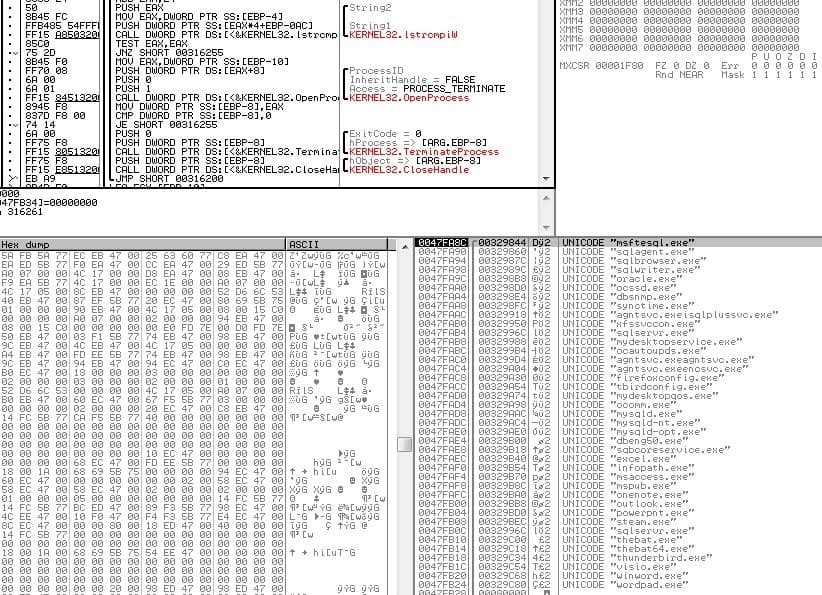
Unlike GandCrab v4, this version is able to kill some processes associated with some popular applications (i.e. Word, Excel, SQLServer etc.) to allow the code to encrypt the files opened by these applications.

GandCrab 5

The payment process is implemented through the hidden service associated with the Tor address:

hxxp://gandcrabmfe6mnef[.]onion, which is the same used by previous versions of the malware.

Technical details, including IoCs and Yara Rules, are reported in the analysis shared by researchers at the ZLab.

You can download the full ZLAB Malware Analysis Report at the following URL:

http://csecybsec.com/download/zlab/20181001_CSE_GandCrabv5.pdf


[adrotate banner=”9″] [adrotate banner=”12″]

Pierluigi Paganini

(Security Affairs – ransomare, cybercrime)

[adrotate banner=”5″]

[adrotate banner=”13″]


