
Security Affairs
Two Barracuda ESG Flaws Could Be Combined for Full Root Access; Patches Released|Cyberattack Hits French Blood Banks as Hackers Target Refrigeration Systems Across Europe|CVE-2026-58868: Critical Android Bug Could Let Attackers Run Remote Code|U.S. CISA adds WordPress flaw to its Known Exploited Vulnerabilities catalog|Binance Hack: How Fake Job Interviews and AI Abuse Led to a $6.34 Billion Attack|Synology Warns of Ransomware Attacks Targeting NAS Devices Running Outdated DSM Versions|Inside XCPE, the botnet that turned 1.3M set-top boxes into proxy servers|NIS2 Makes Board Members Personally Liable for Access Control Decisions|Apple’s spyware notifications reach the Bundestag: what the BSI says to do now|VOLTA, the infostealer that asks an AI which victims are worth the effort|New wave of fridge cyberattacks hits European supermarkets, this time in Belgium, Luxembourg, Sweden and Estonia|Hackers Send Fake Nuclear Threat Alerts to Ukrainian and Russian Citizens|Two Barracuda ESG Flaws Could Be Combined for Full Root Access; Patches Released|Cyberattack Hits French Blood Banks as Hackers Target Refrigeration Systems Across Europe|CVE-2026-58868: Critical Android Bug Could Let Attackers Run Remote Code|U.S. CISA adds WordPress flaw to its Known Exploited Vulnerabilities catalog|Binance Hack: How Fake Job Interviews and AI Abuse Led to a $6.34 Billion Attack|Synology Warns of Ransomware Attacks Targeting NAS Devices Running Outdated DSM Versions|Inside XCPE, the botnet that turned 1.3M set-top boxes into proxy servers|NIS2 Makes Board Members Personally Liable for Access Control Decisions|Apple’s spyware notifications reach the Bundestag: what the BSI says to do now|VOLTA, the infostealer that asks an AI which victims are worth the effort|New wave of fridge cyberattacks hits European supermarkets, this time in Belgium, Luxembourg, Sweden and Estonia|Hackers Send Fake Nuclear Threat Alerts to Ukrainian and Russian Citizens|
Advertisement

Ad Placeholder

Full Width × 90

Breaking News

New Go-written GobRAT RAT targets Linux Routers in Japan

A new Golang remote access trojan (RAT), tracked as GobRAT, is targeting Linux routers in Japan, the JPCERT Coordination Center warns. JPCERT/CC is warning of cyberattacks against Linux routers in Japan that have been infected with a new Golang remote access trojan (RAT) called GobRAT. Threat actors are targeting Linux routers with publicly exposed WEBUI to execute […]

GobRAT

A new Golang remote access trojan (RAT), tracked as GobRAT, is targeting Linux routers in Japan, the JPCERT Coordination Center warns.

JPCERT/CC is warning of cyberattacks against Linux routers in Japan that have been infected with a new Golang remote access trojan (RAT) called GobRAT.

Threat actors are targeting Linux routers with publicly exposed WEBUI to execute malicious scripts to deploy the GobRAT malware.

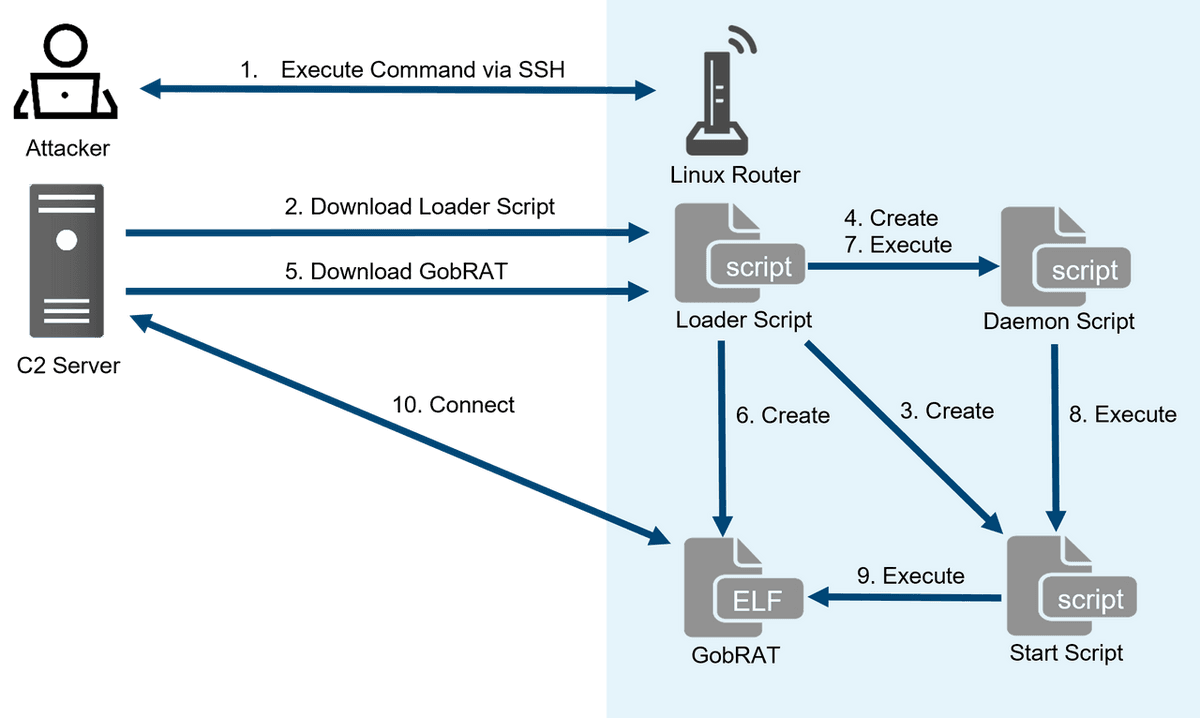
“Initially, the attacker targets a router whose WEBUI is open to the public, executes scripts possibly by using vulnerabilities, and finally infects the GobRAT.” reads the alert published by the JPCERT Coordination Center (JPCERT/CC).

GobRAT

Loader Script acts as a loader, it supports multiple functions for downloading and deploying the GobRAT. The experts noticed an SSH public key, likely used as a backdoor, which is hard-coded in the script. The Loader Script maintains persistence via crontab because GobRAT does not support such a function.

The Loader Script includes multiple functions, such as disabling Firewall, downloading GobRAT for the target machine’s architecture, creating Start Script and making it persistent, creating and running the Daemon Script, and registering a SSH public key in /root/.ssh/authorized_keys.

The RAT communicates with C2 server via TLS and can execute various commands. The Japan CERT reported that the RAT is packed with UPX version 4 series. The researchers observed samples for multiple architectures, including ARM, MIPS, x86, and x86-64.

Upon starting up, the GobRAT checks IP address and MAC address of itself, uptime by uptime command, network communication status by /proc/net/dev.

The malware supports 22 commands, the researchers have identified the following commands:

  • Obtain machine Information
  • Execute reverse shell
  • Read/write files
  • Configure new C2 and protocol
  • Start socks5
  • Execute file in /zone/frpc
  • Attempt to login to sshd, Telnet, Redis, MySQL, PostgreSQL services running on another machine

“In recent years, different types of malware using Go language have been confirmed, and the GobRAT malware confirmed this time uses gob, which can only be handled by Go language, for communication.” concludes the alert that also provides indicators of compromise. “Please continuously beware of malware that infects routers, not limited to GobRAT, since they are difficult to detect.”

Follow me on Twitter: @securityaffairs and Facebook and Mastodon

Pierluigi Paganini

(SecurityAffairs – hacking, malware)


