
Security Affairs
Cyberattack Hits French Blood Banks as Hackers Target Refrigeration Systems Across Europe|CVE-2026-58868: Critical Android Bug Could Let Attackers Run Remote Code|U.S. CISA adds WordPress flaw to its Known Exploited Vulnerabilities catalog|Binance Hack: How Fake Job Interviews and AI Abuse Led to a $6.34 Billion Attack|Synology Warns of Ransomware Attacks Targeting NAS Devices Running Outdated DSM Versions|Inside XCPE, the botnet that turned 1.3M set-top boxes into proxy servers|NIS2 Makes Board Members Personally Liable for Access Control Decisions|Apple’s spyware notifications reach the Bundestag: what the BSI says to do now|VOLTA, the infostealer that asks an AI which victims are worth the effort|New wave of fridge cyberattacks hits European supermarkets, this time in Belgium, Luxembourg, Sweden and Estonia|Hackers Send Fake Nuclear Threat Alerts to Ukrainian and Russian Citizens|Chainalysis Investigates Security Incident Involving AI-Driven Attack Techniques|Cyberattack Hits French Blood Banks as Hackers Target Refrigeration Systems Across Europe|CVE-2026-58868: Critical Android Bug Could Let Attackers Run Remote Code|U.S. CISA adds WordPress flaw to its Known Exploited Vulnerabilities catalog|Binance Hack: How Fake Job Interviews and AI Abuse Led to a $6.34 Billion Attack|Synology Warns of Ransomware Attacks Targeting NAS Devices Running Outdated DSM Versions|Inside XCPE, the botnet that turned 1.3M set-top boxes into proxy servers|NIS2 Makes Board Members Personally Liable for Access Control Decisions|Apple’s spyware notifications reach the Bundestag: what the BSI says to do now|VOLTA, the infostealer that asks an AI which victims are worth the effort|New wave of fridge cyberattacks hits European supermarkets, this time in Belgium, Luxembourg, Sweden and Estonia|Hackers Send Fake Nuclear Threat Alerts to Ukrainian and Russian Citizens|Chainalysis Investigates Security Incident Involving AI-Driven Attack Techniques|
Advertisement

Ad Placeholder

Full Width × 90

Breaking News

New GoldBrute Botnet is attempting to infect 1.5 Million RDP Servers

A new botnet tracked as GoldBrute is scanning the web for Windows machines with Remote Desktop Protocol (RDP) connection enabled. A new botnet tracked as GoldBrute has appeared in the threat landscape, it is scanning the web for Windows machines with Remote Desktop Protocol (RDP) connection enabled. The botnet is currently targeting over 1.5 million […]

GoldBrute botnet

A new botnet tracked as GoldBrute is scanning the web for Windows machines with Remote Desktop Protocol (RDP) connection enabled.

A new botnet tracked as GoldBrute has appeared in the threat landscape, it is scanning the web for Windows machines with Remote Desktop Protocol (RDP) connection enabled.

The botnet is currently targeting over 1.5 million unique endpoints online, it is used to brute-force RDP connections or to carry out credential stuffing attacks.

“This botnet is currently brute forcing a list of about 1.5 million RDP servers exposed to the Internet. Shdoan lists about 2.4 million exposed servers  [1]. GoldBrute uses its own list and is extending it as it continues to scan and grow.” wrote the researchers Renato Marinho of Morphus Labs who discovered the bot.

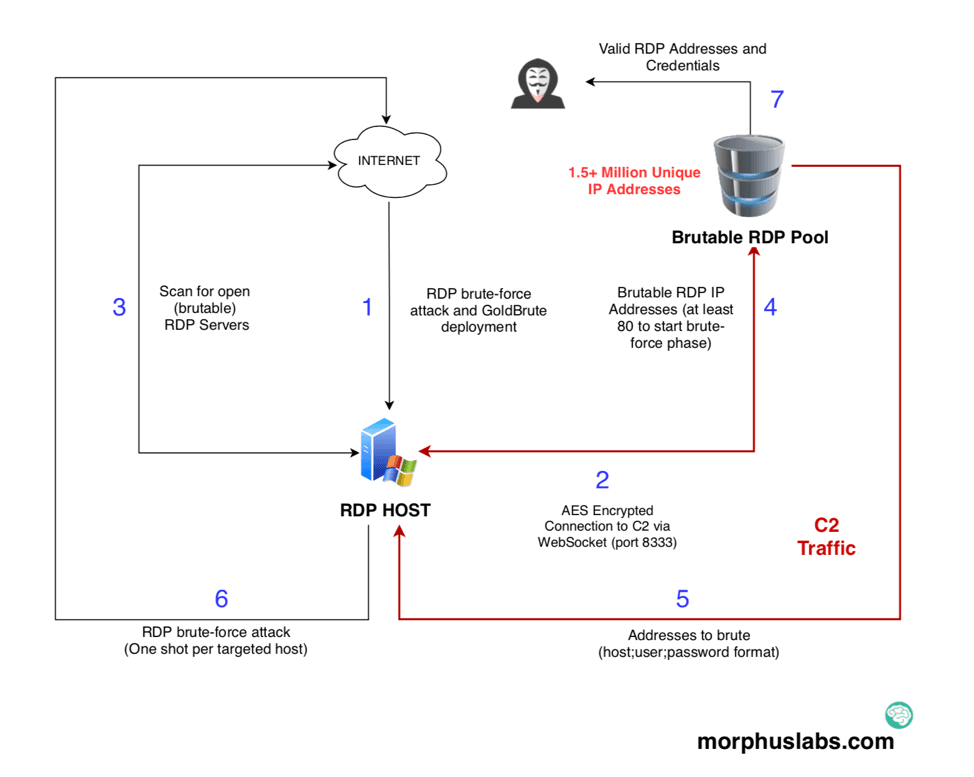
The GoldBrute botnet currently has a single command and control server (104[.]156[.]249[.]231), its bots exchange data with the C2 via AES encrypted WebSocket connections to port 8333. 

Querying the Shodan search engine for systems with RDP enabled it is possible to find roughly 2.4 million machines.

“An infected system will first be instructed to download the bot code. The download is very large (80 MBytes) and includes the complete Java Runtime. The bot itself is implemented in a Java class called GoldBrute” continues the expert.

“Initially, the bot will start scanning random IP addresses to find more hosts with exposed RDP servers. These IPs are reported back to the C&C server. After the bot reported 80 new victims, the C&C server will assign a set of targets to brute force to the bot.” 

GoldBrute botnet

Below the complete attack chain:

  • Botnet brute-forces RDP connection and gains access to a poorly protected Windows system.
  • It downloads a big zip archive containing the GoldBrute Java code and the Java runtime itself. It uncompresses and runs a jar file called “bitcoin.dll”.
  • The bot will start to scan the internet for “brutable” RDP servers and send their IPs to the C2 that in turn sends a list of IP addresses to brute force.
  • GoldBrute bot gets different “host + username + password”  combinations.
  • Bot performs brute-force attack and reports result back to C2 server.

According to the researcher, the list of “brutable” RDP targets is rapidly growing, this suggests that also the size of the botnet is increasing.

“Analyzing the GoldBrute code and understanding its parameters and thresholds, it was possible to manipulate the code to make it save all “host + username + password” combinations on our lab machine.” continues the expert.

“After 6 hours, we received 2.1 million IP addresses from the C2 server from which 1,596,571 are unique. Of course, we didn’t execute the brute-force phase. With the help of an ELK stack, it was easy to geolocate and plot all the addresses in a global world map, as shown below.”

goldbrute botnet map

The GoldBrute botnet is difficult to detect because every bot only launches one password-guessing attempt per victim.

The report published by Marinho also includes a list of IoCs.

[adrotate banner=”9″] [adrotate banner=”12″]

Pierluigi Paganini

(SecurityAffairs – GoldBrute botnet, hacking)

[adrotate banner=”5″]

[adrotate banner=”13″]


