
Security Affairs
Two Barracuda ESG Flaws Could Be Combined for Full Root Access; Patches Released|Cyberattack Hits French Blood Banks as Hackers Target Refrigeration Systems Across Europe|CVE-2026-58868: Critical Android Bug Could Let Attackers Run Remote Code|U.S. CISA adds WordPress flaw to its Known Exploited Vulnerabilities catalog|Binance Hack: How Fake Job Interviews and AI Abuse Led to a $6.34 Billion Attack|Synology Warns of Ransomware Attacks Targeting NAS Devices Running Outdated DSM Versions|Inside XCPE, the botnet that turned 1.3M set-top boxes into proxy servers|NIS2 Makes Board Members Personally Liable for Access Control Decisions|Apple’s spyware notifications reach the Bundestag: what the BSI says to do now|VOLTA, the infostealer that asks an AI which victims are worth the effort|New wave of fridge cyberattacks hits European supermarkets, this time in Belgium, Luxembourg, Sweden and Estonia|Hackers Send Fake Nuclear Threat Alerts to Ukrainian and Russian Citizens|Two Barracuda ESG Flaws Could Be Combined for Full Root Access; Patches Released|Cyberattack Hits French Blood Banks as Hackers Target Refrigeration Systems Across Europe|CVE-2026-58868: Critical Android Bug Could Let Attackers Run Remote Code|U.S. CISA adds WordPress flaw to its Known Exploited Vulnerabilities catalog|Binance Hack: How Fake Job Interviews and AI Abuse Led to a $6.34 Billion Attack|Synology Warns of Ransomware Attacks Targeting NAS Devices Running Outdated DSM Versions|Inside XCPE, the botnet that turned 1.3M set-top boxes into proxy servers|NIS2 Makes Board Members Personally Liable for Access Control Decisions|Apple’s spyware notifications reach the Bundestag: what the BSI says to do now|VOLTA, the infostealer that asks an AI which victims are worth the effort|New wave of fridge cyberattacks hits European supermarkets, this time in Belgium, Luxembourg, Sweden and Estonia|Hackers Send Fake Nuclear Threat Alerts to Ukrainian and Russian Citizens|
Advertisement

Ad Placeholder

Full Width × 90

Breaking News

Google open sourced the ClusterFuzz fuzzing platform

Google has open sourced ClusterFuzz, its fuzzing infrastructure it has developed to find memory corruption vulnerabilities in Chrome. Google has open sourced its fuzzing infrastructure ClusterFuzz that the tech giant developed to find memory corruption bugs in the Chrome browser. ClusterFuzz is a scalable fuzzing tool that can run on clusters with more than 25,000 cores. […]

ClusterFuzz

Google has open sourced ClusterFuzz, its fuzzing infrastructure it has developed to find memory corruption vulnerabilities in Chrome.

Google has open sourced its fuzzing infrastructure ClusterFuzz that the tech giant developed to find memory corruption bugs in the Chrome browser.

ClusterFuzz is a scalable fuzzing tool that can run on clusters with more than 25,000 cores.

The platform has been available as a free service to open source projects through the OSS-Fuzz service. 

“Fuzzing is an automated method for detecting bugs in software that works by feeding unexpected inputs to a target program. It is effective at finding memory corruption bugs, which often have serious security implications.” reads a blog post published by Google.

“Manually finding these issues is both difficult and time consuming, and bugs often slip through despite rigorous code review practices. For software projects written in an unsafe language such as C or C++, fuzzing is a crucial part of ensuring their security and stability.”

The fuzzing test methodology is effective in detecting bugs in software on a large scale, especially when it is directly integrated with the development process.

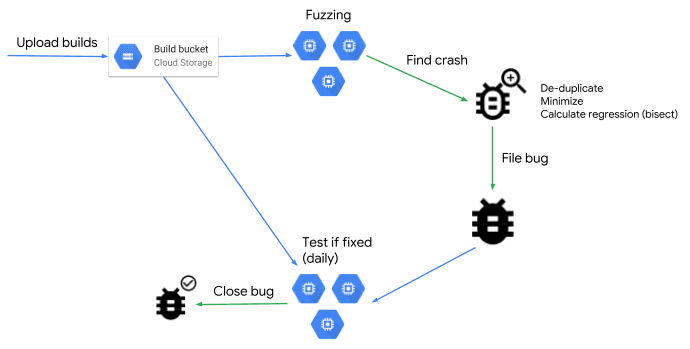
ClusterFuzz was created more than 8 years ago to provide end-to-end automation, from bug detection, to triage (accurate deduplication, bisection), to bug reporting, and finally to automatic closure of bug reports.

Google confirmed that to date, ClusterFuzz discovered over 16,000 vulnerabilities in Chrome and more than 11,000 vulnerabilities across more than 160 open source projects integrated with OSS-Fuzz.

“It is an integral part of the development process of Chrome and many other open source projects. ClusterFuzz is often able to detect bugs hours after they are introduced and verify the fix within a day.” continues the blog post.

“Check out our GitHub repository. You can try ClusterFuzz locally by following these instructions.”

ClusterFuzz

ClusterFuzz can be also installed locally on a computer cluster.

[adrotate banner=”9″] [adrotate banner=”12″]

Pierluigi Paganini

(SecurityAffairs – ClusterFuzz, hacking)

[adrotate banner=”5″] [adrotate banner=”13″]


