
Security Affairs
Cyberattack Hits French Blood Banks as Hackers Target Refrigeration Systems Across Europe|CVE-2026-58868: Critical Android Bug Could Let Attackers Run Remote Code|U.S. CISA adds WordPress flaw to its Known Exploited Vulnerabilities catalog|Binance Hack: How Fake Job Interviews and AI Abuse Led to a $6.34 Billion Attack|Synology Warns of Ransomware Attacks Targeting NAS Devices Running Outdated DSM Versions|Inside XCPE, the botnet that turned 1.3M set-top boxes into proxy servers|NIS2 Makes Board Members Personally Liable for Access Control Decisions|Apple’s spyware notifications reach the Bundestag: what the BSI says to do now|VOLTA, the infostealer that asks an AI which victims are worth the effort|New wave of fridge cyberattacks hits European supermarkets, this time in Belgium, Luxembourg, Sweden and Estonia|Hackers Send Fake Nuclear Threat Alerts to Ukrainian and Russian Citizens|Chainalysis Investigates Security Incident Involving AI-Driven Attack Techniques|Cyberattack Hits French Blood Banks as Hackers Target Refrigeration Systems Across Europe|CVE-2026-58868: Critical Android Bug Could Let Attackers Run Remote Code|U.S. CISA adds WordPress flaw to its Known Exploited Vulnerabilities catalog|Binance Hack: How Fake Job Interviews and AI Abuse Led to a $6.34 Billion Attack|Synology Warns of Ransomware Attacks Targeting NAS Devices Running Outdated DSM Versions|Inside XCPE, the botnet that turned 1.3M set-top boxes into proxy servers|NIS2 Makes Board Members Personally Liable for Access Control Decisions|Apple’s spyware notifications reach the Bundestag: what the BSI says to do now|VOLTA, the infostealer that asks an AI which victims are worth the effort|New wave of fridge cyberattacks hits European supermarkets, this time in Belgium, Luxembourg, Sweden and Estonia|Hackers Send Fake Nuclear Threat Alerts to Ukrainian and Russian Citizens|Chainalysis Investigates Security Incident Involving AI-Driven Attack Techniques|
Advertisement

Ad Placeholder

Full Width × 90

Breaking News

The Google E2EMail is now fully community-driven open source project

Google has now announced that E2EMail is no more a Google product, instead, it has become a “fully community-driven open source project.” The End-to-End crypto library is a core component of several projects of the IT giant such as the E2EMail, a Chrome app that runs independent of the normal Gmail web interface and allows non-technical users to […]

The Google E2EMail is now fully community-driven open source project

Google has now announced that E2EMail is no more a Google product, instead, it has become a “fully community-driven open source project.”

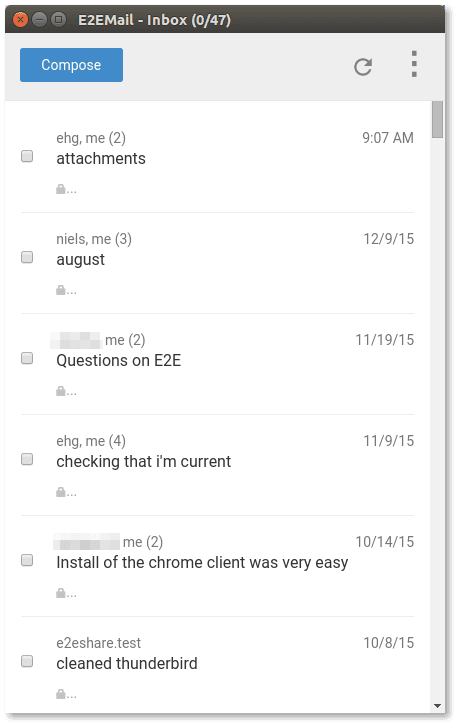
The End-to-End crypto library is a core component of several projects of the IT giant such as the E2EMail, a Chrome app that runs independent of the normal Gmail web interface and allows non-technical users to exchange encrypted text mail over Gmail.

In the past, Google shared the E2EMail source code in order to receive the contributions from several security communities. Now Google has now announced that the same project is no more a Google product, instead, it has become a “fully community-driven open source project.”

The decision is probably motivated by the consideration that no one since now has developed a Chrome extension for E2EMail.

“E2EMail is not a Google product, it’s now a fully community-driven open source project, to which passionate security engineers from across the industry have already contributed.” reads the blog post published by Google.

E2EMail

“E2EMail offers one approach to integrating OpenPGP into Gmail via a Chrome Extension, with improved usability, and while carefully keeping all cleartext of the message body exclusively on the client. E2EMail is built on a proven, open source Javascript crypto library developed at Google.”

Google is looking forward to receive the support of the security community to integrate E2EMail with other projects.

“E2EMail in its current incarnation uses a bare-bones central keyserver for testing, but the recent Key Transparency announcement is crucial to its further evolution,” continues the post. “Key discovery and distribution lie at the heart of the usability challenges that OpenPGP implementations have faced. Key Transparency delivers a solid, scalable, and thus practical solution, replacing the problematic web-of-trust model traditionally used with PGP.”

[adrotate banner=”9″]

Pierluigi Paganini

(Security Affairs – Google, encryption)


