
Security Affairs
Two Barracuda ESG Flaws Could Be Combined for Full Root Access; Patches Released|Cyberattack Hits French Blood Banks as Hackers Target Refrigeration Systems Across Europe|CVE-2026-58868: Critical Android Bug Could Let Attackers Run Remote Code|U.S. CISA adds WordPress flaw to its Known Exploited Vulnerabilities catalog|Binance Hack: How Fake Job Interviews and AI Abuse Led to a $6.34 Billion Attack|Synology Warns of Ransomware Attacks Targeting NAS Devices Running Outdated DSM Versions|Inside XCPE, the botnet that turned 1.3M set-top boxes into proxy servers|NIS2 Makes Board Members Personally Liable for Access Control Decisions|Apple’s spyware notifications reach the Bundestag: what the BSI says to do now|VOLTA, the infostealer that asks an AI which victims are worth the effort|New wave of fridge cyberattacks hits European supermarkets, this time in Belgium, Luxembourg, Sweden and Estonia|Hackers Send Fake Nuclear Threat Alerts to Ukrainian and Russian Citizens|Two Barracuda ESG Flaws Could Be Combined for Full Root Access; Patches Released|Cyberattack Hits French Blood Banks as Hackers Target Refrigeration Systems Across Europe|CVE-2026-58868: Critical Android Bug Could Let Attackers Run Remote Code|U.S. CISA adds WordPress flaw to its Known Exploited Vulnerabilities catalog|Binance Hack: How Fake Job Interviews and AI Abuse Led to a $6.34 Billion Attack|Synology Warns of Ransomware Attacks Targeting NAS Devices Running Outdated DSM Versions|Inside XCPE, the botnet that turned 1.3M set-top boxes into proxy servers|NIS2 Makes Board Members Personally Liable for Access Control Decisions|Apple’s spyware notifications reach the Bundestag: what the BSI says to do now|VOLTA, the infostealer that asks an AI which victims are worth the effort|New wave of fridge cyberattacks hits European supermarkets, this time in Belgium, Luxembourg, Sweden and Estonia|Hackers Send Fake Nuclear Threat Alerts to Ukrainian and Russian Citizens|
Advertisement

Ad Placeholder

Full Width × 90

Breaking News

Malvertising campaign in Google Search redirected users to tech support scam

Malicious ads in Google search results for the US retail giant Target redirected users to a tech support scam. The malvertising campaign was first reported last week by a US user who posted his observations to a StackExchange thread and was then reported by Bleepingcomputer.com. Just querying Google for the term “target,” users were displayed on the […]

Malvertising campaign in Google Search redirected users to tech support scam

Malicious ads in Google search results for the US retail giant Target redirected users to a tech support scam.

The malvertising campaign was first reported last week by a US user who posted his observations to a StackExchange thread and was then reported by Bleepingcomputer.com.

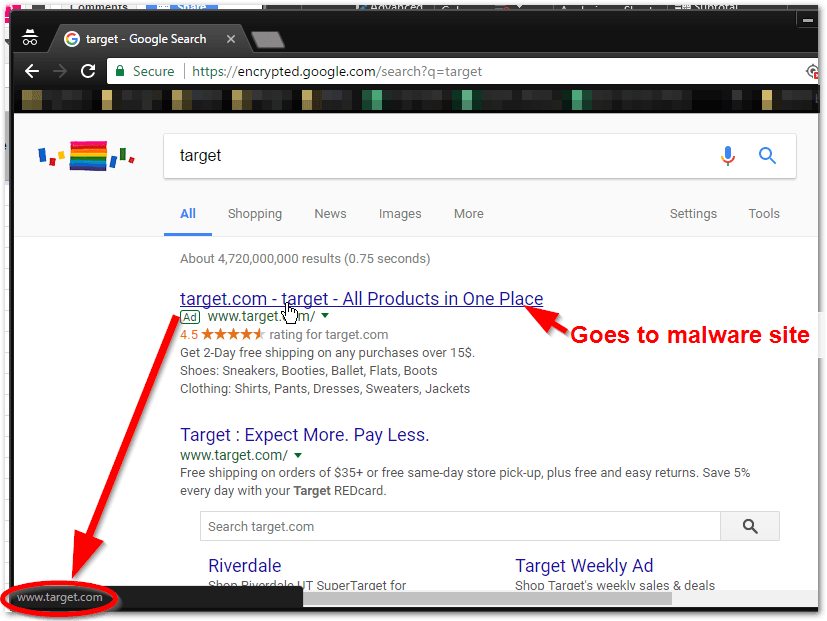
Just querying Google for the term “target,” users were displayed on the top right of the page of the results the malicious ads.

The bogus ads leverage a feature of  oogle Ads service that allows ad publishers to display a URL while redirecting users to another URL.

In the specific case, the rogue ad displayed the link “target.com,” but users were redirected to “tech-supportcenter.us.”

malvertising

In the attack reported by the US users, when users clicked the malicious ad they were redirected to a tech support scam instead of the legitimate website Target.com.

The landing page was a fake Microsoft tech support page urging users to call a phone number to remove a non-existent “HARDDISK_ROOTKIT_TROJAN_HUACK.EXE” file.

malvertising Google ADS

The landing page was registered to a Georgian man and was hosted on two IP addresses, 104.28.19[.]58 and  104.28.18[.]58], that were involved in the past in similar fraudulent activities, including tech support scams, malware hosting, and pharma spam.

According to VirusTotal logs the malvertising campaign also targeted Walmart users.

Unfortunately, such kind of attacks is not new for cybersecurity experts, in the past other malvertising campaigns hit Google.

[adrotate banner=”9″] [adrotate banner=”12″]

Pierluigi Paganini

(Security Affairs – Malicious ads, malvertising)

[adrotate banner=”5″]

[adrotate banner=”13″]


