
Security Affairs
Cyberattack Hits French Blood Banks as Hackers Target Refrigeration Systems Across Europe|CVE-2026-58868: Critical Android Bug Could Let Attackers Run Remote Code|U.S. CISA adds WordPress flaw to its Known Exploited Vulnerabilities catalog|Binance Hack: How Fake Job Interviews and AI Abuse Led to a $6.34 Billion Attack|Synology Warns of Ransomware Attacks Targeting NAS Devices Running Outdated DSM Versions|Inside XCPE, the botnet that turned 1.3M set-top boxes into proxy servers|NIS2 Makes Board Members Personally Liable for Access Control Decisions|Apple’s spyware notifications reach the Bundestag: what the BSI says to do now|VOLTA, the infostealer that asks an AI which victims are worth the effort|New wave of fridge cyberattacks hits European supermarkets, this time in Belgium, Luxembourg, Sweden and Estonia|Hackers Send Fake Nuclear Threat Alerts to Ukrainian and Russian Citizens|Chainalysis Investigates Security Incident Involving AI-Driven Attack Techniques|Cyberattack Hits French Blood Banks as Hackers Target Refrigeration Systems Across Europe|CVE-2026-58868: Critical Android Bug Could Let Attackers Run Remote Code|U.S. CISA adds WordPress flaw to its Known Exploited Vulnerabilities catalog|Binance Hack: How Fake Job Interviews and AI Abuse Led to a $6.34 Billion Attack|Synology Warns of Ransomware Attacks Targeting NAS Devices Running Outdated DSM Versions|Inside XCPE, the botnet that turned 1.3M set-top boxes into proxy servers|NIS2 Makes Board Members Personally Liable for Access Control Decisions|Apple’s spyware notifications reach the Bundestag: what the BSI says to do now|VOLTA, the infostealer that asks an AI which victims are worth the effort|New wave of fridge cyberattacks hits European supermarkets, this time in Belgium, Luxembourg, Sweden and Estonia|Hackers Send Fake Nuclear Threat Alerts to Ukrainian and Russian Citizens|Chainalysis Investigates Security Incident Involving AI-Driven Attack Techniques|
Advertisement

Ad Placeholder

Full Width × 90

Breaking News

Google Play Protect prevented 1.9 billion malware installs from Third-party stores in 2019

Google Play Protect now scans over 100 billion applications on Android devices every day, these amazing figures were disclosed by Google. In May 2017, Google introduced a security defense system called Google Play Protect to protect the devices running its mobile OS. Google aims at monitoring the behavior of the apps and the detection of the malicious […]

Google Play Protect

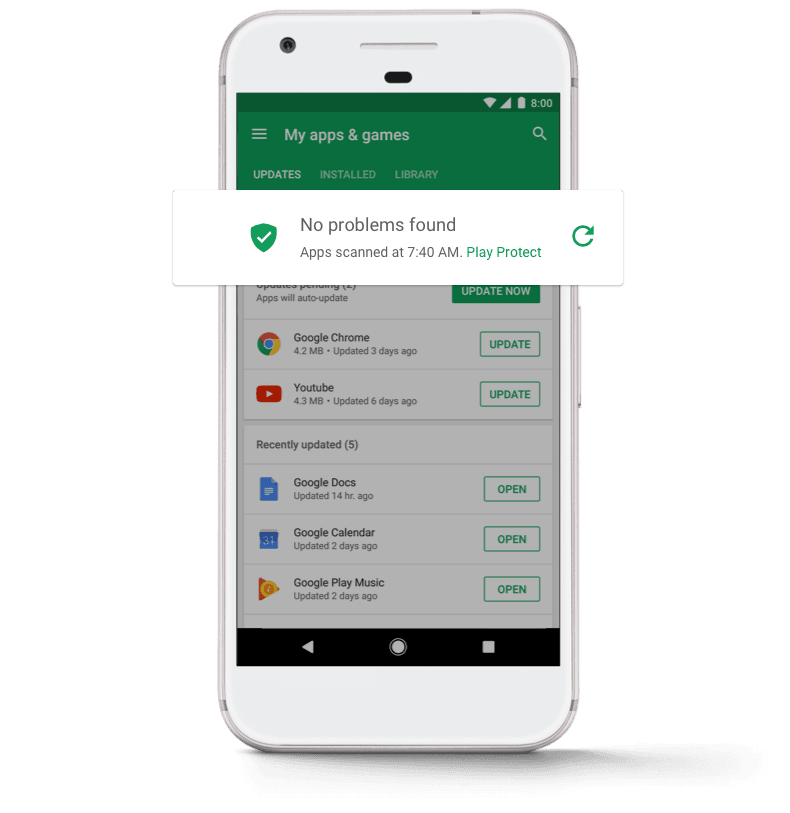
Google Play Protect now scans over 100 billion applications on Android devices every day, these amazing figures were disclosed by Google.

In May 2017, Google introduced a security defense system called Google Play Protect to protect the devices running its mobile OS.

Google aims at monitoring the behavior of the apps and the detection of the malicious ones once they have been installed on Android devices.

Google Play Protect

Google Play Protect implements a machine learning and app usage analysis to identify any malicious activity on the mobile device, it is integrated into the Google Play Store app, this means that its usage is transparent to the end-user that doesn’t need to install or enable it on hid device.

Play Protect implements the following features:

  • App scanning
  • Anti-Theft Measures
  • Browser Protection

The security service also monitors the mobile apps that have been installed by users from third-party stores.

Now Google shared some data related to the activity of its protection system in 2019 when Google Play Protect prevented 1.9 billion malware installs from Third-party stores. The figures represent an increase compared to 1.6 billion, reported in the last two years ([2017], [2018]), they demonstrate the huge effort spent by the company to protect its users.

The data suggest that a growing number of Android users are attempting to install tainted apps from third-party app stores.

Google revealed that in 2019 it managed to block 790,000 violating app submissions before they were published in the official Play Store. 

“Google Play Protect scans over 100B apps everyday, providing users with information about potential security issues and actions they can take to keep their devices safe and secure.” reads the Google announcement. “Last year, Google Play Protect also prevented more than 1.9B malware installs from non-Google Play sources.”

Google reported that after the introduction of a new policy in 2018 to stop apps from unnecessarily accessing privacy-sensitive SMS and Call Log data, it has observed a 98% decrease in apps accessing such type of data.

Similarly to the SMS and Call Log policy, Google also enacted a policy to better protect families in May 2019, this resulted in the removal of tens of thousands of apps from the official Play Store, improving the security of the Android users.

“Our commitment in building the world’s safest and most helpful app platform will continue in 2020” concludes Google “and we will continue to invest in the key app safety areas mentioned in last year’s blog post:

  • Strengthening app safety policies to protect user privacy
  • Faster detection of bad actors and blocking repeat offenders
  • Detecting and removing apps with harmful content and behaviors”
[adrotate banner=”9″] [adrotate banner=”12″]

Pierluigi Paganini

(SecurityAffairs – Google Play, malware)

[adrotate banner=”5″]

[adrotate banner=”13″]


