
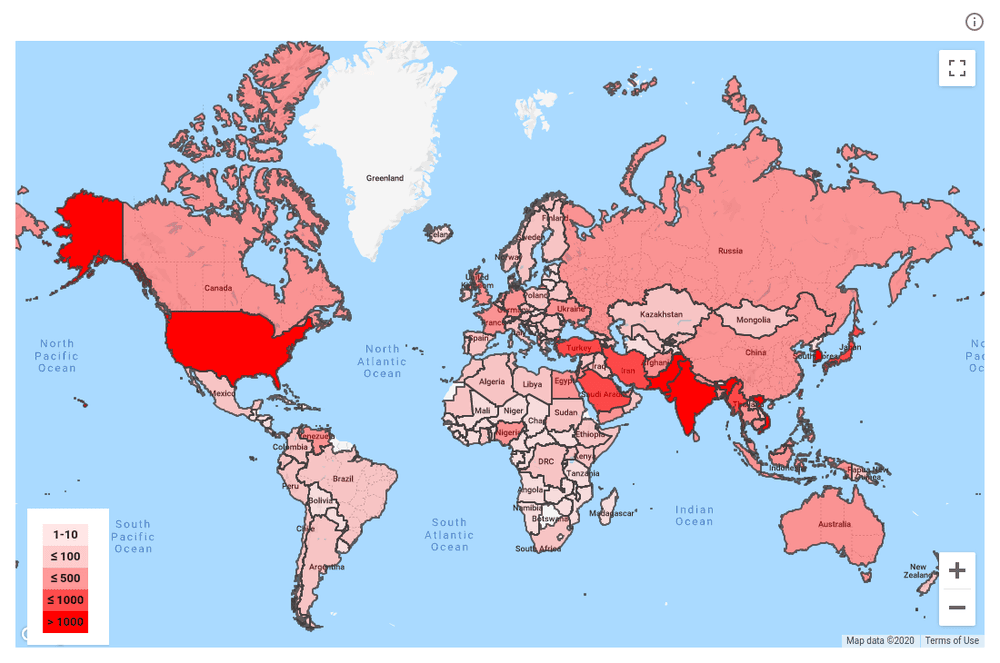
Google announced to have warned users of almost 40,000 alerts of state-sponsored phishing or malware attacks during 2019.
Google shared data on
The number of alerts decreased by 25% when compared to 2018, possible reasons for this drop could be the increased efficiency of defense measures implemented by Google, but we cannot underestimate the risk of an increased level of sophistication of the attacks that allowed nation-state actors to fly under the radar.
“We have a long-standing policy to send you a warning if we detect that your account is a target of government-backed phishing or malware attempts. In 2019, we sent almost 40,000 warnings, a nearly 25 percent drop from 2018.” wrote Toni Gidwani, a Security Engineering Manager with Google’s Threat Analysis Group (TAG).
“One reason for this decline is that our new protections are working—attackers’ efforts have been slowed down and they’re more deliberate in their attempts, meaning attempts are happening less frequently as attackers adapt.”

Google pointed out that users like members of political campaign teams, journalists, activists, dissidents, executives, industries such as finance or government are most exposed to the nation-state attacks, a trend confirmed during 2019. State-sponsored hackers repeatedly go after their targets, according to Google in 2019, one in five accounts that received a warning was targeted multiple times by attackers.
“We’ve yet to see people successfully phished if they participate in Google’s Advanced Protection Program (APP), even if they are repeatedly targeted. APP provides the strongest protections available against phishing and account hijacking and is specifically designed for
Nation-state attackers often exploit zero-day vulnerabilities in their campaigns, when Google experts detect an attack that takes advantage of this kind of flaws, they report the issue to the vendor and give them seven days to patch or produce an advisory or they release an advisory.
Google TAG reported the case of a single threat actor that employed five zero-day vulnerabilities in a relatively short time frame. The exploits were used in watering hole attacks and spear-phishing attacks. Most of the targets observed by Google
The Google Advanced Protection Program (APP) aims at protecting anyone who is at risk of targeted online attacks, such as spear-phishing attampts.
“Advanced Protection uses security keys to help protect your emails, documents, contacts, or other personal data. Even if a hacker has your password, they won’t be able to get access to your account without your security key.” reads the APP page.
“A security key is a small physical device that helps prove that it’s you signing in to your phone, tablet, or computer. You can also use the built-in security key in an iPhone running iOS 10+ or an Android 7+ device. You need your security keys only when you sign in for the first time on a computer, browser, or device. After that, you’ll only be asked for your password.”
The Threat Analyst Group announced that it will continue to identify bad actors and share relevant information about their TTPs with others in the industry.
| [adrotate banner=”9″] | [adrotate banner=”12″] |
(
[adrotate banner=”5″]
[adrotate banner=”13″]


