
Security Affairs
Cyberattack Hits French Blood Banks as Hackers Target Refrigeration Systems Across Europe|CVE-2026-58868: Critical Android Bug Could Let Attackers Run Remote Code|U.S. CISA adds WordPress flaw to its Known Exploited Vulnerabilities catalog|Binance Hack: How Fake Job Interviews and AI Abuse Led to a $6.34 Billion Attack|Synology Warns of Ransomware Attacks Targeting NAS Devices Running Outdated DSM Versions|Inside XCPE, the botnet that turned 1.3M set-top boxes into proxy servers|NIS2 Makes Board Members Personally Liable for Access Control Decisions|Apple’s spyware notifications reach the Bundestag: what the BSI says to do now|VOLTA, the infostealer that asks an AI which victims are worth the effort|New wave of fridge cyberattacks hits European supermarkets, this time in Belgium, Luxembourg, Sweden and Estonia|Hackers Send Fake Nuclear Threat Alerts to Ukrainian and Russian Citizens|Chainalysis Investigates Security Incident Involving AI-Driven Attack Techniques|Cyberattack Hits French Blood Banks as Hackers Target Refrigeration Systems Across Europe|CVE-2026-58868: Critical Android Bug Could Let Attackers Run Remote Code|U.S. CISA adds WordPress flaw to its Known Exploited Vulnerabilities catalog|Binance Hack: How Fake Job Interviews and AI Abuse Led to a $6.34 Billion Attack|Synology Warns of Ransomware Attacks Targeting NAS Devices Running Outdated DSM Versions|Inside XCPE, the botnet that turned 1.3M set-top boxes into proxy servers|NIS2 Makes Board Members Personally Liable for Access Control Decisions|Apple’s spyware notifications reach the Bundestag: what the BSI says to do now|VOLTA, the infostealer that asks an AI which victims are worth the effort|New wave of fridge cyberattacks hits European supermarkets, this time in Belgium, Luxembourg, Sweden and Estonia|Hackers Send Fake Nuclear Threat Alerts to Ukrainian and Russian Citizens|Chainalysis Investigates Security Incident Involving AI-Driven Attack Techniques|
Advertisement

Ad Placeholder

Full Width × 90

Breaking News

Hackers compromised Ethereum mailing list and launched a crypto draining attack

Hackers compromised Ethereum ‘s mailing list provider and sent phishing messages to the members attempting to drain their crypto funds. Hackers compromised Ethereum’s mailing list provider and on the night of June 23, they sent an email to the 35,794 addresses. The email was sent from the address ‘updates@blog.ethereum.org’ and included a link to a […]

Ethereum phishing

Hackers compromised Ethereum ‘s mailing list provider and sent phishing messages to the members attempting to drain their crypto funds.

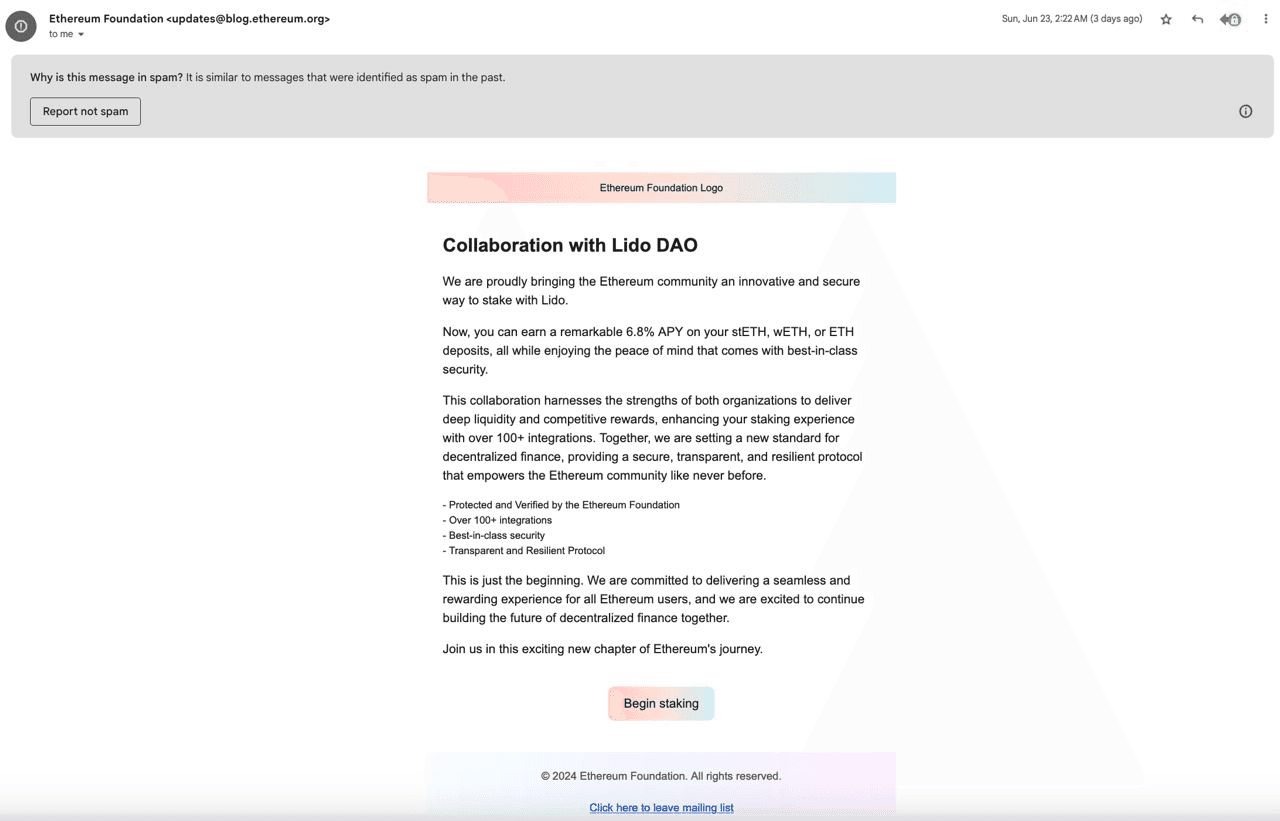
Hackers compromised Ethereum’s mailing list provider and on the night of June 23, they sent an email to the 35,794 addresses. The email was sent from the address ‘updates@blog.ethereum.org’ and included a link to a malicious site running a crypto drainer.

“This website had a crypto drainer running in the background, and if a user initiated their wallet and signed the transaction requested by their website their wallet would have been drained.” reads the incident notice published by Ethereum.

The message was crafted to trick the recipient into visiting a malicious website by announcing a collaboration with Lido DAO and offering a 6.8% annual percentage yield (APY) on staked Ethereum.

Ethereum phishing

The internal security team quickly launched an investigation into the security breach. The team is notifying users via X and email and secured the infrastructure to prevent similar attacks in the future.

The security group also submitted the malicious link to blacklists, resulting in it being blocked by most web3 wallet providers and Cloudflare.

The threat actors sent phishing messages to addresses included in a large email list and 3,759 email addresses exported from the blog mailing list. Among these, 81 were new to the attacker. On-chain transaction analysis indicated that no funds were lost during this specific campaign.

“As we continue working on this incident, we have taken additional measures such as migrating some mail services to other providers, to further help reduce the risk of this happening again.” concludes the notice.

Pierluigi Paganini

Follow me on Twitter: @securityaffairs and Facebook and Mastodon

(SecurityAffairs – hacking, phishing)


